

아티스트의 모델
루이스 리카르도 팔레로, a renowned Spanish painter active in the 19th century, created his masterpiece “아티스트의 모델” in the late 1800s. 출생 1851 그리고 지나가는 것 1896, Falero was known for his skillful depiction of women, often set against rich backgrounds that blended classical themes with sensual undertones. 이 그림, like many of his works, portrays a female model who exudes both elegance and allure, capturing the essence of the classical and romantic ideals of beauty. The subject is presented as the epitome of grace, 힘, 그리고 미묘한 존재. Falero’s intricate understanding of human anatomy and his nuanced use of light and shadow bring the subject of the artwork to life in an almost tangible way.
목차
The Subject and Her Presentation
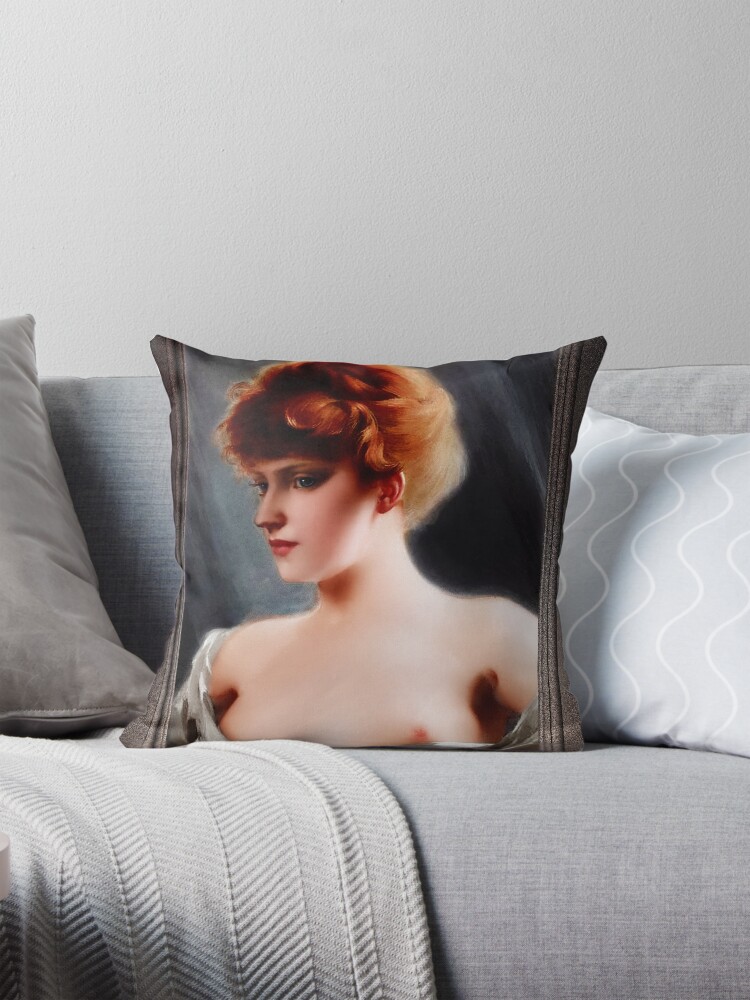
의 중심 주제 “아티스트의 모델” is a woman who gazes slightly off to the side, her expression one of quiet contemplation. She is positioned in profile, offering an intimate yet restrained portrait of her beauty. Her face is delicate and composed, with strikingly detailed features. The artist’s depiction of her hair, a rich reddish hue, is meticulously styled with soft, voluminous curls that frame her face and cascade down her back. This attention to her hair is not only an artistic choice but also an ode to the idealized beauty standards of the time.
The woman’s attire is minimal, focusing primarily on her figure. The fabric that she wears drapes over her body in an almost fluid manner, its softness contributing to the tactile sensation of the painting. The semi-transparent fabric allows for the graceful curve of her shoulder and the outline of her chest to be visible, subtly hinting at her form while maintaining an aura of modesty. The choice of soft whites and grays for the cloth contrasts with her skin tone, which is radiant and smooth, lending her an almost otherworldly appearance.
구성과 분위기
The composition of the painting is deliberate and composed, emphasizing the delicate balance between the subject and her surroundings. The backdrop is somewhat muted, 부드럽게 렌더링됩니다, indistinct tones that allow the model to be the focal point. There is a play of light and shadow on her face and shoulders, suggesting a warm light source from the left. This light serves to highlight her features in a soft glow, giving her an almost ethereal presence. The use of shadow is also significant; it gently outlines her profile, adding depth to the overall composition and guiding the viewer’s gaze from her delicate face down to the curves of her body.
Falero’s ability to convey a sense of quiet sensuality is central to the mood of the painting. There is an air of mystery in her gaze, as though she is both the object of desire and yet removed from it. The contemplative nature of her expression, combined with the softness of her figure, evokes a sense of timeless beauty and purity. The mood of the painting can be described as serene, intimate, and slightly melancholic, as if the subject is both a muse and a woman trapped in a moment of stillness.
재료 및 기술
Falero’s technique is evident in his masterful application of oil paint. The colors used in the painting are warm and muted, with a predominance of earth tones and soft highlights. The richness of the hues, particularly in the woman’s red hair, contrasts with the darker shadows and the neutral tones of her skin and background. The fluidity of the fabric and the softness of her skin are rendered in exquisite detail, showcasing the artist’s expertise in handling light and texture. The contrast between the smoothness of her skin and the textured brushwork used for the fabric creates a dynamic visual interest.
One of the key features of Falero’s work is his use of light to highlight specific aspects of his subjects. 이 그림에서, the subtle play of light across the model’s skin and hair gives a sense of volume and depth. The artist has captured the sheen of her skin and the fine texture of her hair with a technique that enhances their lifelike quality, making them seem almost tangible. The interplay of light and shadow on the fabric further enriches the painting, giving it an added layer of realism.
Thematic Elements and Style
The thematic elements of “아티스트의 모델” are rooted in the classical tradition, yet there is also an evident sensuality that Falero often imbued in his works. The depiction of the female form was central to many academic painters of the time, 그리고 이 작품에서는, the model can be seen as both a subject of admiration and a symbol of beauty. There is a tension between the model’s modest pose and the visible sensuality of her form. This delicate balance speaks to the theme of the objectification of women in art, while simultaneously celebrating their strength and grace.
Falero’s style, which combined elements of realism with romanticism, is evident in the finely executed details of the model’s face and figure. The artist’s deep understanding of classical art and his ability to blend it with a romantic, almost dreamlike quality results in a painting that feels both grounded in the real world and elevated to an almost mythic realm. 모델, despite her seemingly modest presentation, embodies the ideal of beauty that was so prominent in the 19th century, yet she is presented in a way that also evokes contemplation of her humanity.
결론
결론적으로, “아티스트의 모델” by Luis Ricardo Falero captures the duality of the female form as both an object of desire and a figure of grace. Through his meticulous technique and understanding of human anatomy, Falero imbues the subject with a sense of elegance and timeless beauty. 부드러운 조명, delicate fabrics, and contemplative expression all contribute to the mood of the painting, which remains one of quiet allure and sensuality. By merging classical ideals with romantic elements, Falero creates a work that is both a celebration of beauty and a reflection on the nature of artistic representation.
이것은 공개 도메인 이미지의 수정 된 디지털 아트 오래된 마스터 복제입니다.
아티스트 바이오 파생 Wikipedia.org
Falero는 그라나다에서 태어나 원래 스페인 해군에서 경력을 추구했습니다., 하지만 그의 부모의 실망에 그것을 포기; 그가 파리로 여행을 가기로 결정하면서, 그가 미술을 공부한 곳, 화학 및 기계 공학.
화학 및 기계 공학을 공부하는 동안; 그는 자신이 수행해야 하는 실험이 너무 위험하다고 생각했습니다., 따라서 그는 그림에만 관심을 집중하게 됩니다..
그 결과 그는 프랑스 초상화 화가이자 동양화가 Gabriel-Joseph-Marie-Augustin Ferrier의 제자가 되었습니다. (1847 – 1914). 파리 이후, 그는 런던으로 이사했다, 그가 공부를 계속했던 곳, 그리고 결국 정착.
Falero는 천문학에 특별한 관심을 갖고 그의 작품에 천체 별자리를 통합했습니다., 같은 “혜성의 결혼” 과 “쌍둥이 별”. 천문학에 대한 그의 관심과 지식은 Camille Flammarion의 작품을 설명하도록 이끌었습니다..
에 1896, 그의 죽음의 해, Maud Harvey는 친자 관계로 Falero를 고소했습니다.. 소송은 Falero가 Harvey를 유혹했을 때 17, 그의 가정부로 처음 봉사, 그리고 그의 모델. 그가 임신 한 것을 발견했을 때, 그는 그녀를 해고했다.
그녀는 소송에서 이겼고 자녀 양육비로 매주 5실링을 받았습니다.. 팔레로는 유니버시티 칼리지 병원에서 사망, 런던, 세의 나이에 45