

The Artist’s Model
Luis Ricardo Falero, a renowned Spanish painter active in the 19th century, created his masterpiece “The Artist’s Model” in the late 1800s. Geboren in 1851 en binnen overlijden 1896, Falero was known for his skillful depiction of women, often set against rich backgrounds that blended classical themes with sensual undertones. Dit schilderij, like many of his works, portrays a female model who exudes both elegance and allure, capturing the essence of the classical and romantic ideals of beauty. The subject is presented as the epitome of grace, stroom, and ethereal presence. Falero’s intricate understanding of human anatomy and his nuanced use of light and shadow bring the subject of the artwork to life in an almost tangible way.
Inhoudsopgave
The Subject and Her Presentation
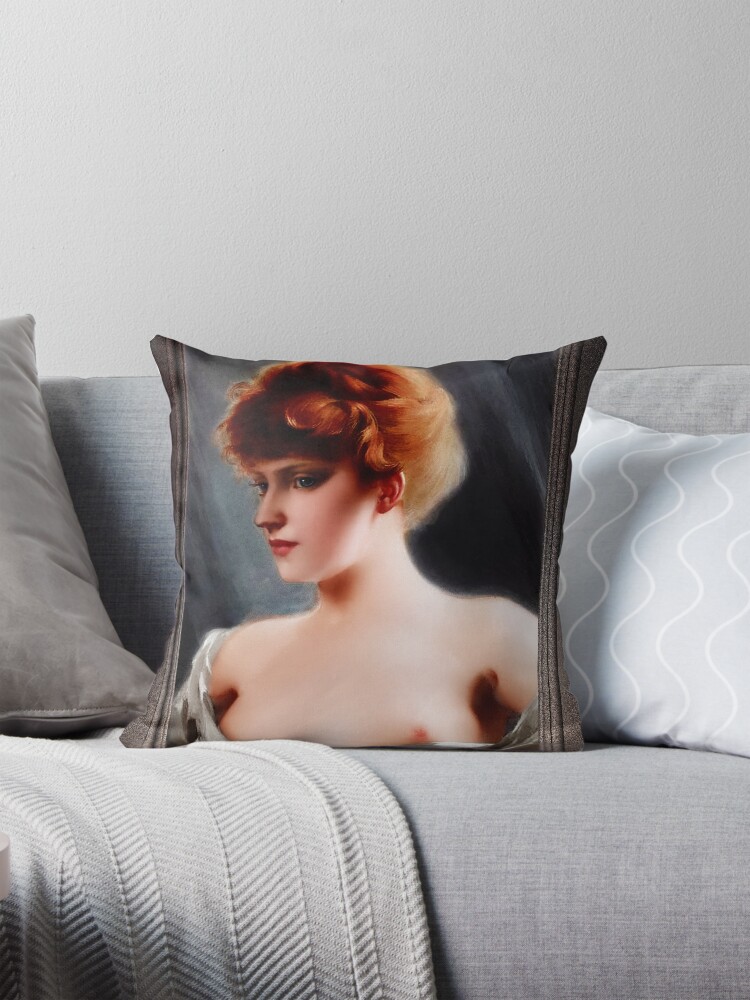
The central subject of “The Artist’s Model” is a woman who gazes slightly off to the side, her expression one of quiet contemplation. She is positioned in profile, offering an intimate yet restrained portrait of her beauty. Her face is delicate and composed, with strikingly detailed features. The artist’s depiction of her hair, a rich reddish hue, is meticulously styled with soft, voluminous curls that frame her face and cascade down her back. This attention to her hair is not only an artistic choice but also an ode to the idealized beauty standards of the time.
The woman’s attire is minimal, focusing primarily on her figure. The fabric that she wears drapes over her body in an almost fluid manner, its softness contributing to the tactile sensation of the painting. The semi-transparent fabric allows for the graceful curve of her shoulder and the outline of her chest to be visible, subtly hinting at her form while maintaining an aura of modesty. The choice of soft whites and grays for the cloth contrasts with her skin tone, which is radiant and smooth, lending her an almost otherworldly appearance.
The Composition and Mood
The composition of the painting is deliberate and composed, emphasizing the delicate balance between the subject and her surroundings. The backdrop is somewhat muted, rendered in soft, indistinct tones that allow the model to be the focal point. There is a play of light and shadow on her face and shoulders, suggesting a warm light source from the left. This light serves to highlight her features in a soft glow, giving her an almost ethereal presence. The use of shadow is also significant; it gently outlines her profile, adding depth to the overall composition and guiding the viewer’s gaze from her delicate face down to the curves of her body.
Falero’s ability to convey a sense of quiet sensuality is central to the mood of the painting. There is an air of mystery in her gaze, as though she is both the object of desire and yet removed from it. The contemplative nature of her expression, combined with the softness of her figure, evokes a sense of timeless beauty and purity. The mood of the painting can be described as serene, intiem, en licht melancholisch, as if the subject is both a muse and a woman trapped in a moment of stillness.
Materialen en techniek
Falero’s technique is evident in his masterful application of oil paint. The colors used in the painting are warm and muted, with a predominance of earth tones and soft highlights. The richness of the hues, particularly in the woman’s red hair, contrasts with the darker shadows and the neutral tones of her skin and background. The fluidity of the fabric and the softness of her skin are rendered in exquisite detail, showcasing the artist’s expertise in handling light and texture. The contrast between the smoothness of her skin and the textured brushwork used for the fabric creates a dynamic visual interest.
One of the key features of Falero’s work is his use of light to highlight specific aspects of his subjects. Op dit schilderij, the subtle play of light across the model’s skin and hair gives a sense of volume and depth. The artist has captured the sheen of her skin and the fine texture of her hair with a technique that enhances their lifelike quality, making them seem almost tangible. The interplay of light and shadow on the fabric further enriches the painting, giving it an added layer of realism.
Thematic Elements and Style
The thematic elements of “The Artist’s Model” are rooted in the classical tradition, yet there is also an evident sensuality that Falero often imbued in his works. The depiction of the female form was central to many academic painters of the time, en in dit stuk, the model can be seen as both a subject of admiration and a symbol of beauty. There is a tension between the model’s modest pose and the visible sensuality of her form. This delicate balance speaks to the theme of the objectification of women in art, while simultaneously celebrating their strength and grace.
Falero’s style, which combined elements of realism with romanticism, is evident in the finely executed details of the model’s face and figure. The artist’s deep understanding of classical art and his ability to blend it with a romantic, almost dreamlike quality results in a painting that feels both grounded in the real world and elevated to an almost mythic realm. The model, despite her seemingly modest presentation, embodies the ideal of beauty that was so prominent in the 19th century, yet she is presented in a way that also evokes contemplation of her humanity.
Conclusie
Tot slot, “The Artist’s Model” by Luis Ricardo Falero captures the duality of the female form as both an object of desire and a figure of grace. Through his meticulous technique and understanding of human anatomy, Falero imbues the subject with a sense of elegance and timeless beauty. The soft lighting, delicate fabrics, and contemplative expression all contribute to the mood of the painting, which remains one of quiet allure and sensuality. By merging classical ideals with romantic elements, Falero creates a work that is both a celebration of beauty and a reflection on the nature of artistic representation.
Dit is een retoucheerde digitale reproductie van kunst oude meesters van een openbaar domeinafbeelding.
Bio van kunstenaar afgeleid Wikipedia.org
Falero werd geboren in Granada en had oorspronkelijk een carrière bij de Spaanse marine, maar gaf het op aan de teleurstelling van zijn ouders; toen hij besloot naar Parijs te reizen, waar hij kunst studeerde, scheikunde en werktuigbouwkunde.
Tijdens is studies in scheikunde en werktuigbouwkunde; hij vond de experimenten die hij moest uitvoeren te gevaarlijk, waardoor hij zijn aandacht alleen op het schilderen richtte.
Als gevolg hiervan werd hij een leerling van de Franse portretschilder en oriëntalist Gabriel-Joseph-Marie-Augustin Ferrier (1847 – 1914). Na Parijs, hij verhuisde naar Londen, waar hij zijn studie voortzette, en uiteindelijk geregeld.
Falero had een bijzondere interesse in astronomie en verwerkte hemelse sterrenbeelden in veel van zijn werken, zoals “Het huwelijk van een komeet” en “Tweelingsterren”. Zijn interesse en kennis van astronomie brachten hem er ook toe om de werken van Camille Flammarion te illustreren.
In 1896, het jaar van zijn dood, Maud Harvey klaagde Falero aan wegens vaderschap. Het pak beweerde dat Falero Harvey had verleid toen ze dat was 17, eerst als zijn dienstmeisje, en dan zijn model. Toen hij ontdekte dat ze zwanger was, hij stuurde haar weg.
Ze won de zaak en kreeg vijf shilling per week ter ondersteuning van hun kind. Falero stierf in het University College Hospital, Londen, op de leeftijd van 45