

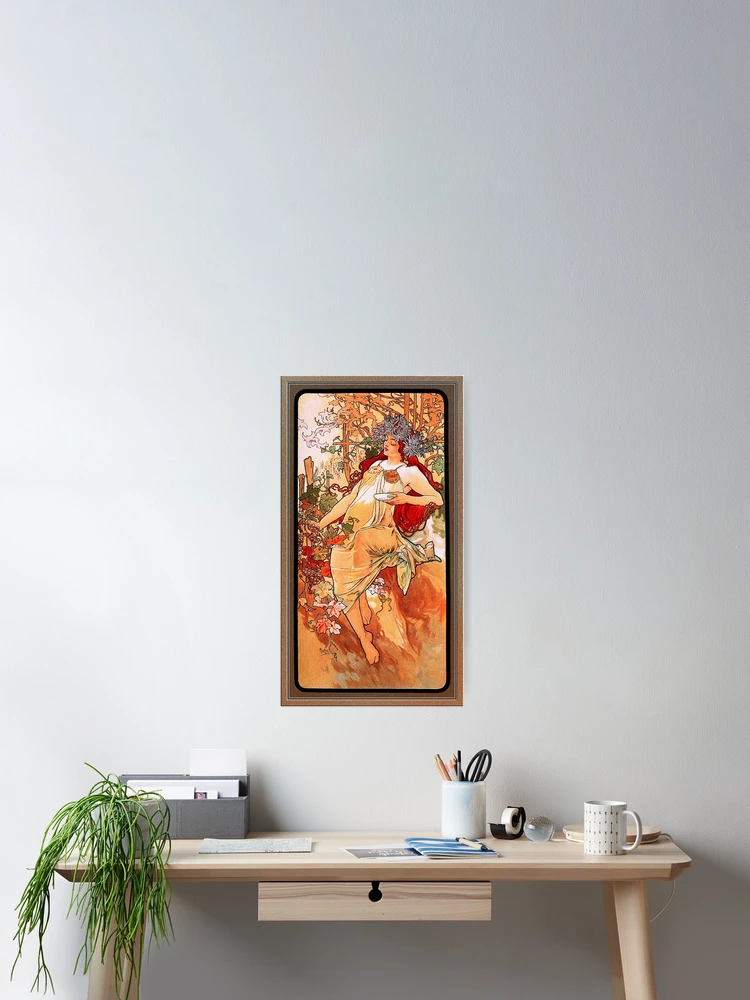
The Autumn c1896
Alphonse Mucha (1860 – 1939), a celebrated Czech painter and graphic artist, air a chruthachadh “Am Foghar” a-steach 1896 as part of his renowned “Ràithean” series of allegorical portraits. This stunning painting reflects Mucha’s mastery of Art Nouveau, blending organic forms with elegant human figures. Through the use of flowing lines, delicate natural motifs, and symbolic representation, Mucha captured the essence of autumn in a way that evokes both the beauty and the melancholic passage of time associated with the season.
Clàr-innse
Prìomh chuspair
At the heart of the composition is a serene female figure, the embodiment of autumn itself. She is seated gracefully in a relaxed pose, her figure enveloped in flowing, diaphanous robes that seem to meld with the natural world around her. The color palette of her attire reflects the hues of the season: orain beairteach, soft yellows, and muted browns that echo the changing leaves. A crown of chrysanthemums, symbolizing the late bloom of autumn, rests gently upon her head, further connecting her to the seasonal theme.
Na làimh chlì, the figure holds a bunch of grapes, a symbol of the harvest and the fruits of labor that are characteristic of autumn. The grapes, ripe and plentiful, speak to the abundance that the fall season often brings after the toil of the warmer months. The woman’s other hand holds a shallow dish, an emblematic gesture of offering or abundance, suggesting the nourishing role autumn plays in preparing for the colder months ahead. A socair, almost dreamy expression adds a layer of tranquility to the scene, as if she is contemplating the beauty of the harvest or the inevitable fading of the season.
Rudan agus samhlachas
The symbolic nature of the painting is rich and layered. The grapes in the woman’s hand are a direct reference to the harvest, a time when nature yields its bounty. Mòran, known for his intricate symbolism, imbues these grapes with both a literal and metaphorical meaning: they represent the culmination of the cycle of growth and the transition to a period of rest. The woman’s gesture of holding the dish could be interpreted as an offering to the viewer, a visual invitation to partake in the season’s beauty, bounty, and passing moments.
A bharrachd air an sin, the surrounding natural elements also enhance the allegorical nature of the piece. Vines and leaves twist and wind around the woman, a’ moladh eadar-cheangal beatha ri nàdar agus na cuairtean a tha a’ riaghladh an dà chuid. Tha làthaireachd dhuilleagan foghair sgapte air feadh an t-suidheachaidh mar chuimhneachan air an ùine a tha do-sheachanta agus nàdar neo-ghluasadach na beatha.. Na duilleagan, aon uair lusach agus uaine, a nis air an lionadh le dubhar orain agus dearg an tuiteam, a’ comharrachadh inbheachd, atharrachadh, agus teachd a' gheamhraidh.
Talamh agus cùl-raon
Tha cùl-raon an deilbh na mheasgachadh co-chòrdail de chruthan organach agus tònaichean ciùin. Ged nach eil sealladh-tìre fìor mhionaideach ann am Mucha, tha am moladh airson àrainneachd nàdarra soilleir. Tha na loidhnichean bog swirling agus craobhan air an toirt a-mach agus duilleach a tha ag èirigh air a’ chùl a’ nochdadh lùban is pàtrain trusgan na boireannaich agus fileantachd iomlan an t-suidheachaidh. An subhailceach, almost dreamlike quality of the background creates a contrast with the more grounded, earthy tones of the foreground, drawing the viewer’s attention to the figure while still maintaining a deep connection to the season she represents.
The terrain beneath the figure’s seated form is made up of soft, flowing lines that suggest the earth without overtly defining it. The lack of a specific, detailed landscape allows the figure to remain the primary focus, highlighting her connection to the environment without the distraction of a complicated background. This approach emphasizes the allegorical nature of the painting, allowing the viewer to engage with the subject matter on a symbolic level rather than a literal one.
Stoidhle agus innleachd
“Am Foghar” is quintessentially Art Nouveau, with its flowing lines, foirmean organach, and ornamental details. Mucha’s characteristic style is evident in the intricate detailing of the leaves, flùraichean, and the woman’s flowing hair. The curvilinear forms of the composition evoke a sense of harmony and fluidity, while the delicate treatment of the figure and the surrounding natural elements exemplifies the refined elegance that Mucha is known for.
Mucha’s technique in this work showcases his ability to fuse the decorative and the symbolic. The woman’s form is rendered with soft curves and gentle proportions, maintaining an idealized yet natural appearance. The robes she wears appear almost weightless, fluttering in the air as if they are made of light itself. This sense of lightness contrasts with the more grounded, earthy elements of the grapes and leaves, which are meticulously detailed to emphasize their tactile, real-world presence.
The color palette of the painting is another hallmark of Mucha’s style. The use of warm autumnal tones, such as gold, òmar, and ochre, creates a rich, inviting atmosphere. These colors, along with the soft interplay of light and shadow, add depth to the composition while maintaining an overall sense of harmony and balance. Mucha’s careful attention to color and form enhances the allegorical theme, reinforcing the idea that autumn is a time of abundance and reflection.
Mood agus cuspair
Faireachdainn de “Am Foghar” is one of peaceful contemplation and quiet beauty. The figure exudes a sense of tranquility, as though she is at one with the natural world around her. There is no sense of urgency or anxiety in her pose or expression; An àite sin, she seems to be absorbed in the timeless rhythms of nature. This calmness evokes a mood of introspection, inviting the viewer to reflect on the passage of time, the cycles of nature, and the fleeting beauty of the autumn season.
The overarching theme of the painting is the celebration of autumn as a time of transition and harvest. Mucha’s allegorical approach elevates the season from a simple marker of time to a deeper symbol of growth, atharrachadh, agus nàdar cearcallach na beatha. The painting encourages a recognition of both the bounty of autumn and the quiet inevitability of its end, as winter approaches. It serves as a reminder that all things are in constant flux, and that beauty can be found in both the beginnings and endings that shape our world.
Am Foghar (Pàirt den t-sreath ràithean de dhealbhan dealbhan boireann boireann) c1896 le Peantair Seiceach Alphonse Mucha (1860 – 1939); a bharrachd air duine comasach Dealbhadair agus Neach-ealain Grafaigeach a bha na phrìomh fheachd aig an àm Art Nouveau; ainmeil airson an stoidhle aige, Postairean taigh-cluiche sgeadaichte agus sgeadachail.
Boireannach òg inntinneach le flùraichean na falt, buailteach a bhith a ’fàs gràinneanan ann an gàrradh tro sheusan an fhoghair.
Is e seo ath-riochdachadh seann mhaighstirean ealain didseatach ath-riochdachadh de ìomhaigh raon poblach.
Neach-ealain Bio
Fiosrachadh gu h-ìosal bho Wikipedia.org
Alfons Maria Mucha Iuchar 24, 1860 – An t-Iuchar 14, 1939), bha e aithnichte gu h-eadar-nàiseanta mar Alphonse Mucha. Bha e na pheantair ainmeil Seiceach, dealbhadair agus neach-ealain grafaigeach, a ’fuireach ann am Paris aig àm Art Nouveau, agus tha e ainmeil airson na postairean amharcail eireachdail agus stoidhle aige, gu sònraichte an fheadhainn aig Sarah Bernhardt.
Rinn e dealbhan, sanasan, pannalan sgeadachaidh, agus dealbhadh, a thàinig am measg nan ìomhaighean as ainmeil den àm.
Anns an dàrna pàirt de a dhreuchd, aig aois 43, thill e gu dhùthaich a dhùthchais ann an sgìre Bohemia-Moravia san Ostair agus thug e air a bhith a ’peantadh sreath de fhichead canabhas cuimhneachail ris an canar The Slav Epic, a ’sealltainn eachdraidh sluagh Slàbhach an t-saoghail, a pheant e eadar 1912 agus 1926.
Ann an 1928, air an 10mh ceann-bliadhna de neo-eisimeileachd Czechoslovakia, thaisbean e an t-sreath do dhùthaich nan Seiceach. Bha e ga fhaicinn mar an obair as cudromaiche aige. Tha e a-nis air a thaisbeanadh ann am Prague.