

El baptisme de Vajk c1875
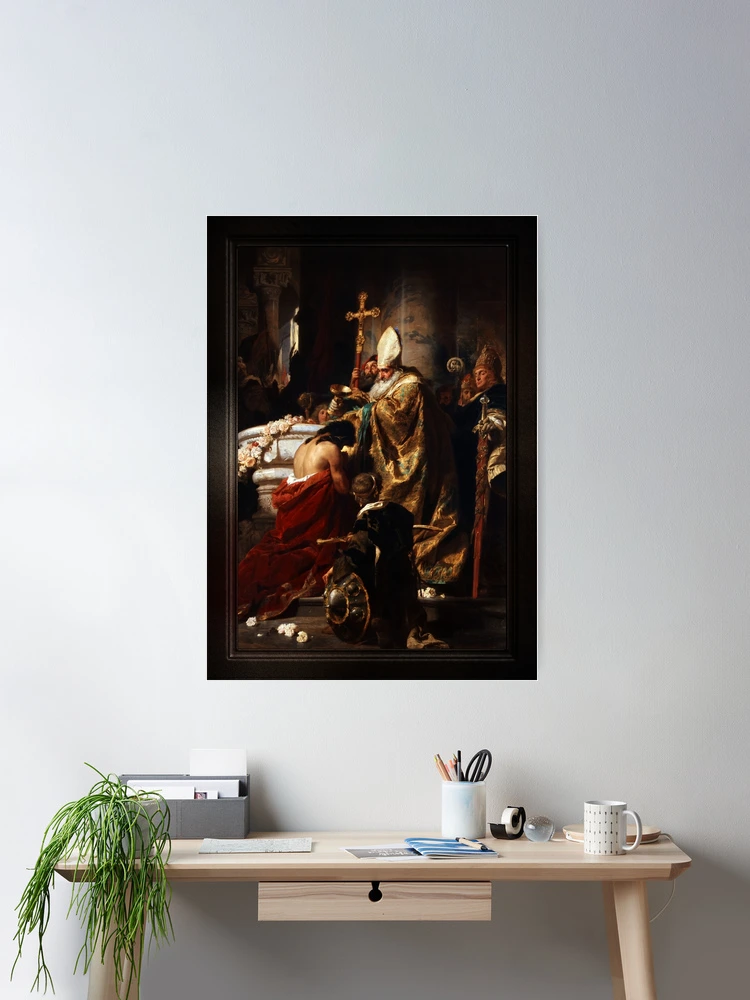
“El baptisme de Vajk,” creat a 1875 de l'artista hongarès Gyula Benczúr (1844 – 1920), és un retrat notable d'un moment significatiu de la història hongaresa. L'escena captura el bateig de Vajk, el futur rei Esteve I d'Hongria o rei Sant Esteve (975 – 1038), un esdeveniment cabdal que va anunciar la conversió del poble hongarès al cristianisme. Aquesta obra d'art monumental reflecteix la barreja històrica, religiós, i temes nacionals, magistralment interpretat amb la precisió i la grandesa característiques de Benczúr. A través del seu ús del color, composició, i simbolisme, Benczúr eleva l'escena a un moment de profunda transcendència espiritual i política.
Taula de continguts
Composició i temàtica
The central theme of the painting is the baptism of Vajk, OMS, as a young man, kneels before a high-ranking ecclesiastical figure. The solemnity of the moment is enhanced by the dramatic lighting and the positioning of figures, creating a clear sense of hierarchy. The solemnity of the sacrament is emphasized by the detailed depiction of Vajk’s posture, as he bows his head in humble submission, accepting his faith and a destiny that will shape the future of Hungary.
The religious leader performing the baptism is a figure of great authority, wearing a ceremonial bishop’s vestments adorned in rich gold and red. The bishop’s position, standing over Vajk, gives the impression of his spiritual dominance, overseeing the transformation of the young ruler. En canvi, Vajk’s attire, simple, però simbòlic, consists of a red cloth that symbolizes the sacrifice and blood of Christ, marking the significant shift in his life.
Surrounding this core religious act are several onlookers, dressed in opulent, period-specific clothing, who represent the political and religious elites present to witness this momentous event. These figures are carefully placed, their expressions a mix of reverence and awe, reflecting the historical importance of the baptism not just as a religious act, but as a state affair that would solidify Vajk’s position as the ruler of Hungary.
Materials, Tècniques, i Estil
Benczúr’s use of oil paints is evident in the deep richness of the colors and the fine detailing of textures. The use of light and shadow throughout the painting gives it a sense of depth and grandeur, imbuing the scene with an almost theatrical quality. Les figures, particularly the bishop and Vajk, are painted with a high level of realism, their faces and gestures vividly conveying the emotional weight of the moment. Benczúr’s meticulous attention to detail, particularly in the fabrics and the textures of the armor and robes, demonstrates his technical prowess.
The painter’s style is firmly rooted in academic realism, a movement that sought to depict subjects in a truthful and highly detailed manner. The composition follows traditional narrative conventions, with clear hierarchies between figures and a focus on the central moment of the baptism. This realism, malgrat això, is balanced with a sense of idealization, creating an image that elevates the historical event to the realm of the divine.
Ambient i ambient
L'escenari del bateig és un interior, probablement una església o una catedral, on es produeix la transformació espiritual. L'arquitectura al fons, amb les seves columnes i arcs alts, és grandiós i imponent, contribuint al sentit de la cerimònia. Els vitralls, encara que no es veu explícitament a l'escena, es suggereixen a través del joc de llum, que filtra per l'espai i destaca les figures clau. Aquesta atenció acurada a la il·luminació afegeix una qualitat eteri a l'escena, simbolitzant la presència divina durant el sagrament.
L'estat d'ànim de la pintura és solemne i reverencial. La il·luminació tènue, combinat amb les riques textures de les túnices i el calze daurat que sostenia el bisbe, transmet una sensació de sagrat. The figures in the painting are not merely spectators but are participants in a moment that is both spiritually transformative and politically significant. Benczúr masterfully evokes this duality, religious and national, through his composition, where the spiritual act is portrayed as a moment of profound historical change.
Symbolism and Historical Significance
“El baptisme de Vajk” is steeped in symbolism, much of which relates to the historical context of Hungary during the time of King Stephen I. The baptism itself is not just a religious conversion; it marks the beginning of Hungary’s Christianization, an event that would play a central role in the formation of the Hungarian state. By depicting this moment, Benczúr highlights the critical intersection of faith and governance, illustrating how religion and politics are intertwined in the formation of national identity.
Vajk’s transformation into Stephen I, the first Christian king of Hungary, is symbolized through his kneeling position and the sacred act being performed by the bishop. The imagery of the chalice held by the bishop represents both the sacred blood of Christ and the power of the Christian Church, which was pivotal in shaping the political landscape of Hungary.
The presence of other nobles and bishops further emphasizes the political dimension of the baptism. Their respectful gazes and regal attire demonstrate the gravity of the occasion, where the king’s conversion to Christianity would not only affect his personal faith but also the future of Hungary. The scene encapsulates the moment when religious and political spheres united in the establishment of a Christian Hungarian kingdom.
Conclusió
Gyula Benczúr’s “El baptisme de Vajk” (1875) is a striking example of historical realism, combining deep religious significance with a masterful narrative technique. The composition and the careful attention to detail allow the viewer to step back into a pivotal moment in Hungarian history, one that was not just about faith but also about the future direction of a nation. Through the use of light, color, i textura, Benczúr brings to life a moment that is both historically and spiritually profound, inviting the viewer to reflect on the historical and religious forces that shaped Hungary’s future.
The Baptism of Vajk is a retouched digital art old masters reproduction of a public domain image.
Artista Bio
Informació a continuació de Wikipedia.org
Gyula’s family moved to Kassa when he was still very young and he displayed an early talent for drawing. He began his studies in 1861 with Hermann Anschutz and Johann Georg Hiltensperger (1806–1890). Des de 1865 a 1869, he studied with Karl von Piloty.
He achieved international success in 1870 when he won the Hungarian national competition for historical painting with his depiction of King Stephen’s baptism. He then assisted Piloty with the frescoes at the Maximilianeum and the Rathaus in Munich and illustrated books by the great German writer, Friedrich Schiller. King Ludwig II of Bavaria gave him several commissions.
He was named a Professor at the Academy of Fine Arts, Munic, dins 1875. Soon after, he built a home in Ambach on Lake Starnberg; designed by his brother Béla. En 1883, he returned to Hungary, on va continuar sent professor d'art. Un dels seus alumnes més distingits va ser el pintor nord-americà d'origen suís Adolfo Müller-Ury. Benczúr va ser més tard un favorit entre la classe alta hongaresa, pintant nombrosos retrats de reis i aristòcrates. També va crear algunes obres religioses; notablement els retaules de St. Basílica de Sant Esteve i Castell de Buda.
Va ser membre honorari de l'Acadèmia Hongaresa de Ciències. Els carrers han rebut el seu nom a Balassagyarmat, Balatonkenese, Berettyóújfalu, El teu cul, Budapest, Debrecen, Jászberény, Llúpol, Pécs, Allotjament gratuït, Szeged i Košice. Les seves filles Olga (1875–1962) i Ida (1876–1970) també es van convertir en artistes coneguts.