

The Baptism of Vajk c1875
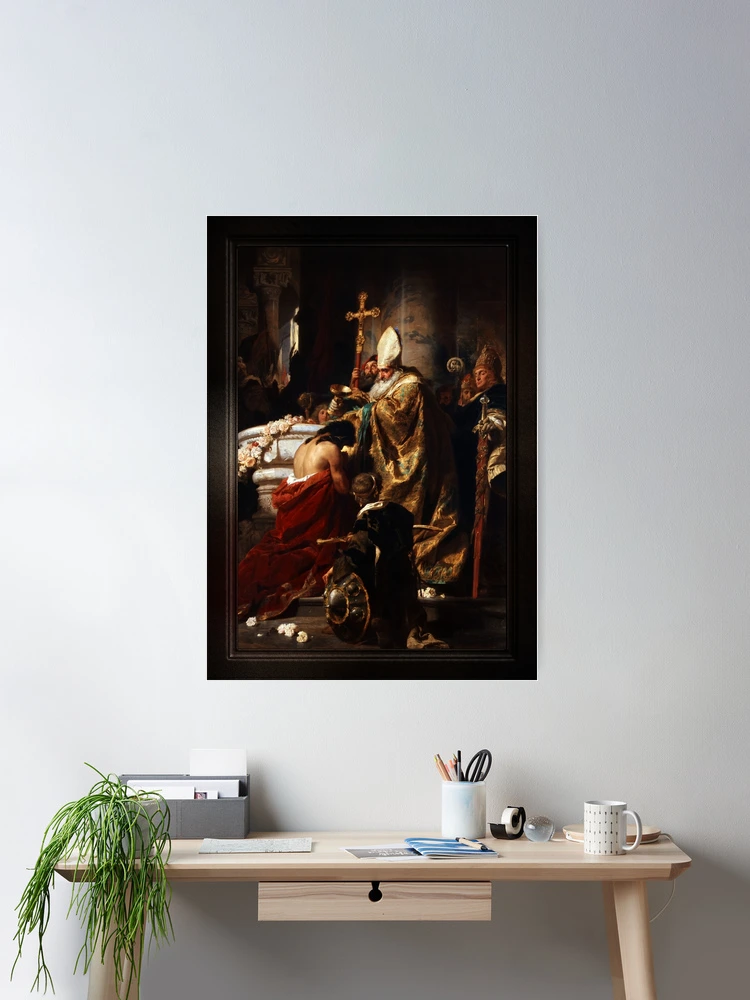
“The Baptism of Vajk,” luotu vuonna 1875 by the Hungarian artist Gyula Benczúr (1844 – 1920), is a remarkable portrayal of a significant moment in Hungarian history. The scene captures the baptism of Vajk, the future King Stephen I of Hungary or King Saint Stephen (975 – 1038), a pivotal event that heralded the conversion of the Hungarian people to Christianity. This monumental work of art reflects the blend of historical, uskonnollinen, and national themes, masterfully rendered with Benczúr’s characteristic precision and grandeur. Through his use of color, koostumus, ja symboliikkaa, Benczúr elevates the scene to a moment of profound spiritual and political significance.
Sisällysluettelo
Composition and Subject Matter
The central theme of the painting is the baptism of Vajk, WHO, as a young man, kneels before a high-ranking ecclesiastical figure. The solemnity of the moment is enhanced by the dramatic lighting and the positioning of figures, creating a clear sense of hierarchy. The solemnity of the sacrament is emphasized by the detailed depiction of Vajk’s posture, as he bows his head in humble submission, accepting his faith and a destiny that will shape the future of Hungary.
The religious leader performing the baptism is a figure of great authority, wearing a ceremonial bishop’s vestments adorned in rich gold and red. The bishop’s position, standing over Vajk, gives the impression of his spiritual dominance, overseeing the transformation of the young ruler. Verrattuna, Vajk’s attire, simple, but symbolic, consists of a red cloth that symbolizes the sacrifice and blood of Christ, marking the significant shift in his life.
Surrounding this core religious act are several onlookers, dressed in opulent, period-specific clothing, who represent the political and religious elites present to witness this momentous event. These figures are carefully placed, their expressions a mix of reverence and awe, reflecting the historical importance of the baptism not just as a religious act, but as a state affair that would solidify Vajk’s position as the ruler of Hungary.
Materiaalit, Techniques, ja Tyyli
Benczúr’s use of oil paints is evident in the deep richness of the colors and the fine detailing of textures. The use of light and shadow throughout the painting gives it a sense of depth and grandeur, imbuing the scene with an almost theatrical quality. Luvut, particularly the bishop and Vajk, are painted with a high level of realism, their faces and gestures vividly conveying the emotional weight of the moment. Benczúr’s meticulous attention to detail, particularly in the fabrics and the textures of the armor and robes, demonstrates his technical prowess.
The painter’s style is firmly rooted in academic realism, a movement that sought to depict subjects in a truthful and highly detailed manner. The composition follows traditional narrative conventions, with clear hierarchies between figures and a focus on the central moment of the baptism. This realism, kuitenkin, is balanced with a sense of idealization, creating an image that elevates the historical event to the realm of the divine.
Setting and Atmosphere
The setting for the baptism is an interior, likely a church or a cathedral, where the spiritual transformation is taking place. The architecture in the background, with its towering columns and arches, is grand and imposing, contributing to the sense of ceremony. The stained glass windows, though not explicitly visible in the scene, are suggested through the play of light, which filters through the space and highlights the key figures. This careful attention to the lighting adds an ethereal quality to the scene, symbolizing the divine presence during the sacrament.
The mood of the painting is solemn and reverential. The dim lighting, combined with the rich textures of the robes and the golden chalice held by the bishop, conveys a sense of sacredness. The figures in the painting are not merely spectators but are participants in a moment that is both spiritually transformative and politically significant. Benczúr masterfully evokes this duality, religious and national, through his composition, where the spiritual act is portrayed as a moment of profound historical change.
Symbolism and Historical Significance
“The Baptism of Vajk” is steeped in symbolism, much of which relates to the historical context of Hungary during the time of King Stephen I. The baptism itself is not just a religious conversion; it marks the beginning of Hungary’s Christianization, an event that would play a central role in the formation of the Hungarian state. By depicting this moment, Benczúr highlights the critical intersection of faith and governance, illustrating how religion and politics are intertwined in the formation of national identity.
Vajk’s transformation into Stephen I, the first Christian king of Hungary, is symbolized through his kneeling position and the sacred act being performed by the bishop. The imagery of the chalice held by the bishop represents both the sacred blood of Christ and the power of the Christian Church, which was pivotal in shaping the political landscape of Hungary.
The presence of other nobles and bishops further emphasizes the political dimension of the baptism. Their respectful gazes and regal attire demonstrate the gravity of the occasion, where the king’s conversion to Christianity would not only affect his personal faith but also the future of Hungary. The scene encapsulates the moment when religious and political spheres united in the establishment of a Christian Hungarian kingdom.
Johtopäätös
Gyula Benczúr’s “The Baptism of Vajk” (1875) is a striking example of historical realism, combining deep religious significance with a masterful narrative technique. The composition and the careful attention to detail allow the viewer to step back into a pivotal moment in Hungarian history, one that was not just about faith but also about the future direction of a nation. Through the use of light, väri-, ja rakenne, Benczúr brings to life a moment that is both historically and spiritually profound, inviting the viewer to reflect on the historical and religious forces that shaped Hungary’s future.
Vajkin kaste on retusoitu digitaalisen taiteen vanhojen mestarien kopio julkisesta kuvasta.
Taiteilijabio
Tiedot alla Wikipedia.org
Gyulan perhe muutti Kassalle, kun hän oli vielä hyvin nuori ja hän osoitti varhaista piirtämiskykyä. Hän aloitti opintonsa vuonna 1861 sekä Hermann Anschutz ja Johann Georg Hiltensperger (1806- 1890). Alkaen 1865 että 1869, hän opiskeli Karl von Pilotyn luona.
Hän saavutti kansainvälistä menestystä vuonna 1870 kun hän voitti Unkarin kansallisen historiallisen maalauskilpailun kuvaamalla kuningas Stephenin kastetta. Sitten hän avusti Pilotyä Maximilianeumin ja Rathausin freskoilla Münchenissä ja suuren saksalaisen kirjailijan kuvituksia, Friedrich Schiller. Baijerin kuningas Ludwig II antoi hänelle useita toimeksiantoja.
Hänet nimitettiin Kuvataideakatemian professoriksi, München, sisään 1875. Pian sen jälkeen, hän rakensi kodin Ambachiin Starnberg -järvelle; hänen veljensä Bélan suunnittelema. Sisään 1883, hän palasi Unkariin, jossa hän jatkoi taiteen opettajana. Yksi hänen arvostetuimmista oppilaistaan oli sveitsiläissyntyinen amerikkalainen taidemaalari Adolfo Müller-Ury. Benczúr oli myöhemmin unkarilaisen ylemmän luokan suosikki, maalaa lukuisia muotokuvia kuninkaista ja aristokraateista. Hän loi myös joitakin uskonnollisia teoksia; erityisesti alttaritauluja St.. Stefanuksen basilika ja Budan linna.
Hän oli Unkarin tiedeakatemian kunniajäsen. Kadut on nimetty hänen mukaansa Balassagyarmatissa, Balatonkenese, Berettyóújfalu, Bonyhád, Budapest, Debrecen, Jászberény, Humala, Rintalihakset, Ilmainen majoitus, Szeged ja Košice. Hänen tyttärensä Olga (1875- 1962) ja Ida (1876–1970) tuli myös tunnettuja taiteilijoita.