

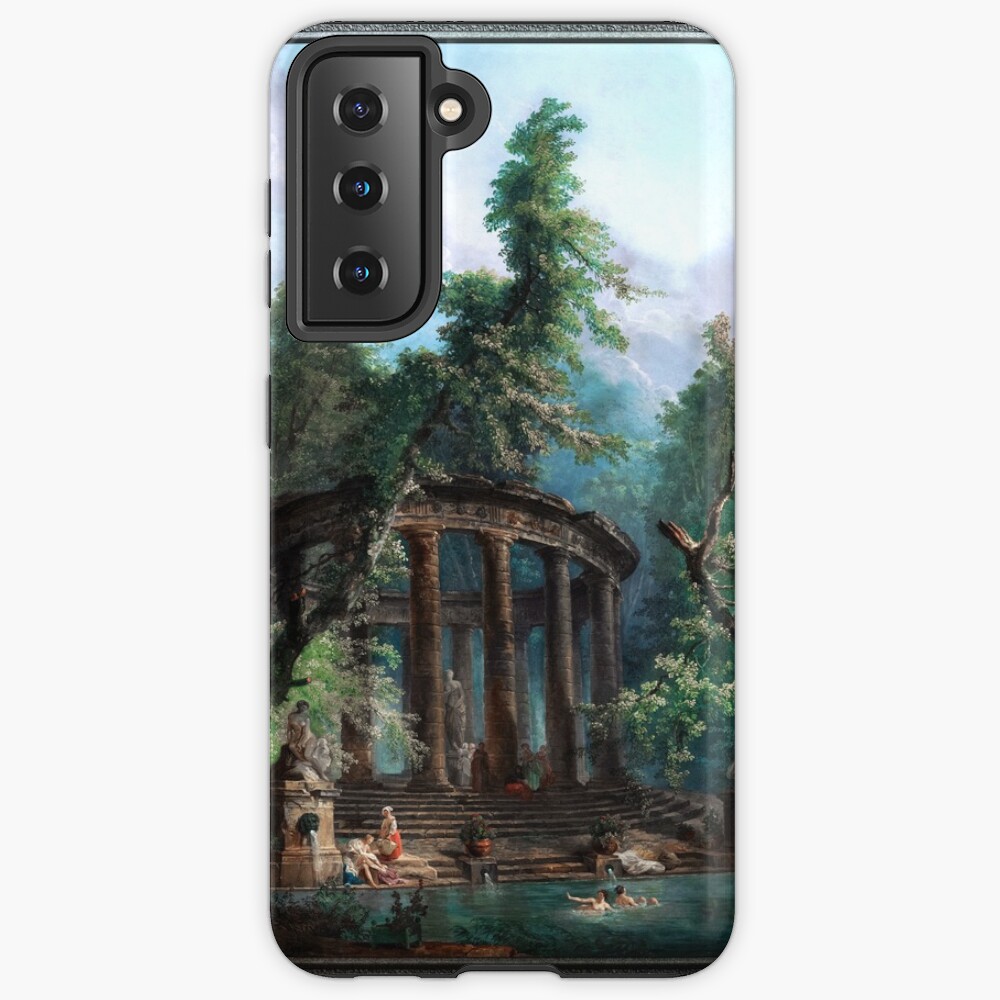
The Bathing Pool c1753
“The Bathing Pool,” erstallt an 1753 vum renomméierte franséische Moler Hubert Robert (1733 – 1808), showcases the artist’s mastery of architectural ruins and the romanticized nature of Classical antiquity. Robert, an esteemed artist of the Rococo and Neoclassical periods, has painted a tranquil yet vibrant scene that captivates the viewer with its harmonious blend of natural beauty and classical structures. The painting features a classical Roman bathhouse partially overtaken by nature, surrounded by lush greenery, and populated with figures engaged in leisurely activities. The scene evokes an atmosphere of serenity, nostalgia, an zäitlos Eleganz, a hallmark of Robert’s style, which often celebrated the contrast between human achievement and the inevitable encroachment of nature.

Inhaltsverzeechnes
De Kader: Classical Ruins and Lush Greenery
De Kader vun “The Bathing Pool” is an idyllic and somewhat melancholic portrayal of a Roman ruin. Am Virdergrond, a circular colonnade, composed of imposing stone pillars, frames the scene. Dës Sailen, weathered by time, are still strong but bear the marks of age, with ivy creeping up their surfaces and tree branches intertwining through their spaces. The columns support a domed structure, hinting at a once grandiose building now abandoned and reclaimed by nature. The structure’s deterioration is made more poignant by the overgrowth of greenery, emphasizing the passage of time and the impermanence of even the greatest human creations.
Behind the bathhouse, the landscape is verdant and rich with plant life, with trees, bushes, and flowering vines spilling over the stonework. The dense foliage brings an air of quiet abundance, a peaceful backdrop to the figures within the pool. Nature’s dominance over the crumbling architecture adds to the romanticized ruin theme that Robert so often explored in his works.
The background extends to a distant, ethereal sky, painted with soft hues of blue and white clouds, creating a sense of openness and tranquility. This harmonious union between the decaying human-made structure and the flourishing natural world is a reflection of Robert’s deep fascination with the sublime beauty of nature and its ability to reclaim what was once built by mankind.
D'Figuren: Leisure and Graceful Activity
In the foreground of the painting, several figures are depicted in relaxed poses, participating in various leisurely activities typical of an ancient bathing ritual. A group of women is seen bathing in the tranquil waters of a pool, their forms partially submerged. Dës Zuele sinn, rendered with grace and elegance, evoke the classical ideal of beauty, each draped in flowing garments.
Eng vun de Fraen, seated by the edge of the pool, appears to be drying herself, while another stands by the water’s edge, looking serenely into the distance. The artist has paid meticulous attention to the details of their clothing, with the fabrics of their garments capturing the soft play of light and shadow.
Their leisurely actions contribute to the mood of relaxation and harmony in the scene, reinforcing the theme of tranquility. A nearby male figure, possibly a servant or attendant, is visible as well, gently assisting one of the women or perhaps preparing to enter the pool. His presence adds a human touch to the scene, grounding the viewer’s experience in a sense of historical realism while still maintaining the ethereal quality of the painting.
The figures in “The Bathing Pool” embody the Rococo style’s emphasis on grace, Bewegung, a Schéinheets, though Robert subtly infuses them with a more contemplative air than is typically seen in the exuberant works of the period. The poses of the figures are not overtly theatrical, but rather relaxed and serene, emphasizing the calm and leisurely nature of the scene. Their interactions with one another suggest a sense of communal ease, as if in a private retreat or haven where time itself slows.
Materialien an Technik: Classical Precision Meets Romantic Atmosphere
Hubert Robert’s technical skill is evident in the execution of both the architectural elements and the natural surroundings. The precision of the columns and the detailed rendering of the stonework contrasts with the softer, more fluid treatment of the foliage and water.
The artist’s technique is particularly effective in conveying the interplay of light and shadow, which is vital in creating the depth and realism of the scene. Der mëller, diffused light that bathes the entire landscape lends an ethereal glow to the pool and figures, highlighting their forms and contributing to the peaceful ambiance of the painting.
Robert’s use of perspective is subtle but effective. The way the colonnade and the surrounding landscape recede into the distance creates a sense of expansive space. The ruins seem to stretch out before the viewer, inviting them into this almost dreamlike world of classical antiquity.
The colors are soft and harmonious, with light blues and greens predominating the palette, weider d'Rou ze verbesseren, idyllic mood. The coolness of the water, the verdant tones of the trees, and the muted stonework come together to create a visually cohesive and calming composition.
Stëmmung an Thema: Natur, Zäit, and Transience
D'Stëmmung vum “The Bathing Pool” ass ee vu rouege Iwwerleeung. It evokes a sense of nostalgia for a past age while also suggesting the inevitability of time’s passage. The ruins, once a symbol of human achievement, now stand in quiet ruin, overtaken by nature. This sense of impermanence is tempered, awer, by the serenity of the figures and the landscape, which suggests that, while human endeavors may fade, nature continues in its timeless cycle.
The theme of the painting revolves around the relationship between humanity, Natur, an de Passage vun der Zäit. The pool and its surroundings are not merely an architectural space but a metaphor for the fleeting nature of human civilization, contrasted with the eternal quality of nature. The figures in the scene represent a moment in time, but their activity is timeless, a serene reflection of a world that has endured beyond the human presence.
The Bathing Pool is a retouched digital art old masters reproduction of a public domain image that is available for purchase online as a gewalzt Leinwanddruck.
Kënschtler Bio
Ënnert Info Ofgeleet Vun Wikipedia
Den Hubert Robert gouf zu Paräis gebuer 1733. Säi Papp, Nicolas robert, war am Déngscht vum François-Joseph de Choiseul, marquis de Stainville e féierende Diplomat aus Loutrengen. De jonke Robert huet seng Studie mat de Jesuiten um Collège de Navarre ofgeschloss 1751 an den Atelier vum Sculpteur Michel-Ange Slodtz eragaangen, deen him Design a Perspektiv geléiert huet, awer hien encouragéiert huet sech op d'Molerei ze zéien.. An 1754 hien ass am Zuch vum Étienne-François de Choiseul op Roum fortgaang, Jong vu sengem Papp sengem Patron, dee franséischen Ambassadeur ernannt gouf a Staatssekretär fir Aussepolitik vum Louis XV. 1758.
Hien huet voll eelef Joer zu Roum verbruecht, eng bemierkenswäert Längt vun der Zäit; nodeems dem jonke Kënschtler seng offiziell Residenz op der Franséischer Akademie zu Roum ausgaang ass, hien huet sech selwer ënnerstëtzt vu Wierker, déi hie produzéiert huet fir besiche Kenner wéi den Abbé de Saint-Non, deen de Robert op Neapel am Abrëll geholl huet 1760 fir d'Ruine vu Pompeji ze besichen. Der Marquis de Marigny, Direkter vun de Bâtiments du Roi hält sech a senger Entwécklung a Korrespondenz mam Natoire um Laafenden, Direkter vun der Franséischer Akademie, déi d'Pensiounskräften opgeruff hunn ausserhalb vun Dieren ze skizzéieren, aus der Natur: De Robert brauch keen Drang; Zeechnungen aus senge Skizzenbicher dokumentéieren seng Reesen: Villa d'Este, Caprarola.
Vue op den Hafen vu Rippeta zu Roum, c. 1766, weist den antike Réimesche Pantheon nieft engem imaginären Hafen
De Kontrast tëscht de Ruine vum antike Roum an dem Liewen vu senger Zäit huet säi gréissten Interessi opgereegt. Hien huet eng Zäit am Studio vu Pannini geschafft, deenen hiren Afloss an der Imaginary View of the Ruined Louvre Gallery ze gesinn ass (Illustratioun). De Robert huet seng Zäit an der Gesellschaft vu jonke Kënschtler am Krees vu Piranesi verbruecht, whose capricci of romantically overgrown ruins influenced him so greatly that he gained the nickname Robert des ruines.[2] D'Alben mat Sketcher an Zeechnungen, déi hien zu Roum zesummegesat huet, hunn him Motiver geliwwert, déi hien a senger ganzer Karriär a Biller geschafft huet.