

Austerlitzin taistelu
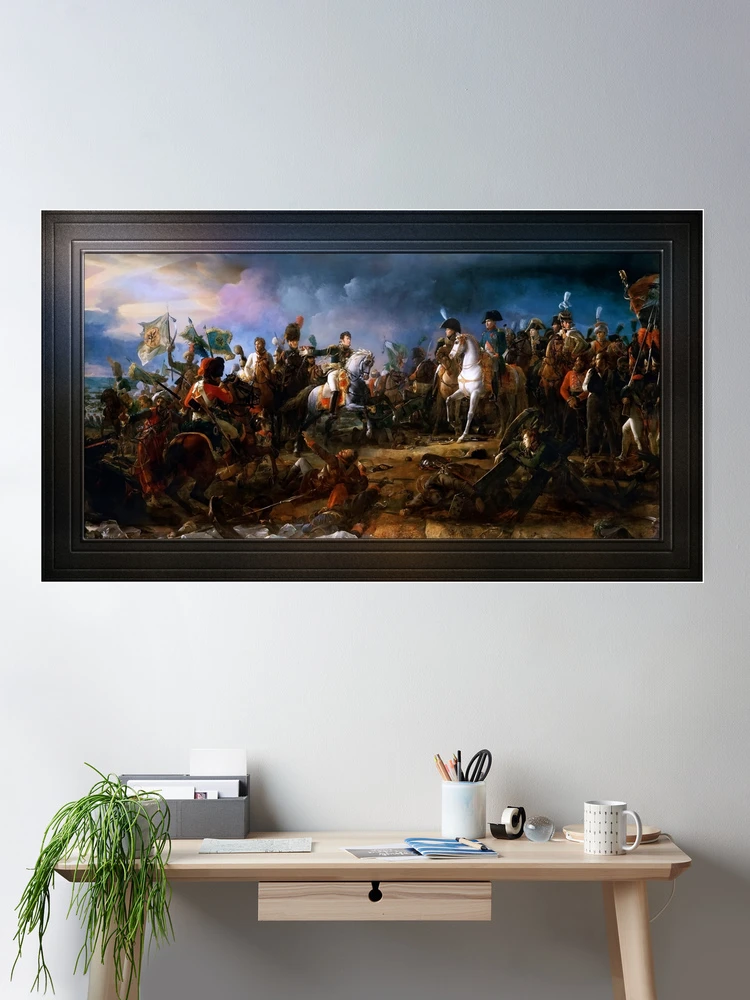
Teos nimeltä The Taistelu Austerlitzistä, (2. joulukuuta, 1805), luotu ympäri 1810 by French painter François Pascal Simon, Paroni Gerard (1770 – 1837), captures one of the most significant battles of the Napoleonic Wars. Known as the Battle of the Three Emperors, this pivotal confrontation between Napoleon Bonaparte, Tsar Alexander I of Russia, and Holy Roman Emperor Francis II is immortalized in this grand composition. Kohtaus, set in the midst of chaos and carnage, vividly portrays the intensity and dramatic nature of warfare during the early 19th century. It is an exemplary work of historical art, a striking mix of realism, drama, and national pride.
Sisällysluettelo
Pääaihe: The Battlefield and Its Commanders
The central subject of the painting is a vast battlefield strewn with soldiers, flags, and fallen soldiers amidst the aftermath of intense combat. At the forefront, Napoleon Bonaparte, mounted on a white steed, stands as the undeniable focal point. His commanding posture exudes authority and confidence, reflecting his role as the mastermind behind the victory. His regal presence contrasts sharply with the chaos around him, which includes the deaths of numerous soldiers and the disarray of the battlefield. Napoleon’s horse is depicted as calm amidst the violence, as his sharp, focused gaze surveys the battlefield, likely calculating his next move.
Other key figures include the Tsar of Russia, Alexander I, whose dignified yet tense posture further emphasizes the turmoil of the conflict. His royal blue uniform, complete with gold epaulets and a decorative sash, signifies his nobility and status, while also showing his involvement in a struggle that he could not win. To the left of the scene, other officers are seen rallying their troops, coordinating efforts in the middle of a bloody battle. These military leaders, both French and foreign, represent the intersection of power, strategy, and the high cost of war. Their interactions and movements are charged with urgency and tension.
Objects and Symbols: Flags, Weapons, and Debris
In addition to the commanding figures, the scene is teeming with symbols of war. Various military flags can be seen fluttering in the wind, a visual representation of the allegiances in this conflict. The flags are emblazoned with symbols of national pride and military power, their detailed designs hinting at the ongoing struggle for supremacy. The color contrast of these flags against the muted tones of the sky and terrain reflects the struggle between opposing forces, Napoleon’s French army and the allied Russian and Austrian forces.
Weapons, including swords, muskets, and bayonets, are scattered across the scene, many of them abandoned or broken, symbolizing the personal toll that war takes on both soldiers and commanders. Nämä esineet, while seemingly insignificant in their scattered state, contribute to the overall chaotic atmosphere of the battle. Lisäksi, the bodies of fallen soldiers, including both French and allied forces, litter the battlefield, emphasizing the devastation of war. Blood-stained uniforms and wounded men in the background reflect the personal cost of the grand political and military maneuverings.
Maasto ja ympäristö: The Landscape of War
The landscape in Austerlitzin taistelu plays a crucial role in conveying the tone of the artwork. The background is dominated by tumultuous skies filled with stormy clouds, which intensify the scene’s mood of destruction and upheaval. The soft pink and purple hues of the clouds hint at the coming dusk, a symbolic representation of the end of the battle and the ominous aftermath that awaits the vanquished. The mountainous terrain in the distance offers a dramatic backdrop to the chaos unfolding in the foreground, while patches of fog or smoke obscure portions of the scene, adding to the disorientation of battle.
The ground is churned into mud and scattered with debris, as the clash of heavy artillery and cavalry have torn through the once-pristine field. The soil is punctuated by craters and trenches, illustrating the violent exchange of gunfire and cannonballs. This depiction serves as a visual reminder of the brutal physical toll warfare inflicts on the landscape, turning fertile earth into a desolate war zone.
Style and Artistic Technique: Realism and Drama
Baron Gérard’s painting is rendered in the neoclassical style, a reflection of the era’s preference for grandeur and idealization. The dramatic use of light and shadow creates a sense of depth, pulling the viewer’s eye from the foreground chaos to the distant horizon. The strong contrasts between light and dark enhance the sense of tension and drama, with the figures of Napoleon and his generals illuminated, creating a sense of focus on their leadership amidst the chaos. The battlefield itself is painted with great detail, capturing the human emotion of the scene, from the urgency of soldiers engaged in combat to the despair of the wounded.
The emotional intensity of the scene is amplified by Gérard’s careful attention to facial expressions, body language, and the interaction of light with the soldiers’ uniforms. The vividness of the clothing, the rich golds and reds of Napoleon’s uniform, the dark coats of the Russian soldiers, and the bloody wounds of the fallen, conveys the raw reality of battle, while also celebrating the elegance and power of the leaders at its center. Gérard’s use of texture, particularly in his rendering of the horses and soldiers’ garments, adds to the sense of realism, bringing the viewer into the very moment of this monumental historical event.
Teema ja mieliala: Victory, Uhrata, and Tragedy
The mood of the painting is complex, balancing both triumph and tragedy. Sävellyksen keskellä, Napoleon’s victory is evident, as he surveys the battlefield with a sense of controlled determination. kuitenkin, the surrounding carnage, the broken bodies, the wounded, and the debris of war, reminds the viewer of the true cost of that victory. The victorious Napoleon is contrasted by the fallen and dying, creating a tension between the glory of military conquest and the somber realities of war.
The theme of heroism versus tragedy is deeply embedded in the composition. While Napoleon’s leadership is lauded, the human toll of his victory is undeniable. The figures of the fallen soldiers, both French and allied, serve as poignant reminders that war, though often seen as a means to an end, is a brutal and unforgiving force.
Johtopäätös
François Pascal Simon, Baron Gérard’s Austerlitzin taistelu is a masterful portrayal of one of the most significant battles in European history. Through its detailed depiction of the battlefield, its figures, and its use of light and shadow, the painting encapsulates the complexity of war, its grandeur, its leaders, and the devastating human cost. The emotional intensity of the scene, combined with its historical significance, makes this work a powerful and timeless reminder of the realities of military conflict.
You can read more about the conflict here: https://en.wikipedia.org/wiki/Battle_of_Austerlitz
The Battle of Austerlitz is a retouched digital art old masters reproduction of a public domain image.
Taiteilija bio Wikipedia.org
François Gérard syntyi Roomassa J.. S. Gérard ja Cleria Matteï. Kaksitoista -vuotiaana, Gérard sai pääsyn Pariisin eläkkeelle. Eläkkeeltä, hän siirtyi kuvanveistäjä Augustin Pajoun studioon, jonka hän jätti kahden vuoden lopussa historianmaalari Nicolas-Guy Brenetin studioon, jonka hän lopetti lähes välittömästi ja asetti itsensä Jacques-Louis Davidin alaisuuteen.
Sisään 1789, hän kilpaili Prix de Rome -kilpailussa, jonka toveri Girodet vei pois. Seuraavana vuonna (1790), hän esitteli itsensä uudelleen, mutta hänen isänsä kuolema esti hänen työnsä loppuun saattamisen ja pakotti hänet seuraamaan äitiään Roomaan.
Sisään 1791, hän palasi Pariisiin, mutta hänen köyhyytensä oli niin suuri, että hänen oli pakko luopua opinnoistaan työllisyyden hyväksi, mikä toisi välitöntä voittoa.
David käytti heti apuaan, ja yksi mestarin kuuluisimmista muotokuvista, yrityksestä Louis-Michel Le Pelletier, Saint-Fargeau, voi olla paljon velkaa Gérardille.
Tämä maalaus toteutettiin alkuvuodesta 1793, vuosi, jolloin Gérard, Davidin pyynnöstä, nimettiin vallankumouksellisen tuomioistuimen jäseneksi, hänen kohtalokkaista päätöksistään, kuitenkin, aina poissa itsestään.
Sisään 1794, hän sai kilpailussa ensimmäisen palkinnon, jonka aihe oli Kymmenes elokuu, tuo on, Tuileriesin palatsin myrsky. Kilpailijansa ja ystävänsä Girodetin menestys salongissa edistää edelleen 1793 ja 1794, Gérard (apuna Jean-Baptiste Isabey, miniaturisti) vuonna valmistettu 1795 kuuluisa Bélisaire.
Sisään 1796, hänen anteliaan ystävänsä muotokuva (säilytetään tänään Louvressa) saavutti kiistatonta menestystä, ja Isabeyltä näistä kahdesta teoksesta saadut rahat mahdollistivat Gérardin toteuttamisen 1797 hänen psyykeensä ja rakkautensa (kuva).[4] Viimeinkin, sisään 1799, hänen muotokuva Madame Mèresta vahvisti asemansa yhtenä päivän merkittävimmistä muotokuvamaalareista.
Sisään 1808, peräti kahdeksan (ja sisään 1810, vähintään neljätoista) hänen muotokuvansa esiteltiin salongissa, ja nämä luvut antavat vain viitteitä valtavista lukumääräistä, jotka hän suoritti vuosittain. Kaikki Imperiumin ja Bourbonin restauroinnin johtavat hahmot, ja kaikki Euroopan kuuluisimmat miehet ja naiset, istui Gérardin puolesta.
Tämä poikkeuksellinen muoti johtui osittain hänen käytöksensä ja keskustelunsa viehätyksestä, hänen salonki oli yhtä suosittu kuin hänen studionsa. Rouva de Staël, George Canning, Talleyrand ja Wellingtonin herttua ovat kaikki todistaneet hänen yhteiskuntansa vetovoimasta.
Rikas ja kuuluisa, Gérardia pisti katumus aikaisempien tavoitteiden hylkäämisestä; välein, hän oli todella pyrkinyt Girodetin ja muiden kilpailijoiden kanssa osoittamaan vahvuutensa historian maalaamisessa, edelleen arvokkaampi genre kuin muotokuva.
Hänen Austerlitzin taistelunsa (1810) osoitti laajaa keksintöä ja tyyliä, joka oli vieläkin näkyvämpi L'Entrée d'Henri IV à Parisissa (Versailles'ssa), työ, jonka kanssa 1817 hän kunnioitti palattua Ludvig XVIII: ta. Tämän päivämäärän jälkeen, Gérard kieltäytyi, katsomassa voimattomalla surulla romanttisen koulun edistymistä.
Täynnä kunnianosoituksia - Imperiumin paroni vuonna 1809, instituutin jäsen 7 Maaliskuuta 1812, kunnialegioonan upseeri, ensimmäinen maalari kuninkaalle - hän työskenteli, surullinen ja masentunut. Vallankumous 1830 lisäsi levottomuuttaan, ja päälle 11 tammikuu 1837, kolmen päivän kuumeen jälkeen, hän kuoli.
Gérard muistetaan parhaiten muotokuvistaan. Hänen maalaustensa väri on kärsinyt, mutta hänen piirustuksensa osoittavat loukkaamattoman herkullisesti linjansa puhtauden, ja naiset ovat erityisen merkittäviä neitseellisen yksinkertaisuuden ja ilmaisun rehellisyyden vuoksi. Hänen oppilaitaan olivat Heinrich Christoph Kolbe.