

La battaglia di Austerlitz
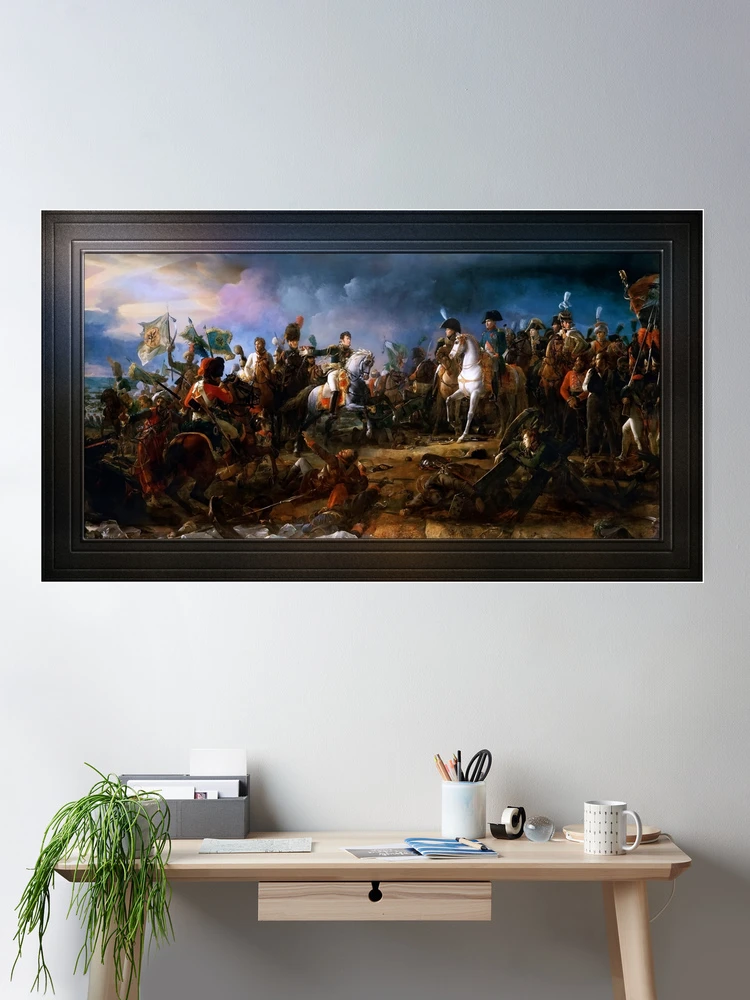
L'opera intitolata Il Battaglia di Austerlitz, (2 dicembre, 1805), creato intorno 1810 by French painter François Pascal Simon, Barone Gerardo (1770 – 1837), captures one of the most significant battles of the Napoleonic Wars. Known as the Battle of the Three Emperors, this pivotal confrontation between Napoleon Bonaparte, Tsar Alexander I of Russia, and Holy Roman Emperor Francis II is immortalized in this grand composition. La scena, set in the midst of chaos and carnage, vividly portrays the intensity and dramatic nature of warfare during the early 19th century. It is an exemplary work of historical art, a striking mix of realism, drama, and national pride.
Sommario
Argomento principale: The Battlefield and Its Commanders
The central subject of the painting is a vast battlefield strewn with soldiers, flags, and fallen soldiers amidst the aftermath of intense combat. At the forefront, Napoleon Bonaparte, montato su un destriero bianco, stands as the undeniable focal point. His commanding posture exudes authority and confidence, reflecting his role as the mastermind behind the victory. His regal presence contrasts sharply with the chaos around him, which includes the deaths of numerous soldiers and the disarray of the battlefield. Napoleon’s horse is depicted as calm amidst the violence, as his sharp, focused gaze surveys the battlefield, likely calculating his next move.
Other key figures include the Tsar of Russia, Alexander I, whose dignified yet tense posture further emphasizes the turmoil of the conflict. His royal blue uniform, complete with gold epaulets and a decorative sash, signifies his nobility and status, while also showing his involvement in a struggle that he could not win. A sinistra della scena, other officers are seen rallying their troops, coordinating efforts in the middle of a bloody battle. These military leaders, both French and foreign, represent the intersection of power, strategy, and the high cost of war. Their interactions and movements are charged with urgency and tension.
Oggetti e simboli: Flags, Weapons, and Debris
In addition to the commanding figures, the scene is teeming with symbols of war. Various military flags can be seen fluttering in the wind, a visual representation of the allegiances in this conflict. The flags are emblazoned with symbols of national pride and military power, their detailed designs hinting at the ongoing struggle for supremacy. The color contrast of these flags against the muted tones of the sky and terrain reflects the struggle between opposing forces, Napoleon’s French army and the allied Russian and Austrian forces.
Weapons, including swords, muskets, and bayonets, are scattered across the scene, many of them abandoned or broken, symbolizing the personal toll that war takes on both soldiers and commanders. Questi articoli, while seemingly insignificant in their scattered state, contribute to the overall chaotic atmosphere of the battle. Inoltre, the bodies of fallen soldiers, including both French and allied forces, litter the battlefield, emphasizing the devastation of war. Blood-stained uniforms and wounded men in the background reflect the personal cost of the grand political and military maneuverings.
Terreno e ambiente: The Landscape of War
Il paesaggio dentro La battaglia di Austerlitz plays a crucial role in conveying the tone of the artwork. The background is dominated by tumultuous skies filled with stormy clouds, which intensify the scene’s mood of destruction and upheaval. The soft pink and purple hues of the clouds hint at the coming dusk, a symbolic representation of the end of the battle and the ominous aftermath that awaits the vanquished. The mountainous terrain in the distance offers a dramatic backdrop to the chaos unfolding in the foreground, while patches of fog or smoke obscure portions of the scene, adding to the disorientation of battle.
The ground is churned into mud and scattered with debris, as the clash of heavy artillery and cavalry have torn through the once-pristine field. The soil is punctuated by craters and trenches, illustrating the violent exchange of gunfire and cannonballs. This depiction serves as a visual reminder of the brutal physical toll warfare inflicts on the landscape, turning fertile earth into a desolate war zone.
Style and Artistic Technique: Realism and Drama
Baron Gérard’s painting is rendered in the neoclassical style, a reflection of the era’s preference for grandeur and idealization. The dramatic use of light and shadow creates a sense of depth, pulling the viewer’s eye from the foreground chaos to the distant horizon. The strong contrasts between light and dark enhance the sense of tension and drama, with the figures of Napoleon and his generals illuminated, creating a sense of focus on their leadership amidst the chaos. The battlefield itself is painted with great detail, capturing the human emotion of the scene, from the urgency of soldiers engaged in combat to the despair of the wounded.
The emotional intensity of the scene is amplified by Gérard’s careful attention to facial expressions, body language, and the interaction of light with the soldiers’ uniforms. The vividness of the clothing, the rich golds and reds of Napoleon’s uniform, the dark coats of the Russian soldiers, and the bloody wounds of the fallen, conveys the raw reality of battle, while also celebrating the elegance and power of the leaders at its center. Gérard’s use of texture, particularly in his rendering of the horses and soldiers’ garments, adds to the sense of realism, bringing the viewer into the very moment of this monumental historical event.
Tema e umore: Vittoria, Sacrificio, and Tragedy
The mood of the painting is complex, balancing both triumph and tragedy. At the center of the composition, Napoleon’s victory is evident, as he surveys the battlefield with a sense of controlled determination. tuttavia, the surrounding carnage, the broken bodies, the wounded, and the debris of war, reminds the viewer of the true cost of that victory. The victorious Napoleon is contrasted by the fallen and dying, creating a tension between the glory of military conquest and the somber realities of war.
The theme of heroism versus tragedy is deeply embedded in the composition. While Napoleon’s leadership is lauded, the human toll of his victory is undeniable. The figures of the fallen soldiers, both French and allied, serve as poignant reminders that war, though often seen as a means to an end, is a brutal and unforgiving force.
Conclusione
François Pascal Simon, Baron Gérard’s La battaglia di Austerlitz is a masterful portrayal of one of the most significant battles in European history. Through its detailed depiction of the battlefield, its figures, and its use of light and shadow, the painting encapsulates the complexity of war, its grandeur, its leaders, and the devastating human cost. The emotional intensity of the scene, combined with its historical significance, makes this work a powerful and timeless reminder of the realities of military conflict.
Puoi leggere di più sul conflitto qui: https://en.wikipedia.org/wiki/Battle_of_Austerlitz
La battaglia di Austerlitz è una riproduzione di vecchi maestri di arte digitale ritoccata di un'immagine di pubblico dominio.
Bio dell'artista da Wikipedia.org
François Gérard è nato a Roma da J. S. Gérard e Cleria Matteï. All'età di dodici anni, Gérard ottenne l'ammissione alla Pension du Roi di Parigi. Dalla Pensione, passò allo studio dello scultore Augustin Pajou, che ha lasciato alla fine di due anni per lo studio del pittore di storia Nicolas-Guy Brenet, che abbandonò quasi subito per mettersi sotto Jacques-Louis David.
Nel 1789, ha gareggiato per il Prix de Rome, che fu portato via dal suo compagno Girodet. L'anno successivo (1790), si è presentato di nuovo, ma la morte del padre impedì il compimento dell'opera e lo obbligò ad accompagnare la madre a Roma.
Nel 1791, è tornato a Parigi, ma la sua povertà era così grande che fu costretto a rinunciare agli studi a favore di un impiego che gli avrebbe portato un profitto immediato.
Davide si avvalse subito del suo aiuto, e uno dei ritratti più celebri di quel maestro, di Louis-Michel Le Pelletier de Saint-Fargeau, deve molto alla mano di Gérard.
Questo dipinto è stato eseguito all'inizio 1793, l'anno in cui Gérard, su richiesta di Davide, fu nominato membro del tribunale rivoluzionario, dalle decisioni fatali di cui lui, tuttavia, invariabilmente si assentava.
Nel 1794, ha ottenuto il primo premio in un concorso, il cui soggetto era Il 10 agosto, questo è, l'assalto al Palazzo delle Tuileries. Ulteriormente stimolato dai successi del suo rivale e amico Girodet nei Saloni di 1793 e 1794, Gerardo (aiutato da Jean-Baptiste Isabey, il miniaturista) prodotto in 1795 il suo famoso Bélisaire.
Nel 1796, un ritratto del suo generoso amico (conservato oggi al Louvre) ottenuto un successo indiscusso, e il denaro ricevuto da Isabey per queste due opere ha permesso a Gérard di eseguire 1797 la sua Psiche e il suo Amore (illustrazione).[4] Infine, nel 1799, il suo ritratto di Madame Mère stabilì la sua posizione come uno dei più importanti ritrattisti dell'epoca.
Nel 1808, fino a otto (e in 1810, non meno di quattordici) suoi ritratti sono stati esposti al Salon, e queste cifre danno solo un'indicazione degli enormi numeri che eseguiva ogni anno. Tutti i protagonisti dell'Impero e della Restaurazione Borbonica, e tutti gli uomini e le donne più celebri d'Europa, seduto per Gérard.
Questa straordinaria moda era dovuta in parte al fascino dei suoi modi e della sua conversazione, poiché il suo salone era tanto frequentato quanto il suo studio. Madame de Staël, Giorgio Canning, Talleyrand e il duca di Wellington hanno tutti testimoniato l'attrazione della sua società.
Ricco e famoso, Gérard fu colpito dal rimorso per le precedenti ambizioni abbandonate; ad intervalli, aveva davvero lottato con Girodet e altri rivali per dimostrare la sua forza nella pittura di storia, ancora un genere più prestigioso della ritrattistica.
La sua battaglia di Austerlitz (1810) ha mostrato un'ampiezza di invenzione e stile che era ancora più evidente in L'Entrée d'Henri IV à Paris (a Versailles), il lavoro con cui in 1817 ha reso omaggio al Luigi XVIII tornato. Dopo questa data, Gérard ha rifiutato, osservando con impotente dolore i progressi della scuola romantica.
Caricato di onori – barone dell'Impero in 1809, membro dell'Institut on 7 marzo 1812, ufficiale della Legion d'Onore, primo pittore del re - ha lavorato su, triste e scoraggiato. La rivoluzione di 1830 aggiunto alla sua inquietudine, e via 11 Gennaio 1837, dopo tre giorni di febbre, è morto.
Gérard è ricordato soprattutto per i suoi ritratti. Il colore dei suoi quadri ha sofferto, ma i suoi disegni mostrano con intatta delicatezza la purezza della sua linea, e quelli delle donne sono particolarmente notevoli per una verginale semplicità e franchezza di espressione. I suoi studenti includevano Heinrich Christoph Kolbe.