

Magen dansare: Her Alluring Dance – A Study in Light and Movement
The Belly Dancer c ~ av österrikiska målaren Hans Zatzka (1859 – 1945); även känd som P. Ronsard, Pierre de Ronsard, eller H. Zabateri och han undertecknade många av hans verk som Joseph Bernard, J. Bernard, eller Bernard Zatzk för att undvika påföljder för bromsavtal som begränsade hur många verk han kunde sälja.
Hans was an Austrian artist renowned for his depictions of idealized female figures within opulent settings, often drawing inspiration from Orientalist themes prevalent in 19th-century European art. “Magen dansare,” likely created around the turn of the century, exemplifies this style with its meticulous detail and evocative atmosphere. The painting is not merely a representation of a dancer; it’s an exploration of light, textur, and graceful motion within a richly decorated interior space.

Innehållsförteckning
Kompositionselement & Spatial Arrangement
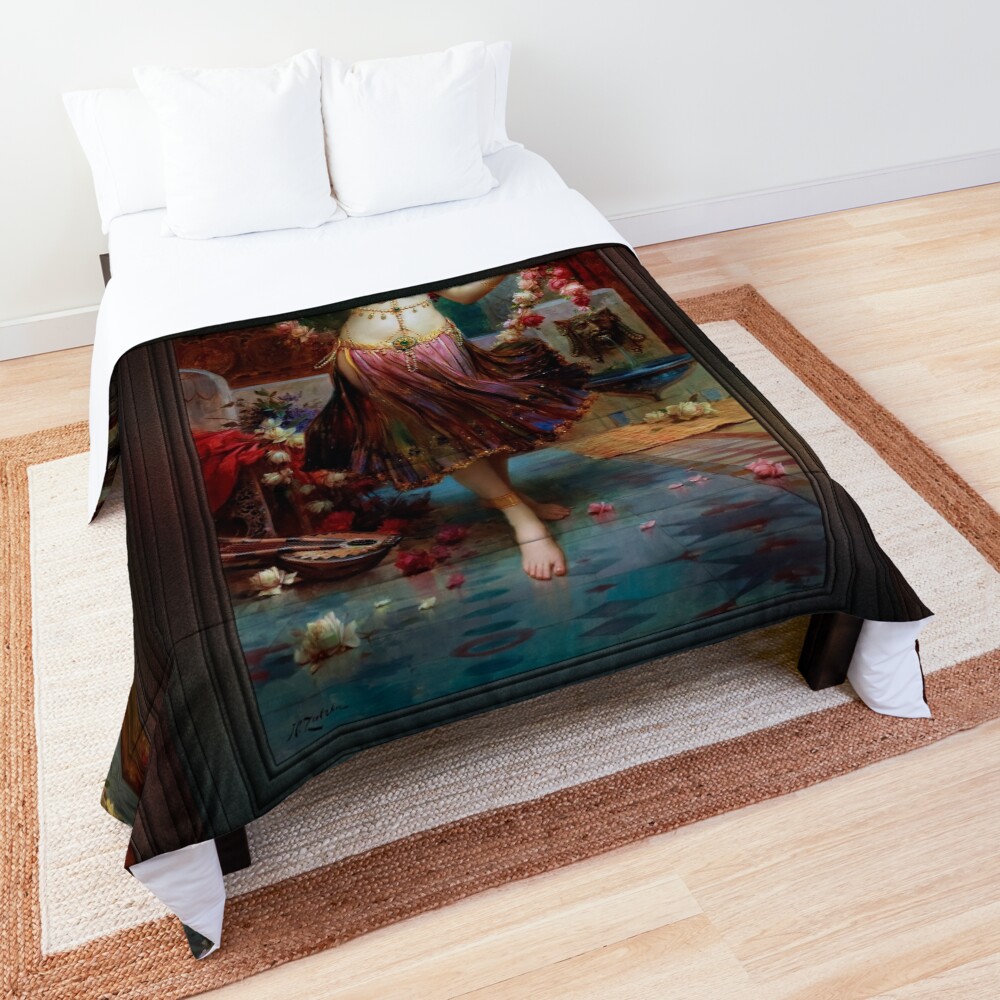
The composition immediately draws the viewer’s eye to the central figure of the belly dancer. She occupies a prominent position in the foreground, her form illuminated by a warm, diffused light source that originates from an unseen location beyond the frame’s right side. The artist employs a pyramidal structure, with the dancer forming the apex and the surrounding architectural details creating a stable base. This arrangement lends a sense of balance and harmony to the scene.
The floor is strewn with scattered petals, leading the eye towards the dancer’s feet and reinforcing her central role. A lute rests on the left side of the composition, hinting at musical accompaniment and adding another layer of cultural context. The background features an elaborately carved archway, partially obscured by shadows, which provides depth and a sense of mystery to the setting.
Färgpalett & Ljuseffekter
Zatzka’s masterful use of color is crucial to the painting’s impact. A warm palette dominates, with rich reds, guld, bruna, and creams creating an atmosphere of luxurious warmth. The dancer’s costume is particularly striking, featuring a layered skirt in shades of crimson, bronze, and gold that shimmer under the light. The skin tones are rendered with remarkable realism, capturing subtle variations in color and texture.
The lighting is not harsh or direct; i stället, it’s soft and diffused, creating gentle gradations of tone across the dancer’s form and the surrounding environment. This technique softens the edges and contributes to the painting’s overall sense of elegance and refinement. The interplay of light and shadow emphasizes the contours of the dancer’s body while simultaneously obscuring details in the background, further focusing attention on the central figure.
The Dancer: Pose & Uttryck
The dancer is depicted mid-motion, her right leg extended slightly forward as she gracefully turns. Her left arm is raised, holding a garland of flowers, while her right hand rests gently on her hip. This pose conveys both dynamism and poise. Her head is tilted slightly downward, and her expression is one of serene concentration rather than overt sensuality. There’s a quiet dignity in her gaze, suggesting an inner focus that transcends the purely performative aspect of her dance. The artist avoids any overtly provocative gestures or expressions, instead opting for a portrayal of graceful movement and understated beauty.
Arkitektoniska detaljer & Interior Setting
The setting is clearly an opulent interior space, likely inspired by Middle Eastern architecture. Intricate carvings adorn the walls and archways, showcasing the artist’s attention to detail. The architectural elements are not merely decorative; they contribute significantly to the painting’s overall atmosphere of luxury and exoticism. A small fountain with a sculpted head is visible on the right side, adding another element of visual interest and reinforcing the sense of an elaborate, well-appointed space. The shadows cast by the architecture create a dramatic contrast with the illuminated areas, enhancing the depth and dimensionality of the scene.
Konstnärliga influenser & Sammanhang
Zatzka’s work reflects the broader trends of Orientalism that were popular in 19th-century European art. This artistic movement involved depicting scenes from North Africa and the Middle East, often romanticizing and idealizing these cultures. While Zatzka’s painting is rooted in this tradition, it also demonstrates a unique sensitivity to light, Färg, och form. His meticulous attention to detail and his ability to capture the essence of graceful movement set him apart from many of his contemporaries. The popularity of belly dancing as entertainment during this period likely contributed to the subject matter’s appeal.
Technical Skill & Artistic Legacy
“Magen dansare” is a testament to Zatzka’s technical skill as an artist. His mastery of oil painting techniques, particularly his ability to render textures and capture light effects, is evident in every detail of the work. The smooth brushstrokes and subtle gradations of tone create a sense of realism while simultaneously enhancing the painting’s overall aesthetic appeal. Zatzka’s legacy lies in his ability to combine technical virtuosity with a keen eye for beauty and an appreciation for the exotic allure of Orientalist themes. His paintings continue to be admired for their elegance, förfining, and evocative atmosphere.
Artist Bio från Wikipedia.org
Hans Zatzka har ibland varit känd som P. Ronsard, Pierre de Ronsard, eller H. Batterier, och signerade många av hans verk som Joseph Bernard, J. Bernard, eller Bernard Zatzka. Syftet med Zatzkas stora utbud av pseudonymer var att undvika straff för att bryta kontrakt som begränsade mängden konstverk han kunde sälja.
Detta har fått vissa konstdatabaser att kombinera Zatzkas verk under pseudonymen Joseph Bernard med den franska skulptören med samma namn. Hans Zatzka föddes den 8 Mars 1859 i Wien. Hans far Bartholomaüs var byggnadsarbetare, och hans mor var Marie Karpischek Zatzka.
Mellan 1877 och 1882, Han studerade vid Academie des Beaux-Arts, under Christian Griepenkerl, Carl Wurzinger, och Karl von Blaas. Zatzka kunde försörja sig på att producera fresker för kyrkor och andra institutioner. I 1885, Zatzka fick i uppdrag att skapa takfresken The Naiad of Baden på Kurhaus Baden.
Många av Zatzkas verk var religiösa målningar och altarbitar tillägnade olika kyrkor i Österrike. i alla fall, han är mer känd för sina målningar av kvinnor, älvor, och andra fantastiska scener. Ofta, han skulle hämta inspiration från Richard Wagners verk och sagorna om bröderna Grimm.
I slutet av 1800 -talet och början av 1900 -talet, flera stycken av Zatzka fotograferades och gjordes till kommersiella och samlingsbara vykort. Under 1920 -talet, Zatzkas stil blev valfri inredning i hela Europa. Dessutom, de föregående trettio åren höll en återupplivning för Zatzka.
The Belly Dancer is a retouched digital art old masters reproduction of a public domain image that is available as a rullat tryck online.