

Narodziny Wenus: A Neo-Classical Reverie
Narodziny Wenus (Narodziny Wenus) ok. 1863 r. autorstwa francuskiego malarza Alexandre'a Cabanela (1823 – 1889), stands as a quintessential example of the French academic style that flourished in the mid-19th century. This large-scale oil painting, currently housed at the Musée d’Orsay in Paris, draws heavily from classical mythology and Renaissance artistic traditions, particularly Sandro Botticelli’s iconic “Birth of Venus” (C. 1486). jednak, Cabanel’s interpretation diverges significantly, showcasing a distinctly different aesthetic sensibility rooted in the prevailing academic conventions of his time. The artwork is not merely an imitation; it’s a reimagining that reflects the evolving artistic landscape and societal values of the Second Empire era.

Spis treści
Struktura kompozycyjna & Narracja
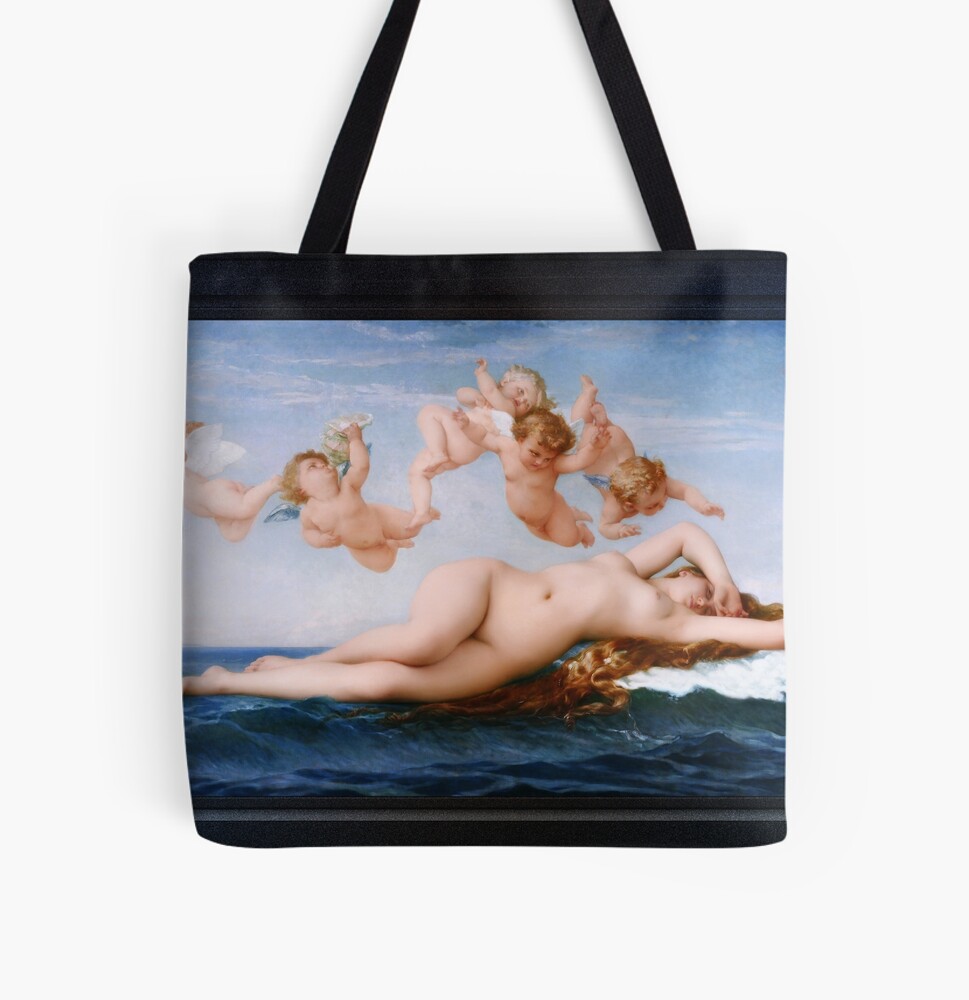
The painting depicts the mythological birth of Venus, the Roman goddess of love and beauty. Venus emerges from a giant scallop shell, adrift on the surface of the sea. The composition is carefully structured to guide the viewer’s eye.
The horizontal plane of the water provides stability, while the verticality of the figures above creates a dynamic contrast. Cabanel’s arrangement emphasizes Venus as the central figure, bathed in soft light and surrounded by a celestial entourage of cherubic figures. The shell itself acts as a focal point, its intricate details drawing attention to the goddess’s arrival into the world. The background features a vast expanse of sea and sky, rendered with subtle gradations of color that evoke a sense of atmospheric perspective.
Wenus: Idealized Beauty & Poza
Venus is depicted in a reclining pose, reminiscent of classical sculptures such as the “Venus de Milo.” Her body is idealized, exhibiting smooth skin, pełne wdzięku krągłości, and an overall impression of perfect physical form. Cabanel’s meticulous attention to anatomical detail aligns with the academic emphasis on realism and technical skill.
Her expression is serene and contemplative; her gaze directed slightly downward, conveying a sense of gentle modesty rather than overt sensuality. The pose itself is carefully considered – it’s both elegant and naturalistic, avoiding any hint of awkwardness or artificiality. Jej długie, flowing hair cascades around her shoulders, further enhancing the impression of ethereal beauty.
The Celestial Attendants: Cherubs & Symbolic Gesture
Above Venus, a group of five cherubic figures float in the air, engaged in various actions that contribute to the narrative and symbolic meaning of the painting. One cherub gently blows upon Venus with a conch shell, symbolizing the announcement of her birth and the dissemination of love throughout the world. Another holds a floral garland, likely intended for adorning the goddess. The remaining cherubs appear to be observing Venus with expressions of wonder and delight. These figures are rendered with delicate features and soft lighting, emphasizing their innocence and otherworldly nature. Their presence reinforces the painting’s mythological context and elevates the scene to a realm of divine beauty.
Paleta kolorów & Oświetlenie
Cabanel’s use of color is characteristic of the academic style – harmonious, balanced, and subtly nuanced. The palette is dominated by soft blues, róże, kremy, i złote, creating an atmosphere of warmth and tranquility. The lighting is diffused and even, illuminating Venus and the cherubs without harsh shadows. This gentle illumination contributes to the painting’s overall sense of serenity and idealized beauty. The artist skillfully employs światłocień—the contrast between light and dark—to model the forms of the figures and create a sense of depth within the composition.
Academic Style & Kontekst historyczny
“Narodziny Wenus” is firmly rooted in the academic tradition, który kładł nacisk na umiejętności techniczne, dokładność anatomiczna, and adherence to classical artistic principles. Cabanel was a leading figure in this movement, and his painting exemplifies its core values.
The work’s popularity during the Second Empire reflects a broader cultural fascination with classical mythology and idealized beauty. It also served as a statement of artistic legitimacy within the highly structured art world of the time, where academic training and recognition by official institutions were paramount. While it drew inspiration from Botticelli’s earlier depiction, Cabanel’s version was celebrated for its technical mastery and adherence to contemporary aesthetic standards.
Wykonanie techniczne & Szczegół
The painting’s surface is remarkably smooth, achieved through meticulous layering of paint and careful blending techniques. Cabanel’s brushwork is virtually invisible, creating a polished and seamless finish that enhances the illusion of realism. The details are rendered with exceptional precision – from the delicate folds of Venus’s drapery to the intricate patterns on the scallop shell. This level of detail underscores Cabanel’s technical virtuosity and his commitment to achieving an idealized representation of beauty.
Bio artysty z Wikipedia.org
Według Diccionario Enciclopedico Salvat, Cabanel jest najlepszym przedstawicielem pompier L’art i ulubionym malarzem Napoleona III
Cabanel wstąpił do École des Beaux-Arts w Paryżu w wieku siedemnastu lat, i studiował u François-Édouarda Picota. Po raz pierwszy wystawiał na Salonie Paryskim w r 1844, i zdobył stypendium Prix de Rome w 1845 w wieku 22. Cabanel został wybrany członkiem Instytutu w r 1863. został mianowany profesorem École des Beaux-Arts w r 1864 and taught there until his death.
Był ściśle związany z Salonem Paryskim: “Był regularnie wybierany do jury Salonu, a jego uczniów na Salonach można było policzyć setkami. przez nich, Cabanel zrobił więcej niż jakikolwiek inny artysta swojego pokolenia, aby ukształtować charakter francuskiego malarstwa belle époque”.
Jego odmowa wraz z Williamem-Adolphe Bouguereau pozwolenia malarzowi impresjonistycznemu Édouardowi Manetowi i wielu innym malarzom na wystawienie ich prac w Salonie 1863 doprowadziło do ustanowienia Salon des Refusés przez rząd francuski.
Cabanel zdobył Wielki Medal Honoru na Salonach im 1865, 1867, i 1878. Odnoszący sukcesy malarz akademicki, jego 1863 malarstwo Narodziny Wenus to jeden z najbardziej znanych przykładów XIX-wiecznego malarstwa akademickiego.
Obraz kupił cesarz Napoleon III; jest też mniejsza replika (malowane w 1875 dla bankiera, Jan Wilk) w Metropolitan Museum of Art w Nowym Jorku. Otrzymał je od Wolfa w r 1893.
Jest to retuszowana cyfrowa reprodukcja obrazu należącego do domeny publicznej, który jest dostępny do zakupu online jako zrolowany obraz na płótnie.