

The Birth of Venus: A Celebration of Classical Beauty
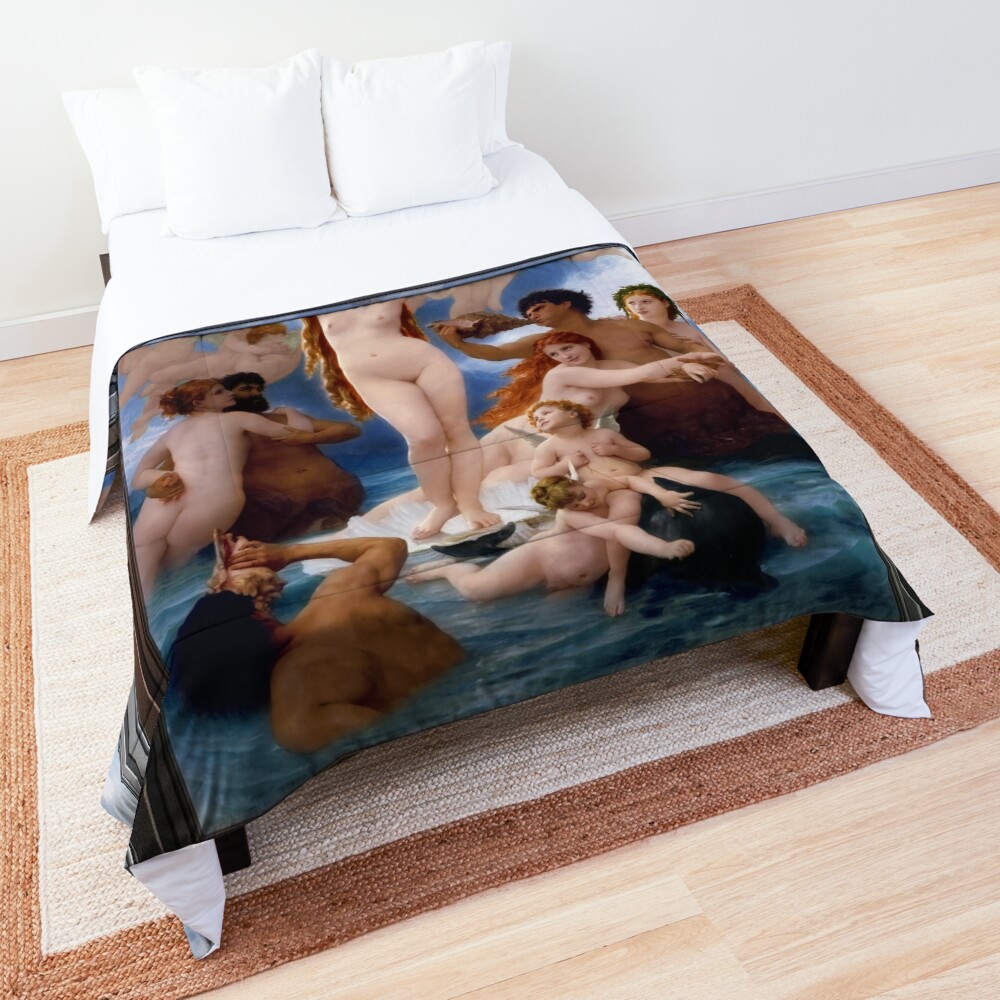
The Birth Of Venus c1879 by French Painter William-Adolphe Bouguereau (1825 – 1905), stands as a quintessential example of Academic art, embodying the principles of idealized beauty and technical mastery prevalent in mid-19th century France. This large-scale oil painting draws heavily from classical mythology, depicting the arrival of the goddess Venus (Aphrodite to the Greeks) upon the shores of Cyprus. malgrat això, Bouguereau’s interpretation is far removed from earlier depictions; instead of a dramatic or tempestuous emergence, he presents a scene of serene grace and gentle unfolding.
Taula de continguts
Estructura compositiva & Narrative Flow
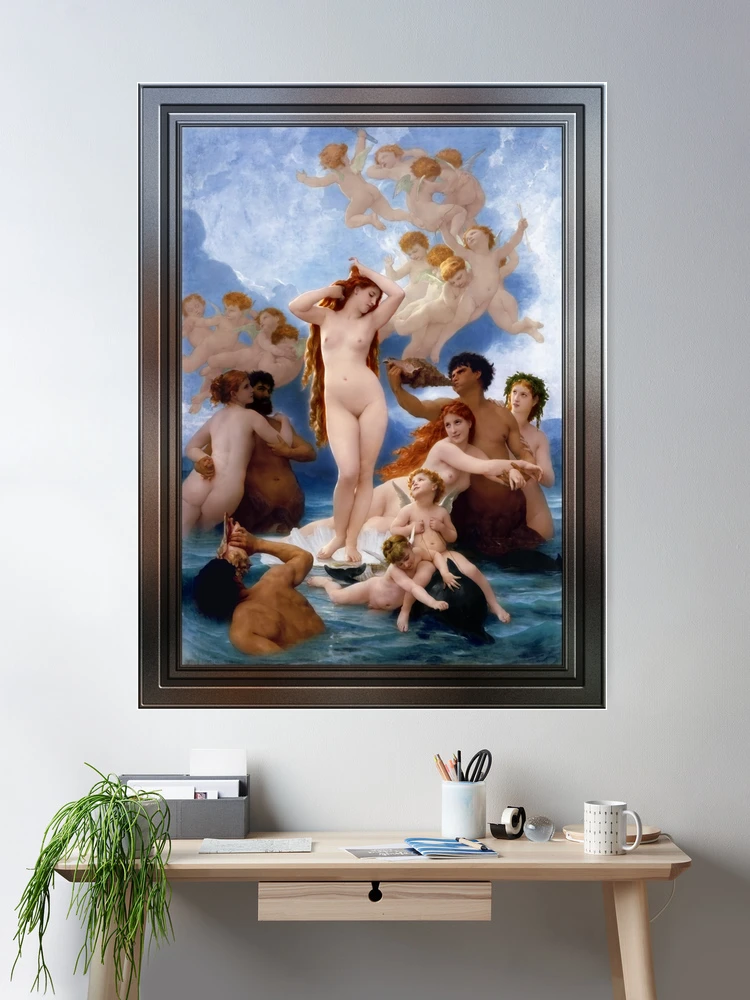
The composition is meticulously structured around Venus herself, positioned centrally within the canvas. She stands upon a massive scallop shell, which serves as her floating pedestal, gently approaching the shoreline. The arrangement isn’t haphazard; it’s carefully orchestrated to guide the viewer’s eye. To her left, a figure representing Zephyr, the west wind, and his consort Chloris, blow Venus towards the shore, their bodies intertwined in a dynamic pose that conveys movement and gentle force. On the right, a nymph, likely Hora, awaits with a floral garland, ready to welcome the goddess. The figures surrounding Venus are not merely decorative; they contribute to the narrative flow, illustrating the forces that brought her into being and the welcoming reception she receives.
Anatomical Precision & Idealized Form
Bouguereau’s reputation rested on his exceptional skill in depicting the human form with anatomical accuracy. En “The Birth of Venus,” this is evident in every curve and contour of the figures. The bodies are rendered with a smooth, almost porcelain-like quality, showcasing an idealized beauty that adheres to classical standards. There’s no attempt at realism in the sense of portraying imperfections; en canvi, Bouguereau elevates the human form to a state of perfect harmony and proportion. Venus’s pose is particularly striking – she stands with one foot slightly raised, creating a sense of poised elegance and effortless grace. The subtle modeling of her flesh, achieved through delicate gradations of light and shadow, further enhances the illusion of three-dimensionality and tactile realism.
Paleta de colors & Atmospheric Effects
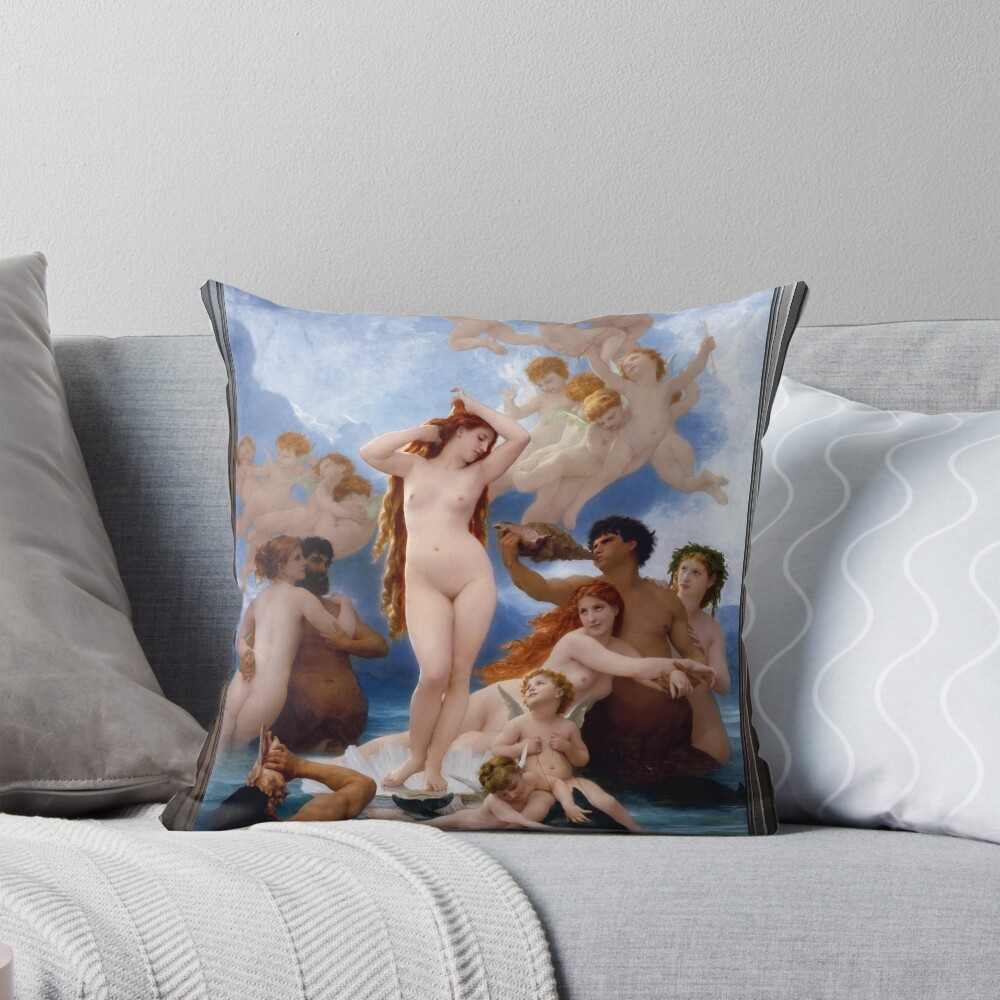
The color palette employed in “The Birth of Venus” is predominantly soft and harmonious. Pale blues and greens dominate the seascape, creating a sense of tranquility and ethereal beauty. The sky is rendered with swirling clouds, suggesting a gentle breeze and an atmosphere of otherworldly calm. Venus’s skin tones are luminous, contrasting beautifully with her flowing auburn hair, which cascades down her shoulders in loose waves. The warm hues of the flesh tones are balanced by the cooler colors of the surrounding environment, creating a visually pleasing contrast that draws attention to the central figure. Bouguereau masterfully uses light and shadow to create depth and volume, enhancing the overall sense of realism and beauty.
Simbolisme & Classical Allusions
Beyond its aesthetic appeal, “The Birth of Venus” is rich in symbolism and classical allusions. The scallop shell upon which Venus stands is a recurring motif associated with her birth in mythology – born from sea foam (Greek: aphros), hence her name Aphrodite. Zephyr and Chloris represent the gentle forces of nature that guide Venus’s arrival, while Hora symbolizes welcome and celebration. The floral garland offered by the nymph signifies beauty and fertility. These symbolic elements contribute to the painting’s overall meaning, reinforcing its connection to classical mythology and celebrating the goddess as a symbol of love, bellesa, i renovació.
Bouguereau’s Artistic Legacy & Academic Tradition
Bouguereau was a leading figure in the Academic art movement, which emphasized technical skill, idealized forms, and adherence to established artistic conventions. “The Birth of Venus” exemplifies these principles perfectly. The painting’s popularity during its time reflects the public’s appreciation for classical themes and the mastery of traditional techniques. While later generations would critique Academic art for its perceived lack of originality and emotional depth, Bouguereau’s work remains admired for its technical brilliance and enduring beauty. “The Birth of Venus” continues to captivate viewers with its serene atmosphere, idealized forms, and celebration of classical mythology. It stands as a testament to the power of artistic skill and the enduring appeal of timeless themes.
Cortesia de la biografia de l'artista Wikipedia.org
William Adolphe Bouguereau va néixer a La Rochelle, França, encès 30 de novembre 1825, en una família de comerciants de vi i oli d'oliva.[4] El fill de Théodore Bouguereau (nascut 1800) i Marie Bonnin (1804), coneguda com Adeline, William es va criar catòlic. Tenia un germà gran, Alfred, i una germana petita, Marie (coneguda com a Hanna), que va morir quan ella tenia set anys.
La família es va traslladar a Saint-Martin-de-Ré a 1832. Un altre germà va néixer a 1834, Kitty. A l'edat de 12, Bouguereau va anar a Mortagne per quedar-se amb el seu oncle Eugène, un sacerdot i va desenvolupar l'amor per la natura, religió i literatura.
En 1839, va ser enviat a estudiar per al sacerdoci a un col·legi catòlic de Pons. Aquí li va ensenyar a dibuixar i pintar Louis Sage, que havia estudiat amb Ingres. Bouguereau va deixar els estudis a contracor per tornar a la seva família, ara resideix a Bordeus.
Allà va conèixer un artista local, Charles Marionneau, i va començar al novembre a l'Escola Municipal de Dibuix i Pintura 1841. Bouguereau també va treballar com a auxiliar de botiga, pintar a mà litografies i fer petites pintures que es reproduïen mitjançant la cromolitografia.
Aviat va ser el millor alumne de la seva classe, i va decidir convertir-se en artista a París. Per finançar la mudança, va vendre retrats - 33 olis en tres mesos. Tots estaven sense signar i només se n'ha rastrejat un. Va arribar a París envellit 20 Al març 1846.
Igualtat abans de la mort (Igualtat abans de la mort), 1848, oli sobre llenç, 141 × 269 cm (55.5 × 105.9 dins), Museu d'Orsay, París. La igualtat és la primera gran pintura de Bouguereau, produït després de dos anys a l'École des Beaux-Arts de París a l'edat de 23.
Bouguereau es va convertir en estudiant a l'École des Beaux-Arts.[4] Per complementar la seva formació formal en dibuix, va assistir a disseccions anatòmiques i va estudiar vestuari històric i arqueologia.
Va ser admès a l'estudi de François-Édouard Picot, on va estudiar pintura a l'estil acadèmic. Dante i Virgili a l'infern (1850) va ser un dels primers exemples de les seves obres neoclàssiques.
La pintura acadèmica va situar el més alt estatus en temes històrics i mitològics, i Bouguereau decidit a guanyar el Prix de Rome, que li valdria una residència de tres anys a la Vila Mèdici de Roma, Itàlia, on a més de les lliçons formals va poder estudiar de primera mà els artistes renaixentistes i les seves obres mestres, així com el grec, Etrusc, i antiguitats romanes.
The Birth Of Venus is a retouched digital art old masters reproduction of a public domain image that is available online as a impressió de tela enrotllada.