

Datteren til Herodias Salome modtager Johannes Døberens hoved
In the haunting engraving titled “Herodias 'datter; Salome Receiving the Head of John the Baptist,” created by the British engraver Thomas Holloway in 1798, we witness a pivotal moment drawn from the Bible, specifically Matthew 14:10-11. This stark and dramatic scene captures the tragic culmination of the beheading of John the Baptist.
Holloway’s meticulous craftsmanship evokes the emotional intensity and weight of the moment, blending both the grotesque and the regal. The engraving portrays Salome, the daughter of Herodias, holding the severed head of the prophet John, an act prompted by her mother’s desire for vengeance.
Indholdsfortegnelse
The Main Subject and Theme
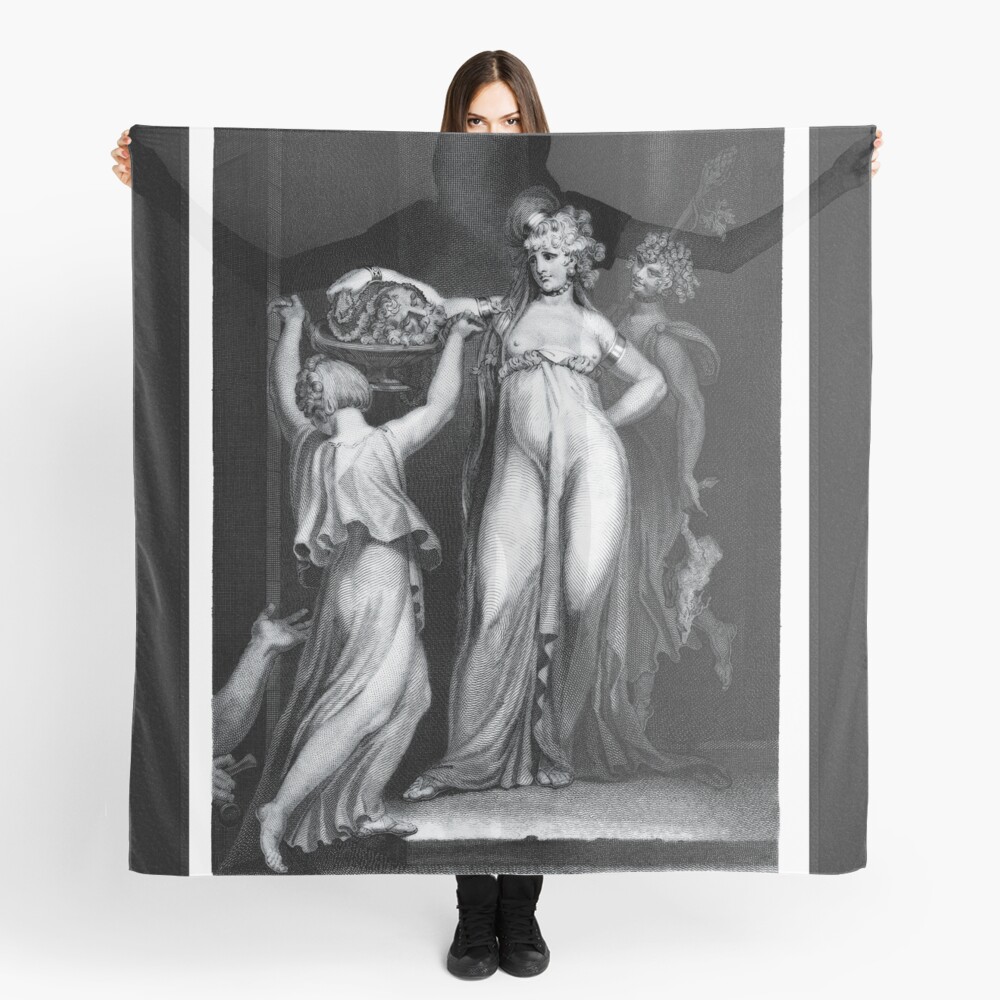
At the heart of Holloway’s engraving stands the female figure of Salome, her expression a curious mix of satisfaction and cold indifference as she receives the gruesome head of John the Baptist. Salome is depicted with long flowing hair, dressed in an elegant yet understated gown that flows to the floor. Hendes holdning er klar, almost regal, despite the grim nature of the event. Her delicate yet firm grasp of the dish holding the severed head of John reflects the disturbing calmness of the scene.
The head of John the Baptist is eerily centered in the image, placed on a silver platter. His features are still discernible, though his eyes are shut in death, adding to the horror of the scene. His decapitated head is an unsettling contrast to the elegant appearance of the figures around it. Behind Salome stands a smaller male figure who seems to assist in the ceremonial transfer of the head, while another figure, draped in a flowing robe, completes the scene. These secondary characters underscore the ritualistic aspect of the narrative and their submission to the will of Herodias.
The theme of the artwork revolves around the notion of vengeance and betrayal, as well as the imbalance of power. Salome’s act is one of obedience to her mother, yet there is a calculated detachment in her demeanor that speaks to the complex emotional and moral implications of her actions. Holloway portrays the moment with an intensity that transcends the physical violence of the scene, offering viewers a glimpse into the darker realms of human nature and the consequences of unchecked power.
Materialer og teknik
Thomas Holloway’s engraving is a masterwork of the intaglio process, a technique that involves incising an image onto a surface, which is then inked and pressed onto paper to create an impression. This traditional method allows for remarkable detail and tonal gradation, and Holloway’s skillful use of light and shadow brings the composition to life. The texture of the engraving, from the intricate folds of Salome’s gown to the delicate portrayal of the severed head, exhibits an exceptional level of detail characteristic of the neoclassical era. The depth of emotion is underscored by the expert contrast between light and dark, which emphasizes the drama of the moment.
The image is rendered in black and white, a stark yet powerful choice that reinforces the gravity of the scene. The contrast between the white of Salome’s skin and gown and the deep shadows of the background lends an almost theatrical quality to the image. This use of chiaroscuro – the contrast between light and dark – is particularly effective in drawing attention to the central figures, allowing their expressions and poses to dominate the composition.
Indstilling og objekter
The setting of the artwork is minimalistic but purposeful. The figures are placed in a semi-darkened space, hinting at a chamber or a palace, though no specific architectural details are given. This lack of specificity enhances the sense of timelessness, allowing the narrative to be universal rather than tied to a specific location or period. The dim lighting surrounding the figures suggests a scene shrouded in secrecy or ritual, contributing to the overall somber and foreboding mood of the piece.
The dish holding John the Baptist’s severed head is one of the most critical objects in the scene. Its presence is almost ceremonial, a stark juxtaposition of death and reverence. The head, severed from the body, conveys the brutality of the execution, yet the treatment of the dish elevates it to an almost sacred object, as though the head itself is now part of a macabre offering or tribute. The blood that would naturally accompany such an event is deliberately omitted from the image, making the scene even more surreal and unsettling. It is as though the severed head is merely a symbol of the act rather than a true representation of its grisly reality.
Stemning og følelsesmæssig påvirkning
The overall mood of the engraving is one of darkness, spænding, and moral ambiguity. The cold detachment of Salome, juxtaposed with the violent symbolism of John the Baptist’s death, creates a tense atmosphere. The lack of empathy displayed by Salome in this moment, while her expression reveals no sign of remorse or distress, calls attention to the inhumanity that often accompanies the pursuit of power. Holloway masterfully captures the eerie calmness of the scene, leaving the viewer with an unsettling sense of foreboding.
The engraved figures are imbued with a quiet stillness, but it is a stillness laced with an undercurrent of violence and intrigue. The sense of detachment from the horror of the act may provoke discomfort in the viewer, challenging them to consider the cost of vengeance and the complex nature of moral judgment. Salome’s role as the instrument of her mother’s revenge places her at the intersection of innocence and guilt, and Holloway’s work invites contemplation of the consequences of blind obedience.
Konklusion
Thomas Holloway’s “Herodias 'datter; Salome Receiving the Head of John the Baptist” is a striking representation of a dark and tragic biblical moment. Through his expert use of engraving techniques and the careful rendering of light and shadow, Holloway brings an age-old story to life with vivid detail and emotional intensity. The scene is both beautiful and horrifying, offering a compelling reflection on the themes of power, vengeance, and moral complexity.
Herodias 'datter; Salome Modtager Lederen af Johannes Døberen, Matthew 14:10-11 c1798 af den britiske graver Thomas Holloway (1748 – 1827), fra et maleri af den schweiziske maler Henry Fuseli (741 – 1825); kendt for at specialisere sig i at skabe kunstværker, der gik ned i det overnaturlige; som også var en dygtig tegner, Skribent og indehaver af stillingen som professor i maleri og keeper ved Royal Academy.
Denne gravering af Thomas Holloway er baseret på et maleri udført Henry Fuseli, der viser datter af kong Herodias, Salome accepterede det afskårne hoved af Johannes Døberen i paladsretten.
The Daughter of Herodias Salome Receiving the Head of John the Baptist is a retouched digital art old masters reproduction of a public domain image that is available for purchase online as a rullet lærred print.

Kunstnerbio fra Wikipedia.org
Holloway kom i lære hos en sælgraver ved navn Stent i en ung alder. Han fortsatte med at studere gravering på Royal Academy begyndende i 1773, i hvilket tidsrum han boede kl 11 Strande række, nær Karlspladsen, Hoxton, og udstillede pastelportrætter på Kunstnersamfundet i 1777.
Han boede senere i Orme House i Hampton, Edgefield, Norfolk, og Coltishall, Norfolk. Han blev hofgraver i 1792.
Født i Broad Street, London, han var den ældste søn af en købmand, der var en tidlig tilhænger af John Wesley; hans mors portræt blev malet af John Russell.
Han blev artikuleret til en sælgraver ved navn Stent, af hvem han hovedsagelig var ansat i udskæring af stålpynt. Efterfølgende deltog han på Royal Academy -skolerne, og i 1773 optrådte første gang på Royal Academy som udstiller af sæler og indgraverede perler. Senere og op til 1792 han bidrog med miniaturer og portrætter i olier og farveblyanter.
Holloways hovedretning var stregravering. Hans tidligste udgivne plader var små portrætter til blade, hovedsagelig af ikke -konformistiske ministre. Senere foretog han en udgave af Johann Kaspar Lavaters essays om fysiognomi, oversat af Henry Hunter, 5 bind., 1789–98.
Værket blev illustreret med ca. 800 plader udført af Holloway selv, Francesco Bartolozzi, William Blake, og andre gravere, under ledelse af Henry Fuseli.
Hans portrætter omfattede dem af Charles Howard, 11hertug af Norfolk, efter Robert Edge Pine, og af Timothy Priestley, 1792, og Richard Price, after Benjamin West, 1793.
He was also employed on the illustrations to John Boydell’s Shakespeare, Robert Bowyer’s History of England, and Bell’s British Theatre.
Holloway is noted for his arduous engravings of cartoons by Raphael at Windsor Castle in 1800, on which he worked for 30 flere år. This ambitious project was a financial failure. The cartoons had already been engraved by Nicolas Dorigny.
Through the influence of Benjamin West, Holloway fik tilladelse til at indgravere i stor skala de syv Raphael -tegnefilm i Windsor, og til denne opgave blev resten af hans liv helliget.
Han engagerede som assistenter sine tidligere elever, R. Slann og T. S. Webb, som hver giftede sig med en niece af Holloway, sammen med Joseph Thomson, en kunstner, der døde ung. De arbejdede sammen på Windsor indtil 1814, da tegnerne blev flyttet til Hampton Court.
Ved færdiggørelsen af den første plade, Paulus forkyndte i Athen, i 1806, kongen udpegede Holloway til sin historiske graver; Sekundet, Christ’s Charge to Peter, appeared in 1810; the third, The Death of Ananias, i 1816; and the fourth, Elymas, i 1820.
In that year all the preliminary drawings were finished, and Holloway retired with his associates to Edgefield in Norfolk, and later to Coltishall, near Norwich, to pursue their work on the plates, of which the fifth, The Miraculous Draught of Fishes, was issued in 1824. This was the last that Holloway lived to complete.
The sixth plate, Paul and Barnabas at Lystra, was almost finished in 1827, and the seventh, Peter and John at the Beautiful Gate, begun.
Førstnævnte dukkede op året efter, 1828, men færdiggørelsen af sidstnævnte blev forsinket indtil 1839, da den blev udgivet med en dedikation til dronningen, and like the rest bore the names of Holloway, Slann, and Webb as the engravers and publishers.