

Julio Zesarren heriotza Erromako Senatuko grabatuan
The Death Of Julius Caesar In The Roman Senate Engraving by British Engraver James Charles Armytage (1802 – 1897); after a painting by French Painter Jean-Léon Gérôme (1824 – 1904). James is known to have created over 200 engravings during his career.
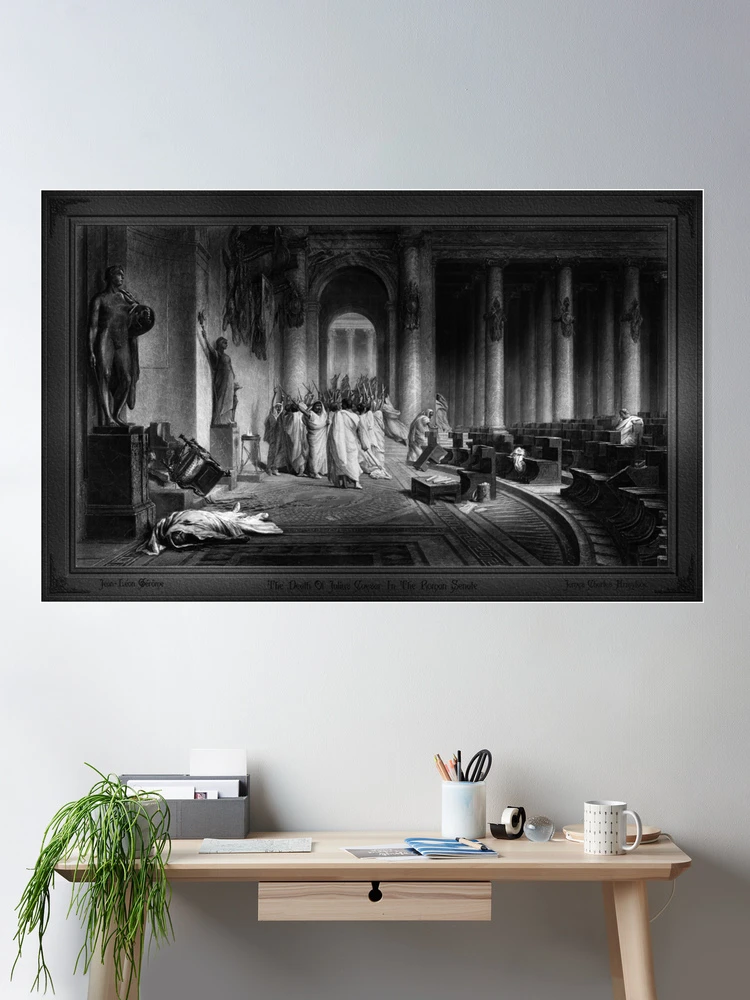
The Death Of Julius Caesar In The Roman Senate is a dramatic and powerful scene that depicts the events of that faithful day on March 15, 44 K.a. Erromako Historian; Erromako Senatuaren Etxean dagoenean, Julio Zesar hil dute 60 conspirators that, led by Marcus Junius Brutus and Gaius Cassius Longinus.
The assassins involved in Caesar’s death have all gathered together cheering his murder, as they flail their swords in the air after stabbing and hacking him to death; while in the background we see many of the other senators of the Roman senate fleeing in fear of their own lives.
With the chair in which Caesar sat toppled over on the steps, we see his bloody body laying on the floor and a trail of his blood being carried on the sandals of his gleeful murders.
The Death Of Julius Caesar In The Roman Senate Engraving is a retouched digital art reproduction of a public domain image.
Hemendik eratorritako informazioaren azpian Wikipedia
Jean-Leon Gerome (11 Maiatza 1824 – 10 Urtarrila 1904) frantziar margolari eta eskultorea izan zen, gaur egun akademizismo gisa ezagutzen den estiloan. Bere margolanak hain erreproduzitu ziren, non “dudarik gabe, munduko artista bizirik ospetsuena 1880rako.”[1] Bere obraren zabalerak pintura historikoa barne hartzen zuen, Greziar mitologia, Orientalismoa, erretratuak, eta beste gai batzuk, pinturaren tradizio akademikoa goren artistiko batera eramanez. Garai akademiko honetako margolari garrantzitsuenetakotzat hartzen da.
In 1840 Parisera joan zen, bertan ikasi zuen Paul Delarocheren eskutik, harekin batera Italiara joan zen 1843. Florentzia bisitatu zuen, Erroma, Vatikanoa eta Ponpeia. Parisera itzuli zenean 1844, Delarocheko ikasle asko bezala, Charles Gleyreren tailerrean sartu zen eta han ikasi zuen denbora labur batez. Ondoren, École des Beaux-Arts-era joan zen. In 1846 Prix de Rome ospetsuan sartzen saiatu zen, baina azken fasean huts egin zuen bere figura-marrazketa nahikoa ez zelako.

Bere koadroa Oilarren borroka (1846) Ariketa akademikoa da, gizon gazte biluzi bat eta oso arropa meheko emakume gazte bat bi oilar borrokan irudikatzen dituena., Napoliko badia atzealdean duela. Margolan hau Parisko Salonera bidali zuen 1847, non hirugarren mailako domina lortu zuen. Lan hau Gleyreren estudiotik sortu zen Neo-Grec mugimenduaren adierazgarri gisa ikusi zen. (tartean, Henri-Pierre Picou eta Jean-Louis Hamon), eta Théophile Gautier frantses eragin handiko kritikariak defendatu zuen, haren berrikuspenak Gérôme ospetsu egin zuen eta modu eraginkorrean abiarazi zuen bere ibilbidea.
Gérôme abandoned his dream of winning the Prix de Rome and took advantage of his sudden success. His paintings The Virgin, the Infant Jesus and Saint John and Anacreon, Bacchus and Eros took a second-class medal at the Paris Salon in 1848. In 1849, he produced the paintings Michelangelo (also called In his Studio) and A Portrait of a Lady.
In 1851, he decorated a vase later offered by Emperor Napoleon III of France to Prince Albert, now part of the Royal Collection at St. James’s Palace, Londres. He exhibited Greek Interior, Souvenir d’Italie, Bacchus and Love, Drunk in 1851; Paestum in 1852; and An Idyll in 1853
In 1852, Gérôme received a commission to paint a large mural of an allegorical subject of his choosing. The Age of Augustus, the Birth of Christ, which would combine the birth of Christ with conquered nations paying homage to Augustus, may have been intended to flatter Napoleon III, whose government commissioned the mural and who was identified as a “new Augustus.
In 1854, beste enkargu garrantzitsu bat osatu zuen, San Kapera apaintzen. Jeronimo San elizan. Séverin Parisen. Bere azken jaunartzea San St. Kapera honetan Jeromek Ingresen eskolak bere erlijio lanetan izan zuen eragina islatzen du; eta barruan 1855 lagundu zuen Pifferaro, Artzaina, eta Augustoren Aroa, the Birth of Christ, to the Universal Exhibition; but it was the modest painting Recreation in a Russian Camp that garnered the most attention .