

Bás Julius Caesar i nGreamú Sheanad na Róimhe
Tá an Death Of Julius Caesar In The Roman Senate Engraving by British Engraver James Charles Armytage (1802 – 1897); after a painting by French Painter Jean-Léon Gérôme (1824 – 1904). James is known to have created over 200 engravings during his career.
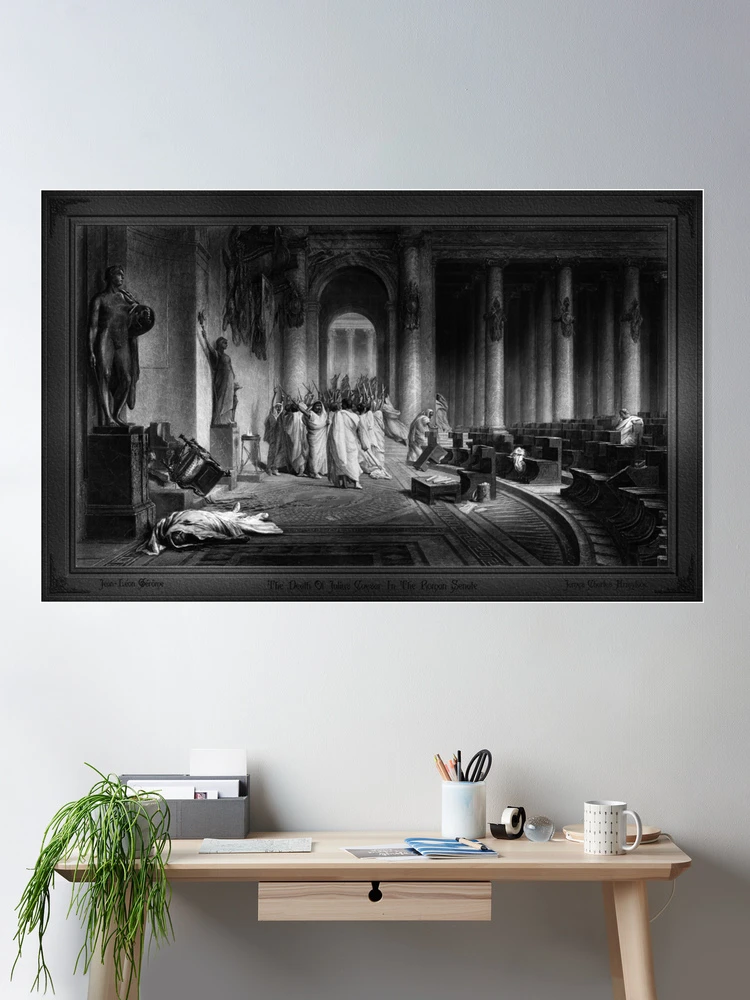
The Death Of Julius Caesar In The Roman Senate is a dramatic and powerful scene that depicts the events of that faithful day on March 15, 44 B.C. in Roman History; when in the Roman Senate House, Julius Caesar is murdered by 60 conspirators that, led by Marcus Junius Brutus and Gaius Cassius Longinus.
The assassins involved in Caesar’s death have all gathered together cheering his murder, as they flail their swords in the air after stabbing and hacking him to death; while in the background we see many of the other senators of the Roman senate fleeing in fear of their own lives.
With the chair in which Caesar sat toppled over on the steps, we see his bloody body laying on the floor and a trail of his blood being carried on the sandals of his gleeful murders.
The Death Of Julius Caesar In The Roman Senate Engraving is a retouched digital art reproduction of a public domain image.
Below Info Derived From Wikipedia
Jean-Leon Gerome (11 Bealtaine 1824 - 10 Eanáir 1904) péintéir agus dealbhóir Francach a bhí ann sa stíl ar a dtugtar an t-acadamhlacht anois. Bhí a chuid saothar péintéireachta chomh forleathan is a bhí sé “d’fhéadfaí a mhaíomh gurb é an t-ealaíontóir beo is cáiliúla ar domhan faoi 1880.”[1] Áiríodh péintéireacht stairiúil i raon a chuid oeuvre, miotaseolaíocht na Gréige, Orientalism, portráidí, agus ábhair eile, ag tabhairt an traidisiúin phéinteála acadúil go barr ealaíonta. Meastar go bhfuil sé ar cheann de na péintéirí is tábhachtaí ón tréimhse acadúil seo.
I 1840 chuaigh sé go Páras, áit a ndearna sé staidéar faoi Paul Delaroche, a raibh sé in éineacht leis go dtí an Iodáil i 1843. Thug sé cuairt ar Fhlórans, An Róimh, na Vatacáine agus Pompeii. Ar fhilleadh dó go Páras i 1844, like many students of Delaroche, he joined the atelier of Charles Gleyre and studied there for a brief time. He then attended the École des Beaux-Arts. I 1846 he tried to enter the prestigious Prix de Rome, but failed in the final stage because his figure drawing was inadequate.

His painting The Cock Fight (1846) is an academic exercise depicting a nude young man and a very thinly draped young woman with two fighting cocks, with the Bay of Naples in the background. He sent this painting to the Paris Salon of 1847, where it gained him a third-class medal. This work was seen as the epitome of the Neo-Grec movement that had formed out of Gleyre’s studio (including Henri-Pierre Picou and Jean-Louis Hamon), and was championed by the influential French critic Théophile Gautier, whose review made Gérôme famous and effectively launched his career.
Gérôme abandoned his dream of winning the Prix de Rome and took advantage of his sudden success. His paintings The Virgin, the Infant Jesus and Saint John and Anacreon, Bacchus and Eros took a second-class medal at the Paris Salon in 1848. I 1849, he produced the paintings Michelangelo (also called In his Studio) and A Portrait of a Lady.
I 1851, he decorated a vase later offered by Emperor Napoleon III of France to Prince Albert, now part of the Royal Collection at St. James’s Palace, Londain. He exhibited Greek Interior, Souvenir d’Italie, Bacchus and Love, Drunk in 1851; Paestum in 1852; and An Idyll in 1853
I 1852, Fuair Gérôme coimisiún chun múrmhaisiú mór a phéinteáil d’ábhar ailgéarach dá rogha féin. Aois Augustus, Breith Chríost, rud a chomhcheangail breith Chríost le náisiúin chonctha ag tabhairt ómóis do Ágastas, b'fhéidir go raibh sé i gceist go ndéanfadh sé magadh ar Napoleon III, ar choimisiúnaigh a rialtas an múrmhaisiú agus cé a aithníodh mar a “Augustus nua.
I 1854, he completed another important commission, decorating the Chapel of St. Jerome in the church of St. Séverin in Paris. His Last Communion of St. Jerome in this chapel reflects the influence of the school of Ingres on his religious works; agus i 1855 he contributed Pifferaro, Shepherd, and The Age of Augustus, Breith Chríost, to the Universal Exhibition; but it was the modest painting Recreation in a Russian Camp that garnered the most attention .