

Bruadar Naomh. Ioseph
Bruadar Naomh. Eòsaph c1773-74 leis a ’pheantair Gearmailteach Anton Raphael Mengs (1728 – 1779); peantair ainmeil den stoidhle Rococo a bha cuideachd mar phàirt de ghluasad tòiseachaidh an stoidhle peantaidh Neoclassical.
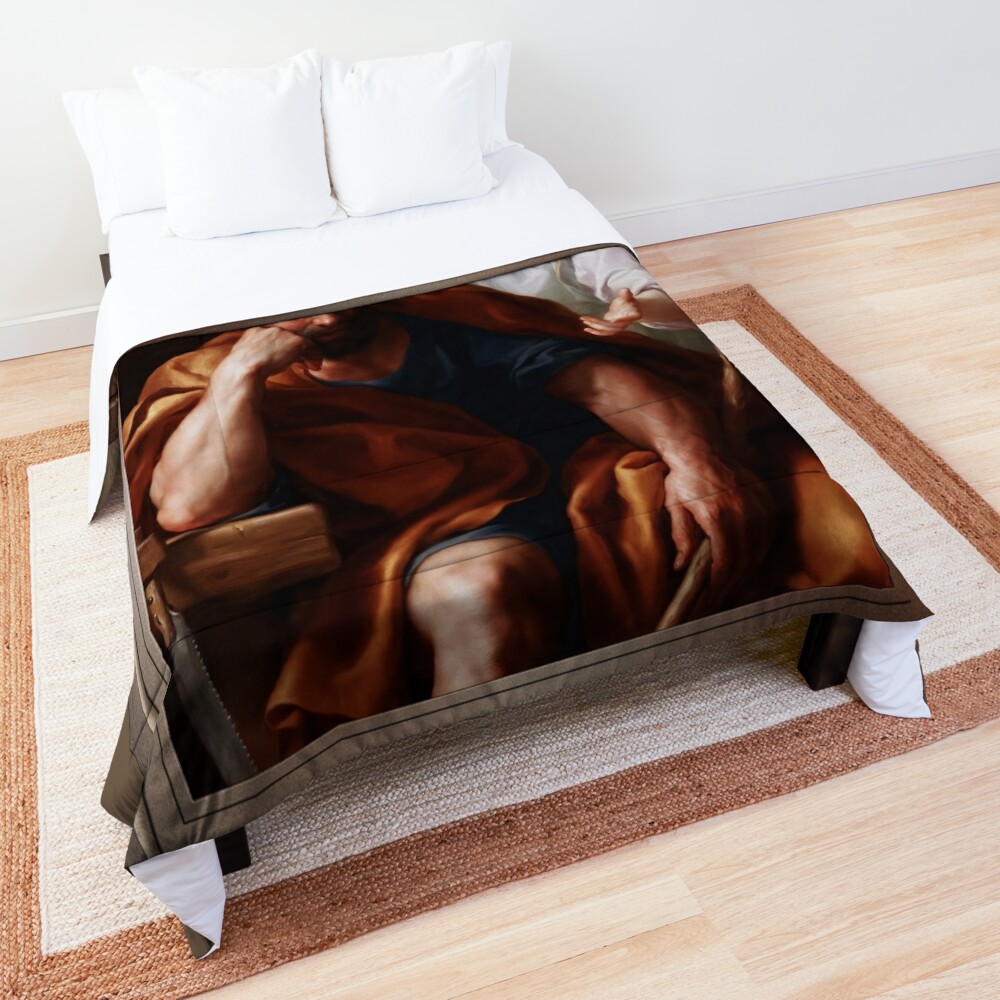
A painting of St. Joseph sitting on a chair by a table dreaming, while an Aingeal appears and guides him in to what must be done.
Bruadar Naomh. Joseph is a retouched digital art old masters reproduction of a public domain image that is available for purchase online as a clò-bhualadh canabhas rollaichte.
Fiosrachadh gu h-ìosal bho Wikipedia.org
Mengs was born in 1728 at Ústí nad Labem (German: Aussig) in the Kingdom of Bohemia, the son of Ismael Mengs [da], a Danish painter who eventually established himself at Dresden, where the court of Saxonian-Polish electors and kings was. His older sister, Therese Maron, bha e na pheantair cuideachd, as was his younger sister, Julia.
His and Therese’s births in Bohemia were mere coincidence. Their mother was not their father’s wife; Ismael carried on a years-long affair with the family’s housekeeper, Charlotte Bormann. In an effort to conceal the births of two illegitimate children, Ismael took Charlotte, under the pretext of “vacations”, to the nearest bigger town abroad, Ústí nad Labem (90 km upstream of the Elbe River).
At least in Anton’s case, Ismael Mengs took his baby and Charlotte back to Dresden a few weeks after the birth. There they lived for the next 13 bliadhna. Ann an 1741 Ismael moved his family from Dresden to Rome.
Ann an 1749 Anton Raphael Mengs was appointed first painter to Frederick Augustus, elector of Saxony, but this did not prevent him from continuing to spend much of his time in Rome. There he married Margarita Guazzi, who had sat for him as a model in 1748. He converted to Catholicism, agus a-steach 1754 he became director of the Vatican painting school.
His fresco painting Parnassus at Villa Albani gained him a reputation as a master painter.
Ann an 1749 Mengs accepted a commission from the Duke of Northumberland to make a copy, in oil on canvas, of Raphael’s fresco The School of Athens for his London home. Executed in 1752–5, Mengs’s painting is full-sized, but he adapted the composition to a rectangular format and added other figures.