

De luisteraar
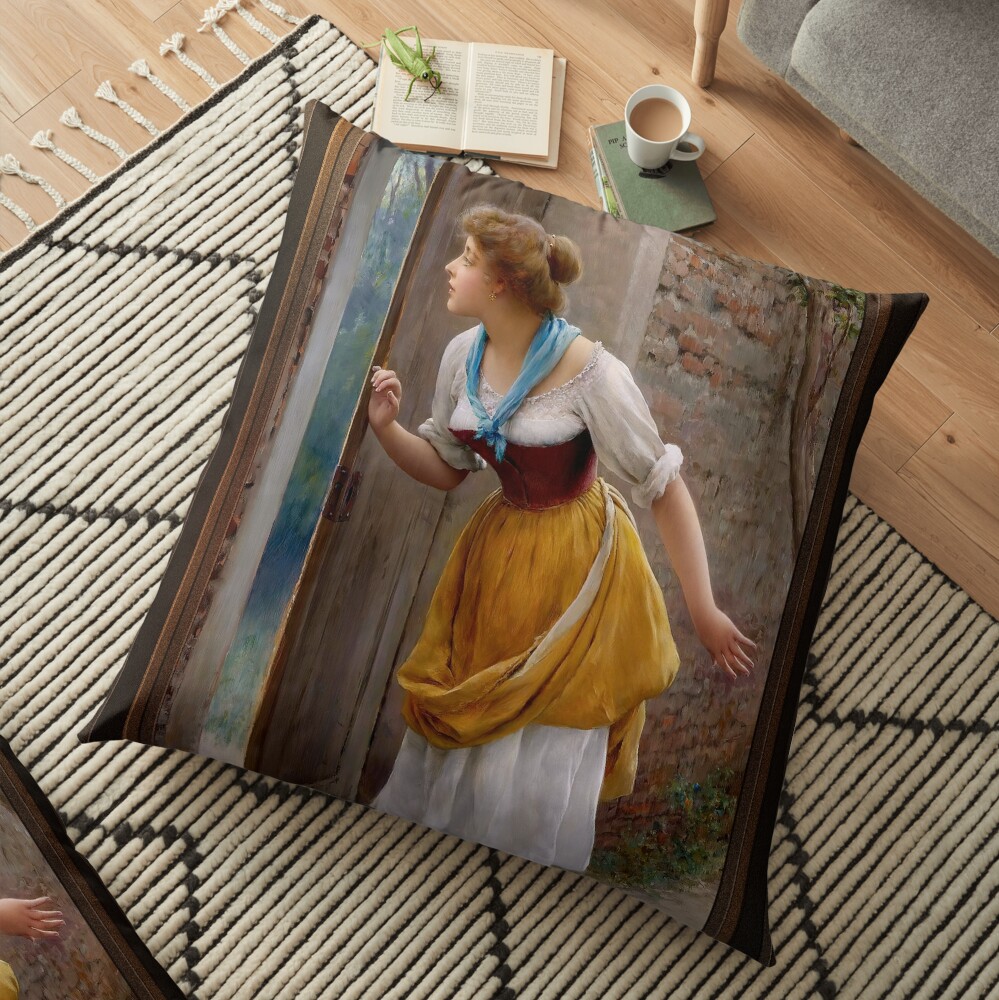
“De luisteraar,” gemaakt in 1906 van de Italiaanse schilder Eugen von Blaas (1843–1931), is een opvallende afbeelding van een jonge vrouw die gevangen zit in een moment van nieuwsgierigheid en intriges. Het werk illustreert de vaardigheid van de kunstenaar in het uitbeelden van zowel de onschuld als de subtiele emotionele complexiteit van zijn onderwerpen.
Tegen een rustieke achtergrond van gedempte aardetinten, het schilderij is een elegante mix van realisme en een intiem verhaal. De jonge vrouw, met haar hoofd gekeerd naar een gedeeltelijk geopende deur, kijkt met gerichte aandacht, alsof ze naar iets aan de andere kant luistert. De compositie legt een rustig maar spannend moment vast, perfect passend bij het genre van de genreschilderkunst waar Von Blaas bekend om staat.
Inhoudsopgave
Hoofdonderwerp
Centraal in dit werk staat de jonge vrouw, haar delicate vorm omlijst door de verweerde deuropening. Ze is gekleed in een traditionele Europese boerenoutfit, een combinatie van aardetinten die scherp contrasteert met de levendigheid van haar opvallende blauwe sjaal en zachte witte blouse. De kleding van de vrouw, haar lijfje strak en karmozijnrood, rok vloeiend met een gele tint, doordrenkt haar met zowel nederigheid als gratie.
De zachte plooien van haar rok en schort suggereren dat ze waarschijnlijk een huishoudster is of een figuur met een bescheiden sociale status. Haar houding is er één van verwachting, haar lichaam boog zich naar de deur, een lichte kanteling van het hoofd die de indruk wekt aandachtig te luisteren naar iets dat niet bedoeld is om te horen.
Haar hand rust voorzichtig op de deur, alsof ze op het punt staat hem verder open te trekken, but remains suspended in a moment of indecision. The figure is set in motion by her movement and the life-like quality that von Blaas has captured. The gaze of the woman is directed just beyond the edge of the door, her expression caught between curiosity and hesitation, her eyes seemingly searching for clues, seeking the source of whatever caught her attention. The focus on her facial expression adds to the intrigue, leaving the viewer wondering what she has overheard or glimpsed.
Objecten en details
The woman’s presence in the scene is made even more striking by the surrounding environment. The setting is a narrow, rustic alleyway or courtyard, evident from the rough-hewn stonework and the rich texture of the brick wall behind her. The architecture and terrain of this backdrop reveal much about the time period and social setting. The wall is aged and weathered, lending the scene a sense of history, as though this moment of eavesdropping is taking place within a space that has witnessed many such private encounters before.
The door itself is also a key element in the composition, its wood dark and aged, showing visible signs of wear. A rusty metal handle contrasts with the rich textures of the bricks, bringing a level of realism to the artwork. The woman’s hand is almost in direct contact with this handle, emphasizing the fragility of the moment, she stands on the cusp of something unknown, a boundary between what is public and private.
Natuur, te, plays an essential role in the painting. In the upper left corner, a small tree or shrub grows beside the stone wall, a gentle hint of greenery that adds a touch of life to an otherwise neutral-toned environment. The plants, though sparse, help to temper the rigid, industrial feel of the brickwork, bringing warmth and organic balance to the composition.
Stijl en techniek
Eugen von Blaas was known for his meticulous attention to detail and his ability to create paintings that seemed to almost breathe with life. “De luisteraar” is a prime example of this. The artist’s technique is deeply rooted in the realist tradition, with an emphasis on natural light, textuur, and the precise rendering of human figures. The folds of the woman’s skirt and the fine fabric of her blouse are painted with great care, capturing every nuance of material and texture. Het zachte lichtspel over haar gezicht en de schaduwen rond de deur geven diepte en dimensie, het creëren van een geloofwaardige driedimensionale ruimte.
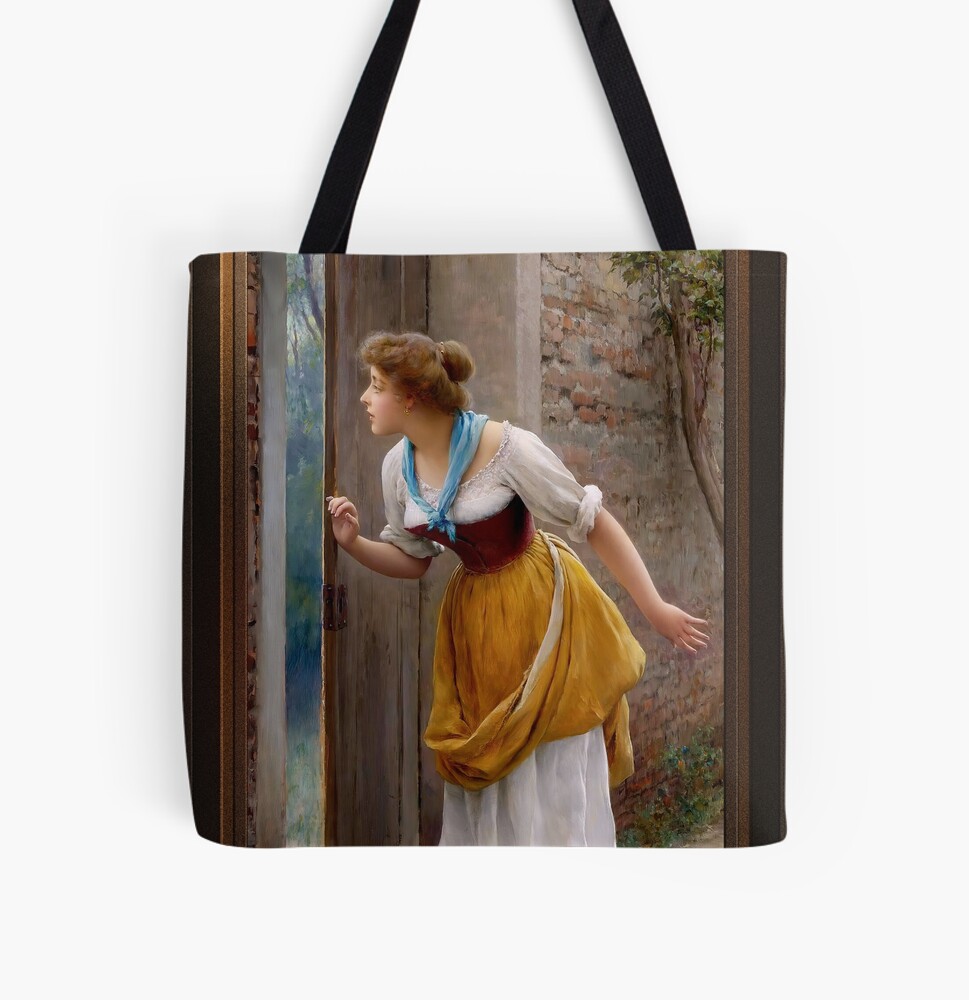
De kleuren in dit stuk zijn warm en toch ingetogen, waarbij de aardetinten van de bakstenen en de kleding van de vrouw een harmonieus palet vormen. De zachte geel- en wittinten in haar kleding contrasteren met de meer gedempte kleuren van de achtergrond, het creëren van een brandpunt in de figuur van de vrouw.
De blauwe sjaal, om haar nek gebonden, dient als opvallend visueel accent, vestigt de aandacht op haar gezicht en voegt een gevoel van zachtheid en rust toe. Dit kleurcontrast versterkt de algehele emotionele toon van het werk, wat bijdraagt aan de sfeer van stille spanning.
Het penseelwerk in “De luisteraar” is zowel nauwkeurig als vloeiend. De manier waarop de kunstenaar met texturen omgaat, van de rustieke bakstenen tot de delicate plooien van stof, is ongelooflijk gedetailleerd. Het gezicht van de vrouw wordt weergegeven met een zachtheid die de kijker uitnodigt om zich emotioneel met haar te verbinden, met de nadruk op het realisme dat Von Blaas probeerde te bereiken. Het schilderij heeft een fotografische kwaliteit, een vluchtig moment met zo'n helderheid vastleggen dat het bijna lijkt alsof het een echt tafereel had kunnen zijn waar de kunstenaar getuige van was.
Thema en stemming
Het thema van “De luisteraar” is er een van nieuwsgierigheid, spanning, en misschien zelfs geheimhouding. De acties van de vrouw impliceren een gevoel van afluisteren – iets dat verboden of privé is en dat ze probeert bloot te leggen. Dit gevoel van voyeurisme voegt een element van psychologische diepgang toe aan het stuk, de kijker meeslepen in een verhaal van verborgen kennis en de gevolgen van het ontdekken van iets dat nooit bedoeld was om gehoord te worden.
De sfeer van het schilderij is er een van stille spanning. Terwijl er geen sprake is van openlijke actie, de lichaamstaal van de vrouw en haar blik creëren een gevoel van spanning. Er is een impliciete suggestie dat er zich net achter de deur iets ontvouwt, iets dat de vrouw niet volledig kan zien, maar wordt er toch toe aangetrokken. De gedempte achtergrond en de stilte van het moment verhogen de spanning, waardoor de kijker zijn eigen interpretatie op de scène kan projecteren.
Conclusie
Eugen von Blaas’s “De luisteraar” is een meesterlijke weergave van een vluchtig moment in de tijd, skillfully capturing the emotional nuances of curiosity and the tension between public and private spaces. The realism and attention to detail invite the viewer to contemplate not only the physical setting but also the internal world of the subject. In its quiet suspense, the painting speaks to universal themes of human nature—our desire to know what lies beyond the threshold, and the complex emotions that come with uncovering secrets not meant for our ears.
Dit is een remastered reproductie van digitale kunst oude meesters van een openbaar domeinafbeelding dat beschikbaar is als a canvas print online.
Deze digitale kunstcreatie, zoals bij alle kunstwerken die op de Xzendor7-website te vinden zijn, is deze online te koop in verschillende materiaalformaten, waaronder canvasafdrukken, acryl afdrukken, metalen prints, hout prints, ingelijste afdrukken, affiches, en zoals opgerolde canvasafdrukken in verschillende maten uit 12 inch tot 72 inch, afhankelijk van de grootte van het daadwerkelijke kunstwerk en de print on demand-winkel waar je de kunst wilt kopen.
Het artwork is ook beschikbaar op een breed scala aan heren- en dameskleding, mokken, bakken, sjaals, notitieboekjes en tijdschriften en veel woondecoratieproducten.
Bio -kunstenaar
Info hieronder afgeleid van Wikipedia.org
Hij werd geboren in Albano, in de buurt van Rome, aan een Tiroolse vader en Italiaanse moeder. Zijn vader Karl, ook een schilder, was zijn leraar. Zijn moeder, Agnesina Auda, was een welgestelde Romeinse vrouw. Het gezin verhuisde naar Venetië toen Karl professor werd aan de Academie van Venetië. Hij schilderde vaak taferelen in Venetië, maar ook portretten en religieuze schilderijen.
Onder zijn werken zijn De huwelijksvorm in de sacristie; Bingo in Campielo in Venetië; Een poppenscène in een school; en La Ninetta. De kunstcriticus Luigi Chirtani, toen het schilderij werd tentoongesteld in de Mostra Nazionale di Venezia, beschreef het als mooi, vleiend, zeer, gestreeld, schoongemaakt, gepolijst, wasvrouw in een schilderij van Mr. Blaas, de favoriete portrettist van grote Venetiaanse aristocraten, gekleed in galasatijnen, glanzende sieraden, kapsels van de rijken.
Zijn kleurrijke en nogal theatrale periodebeelden van de Venetiaanse samenleving, bijv. Op het balkon (1877; Prive collectie), waren heel anders in vergelijking met delicate pastels en etsen van de binnenplaatsen, balkon en grachten van het moderne Venetië.
Eugene de Blaas’ schilderijen werden tentoongesteld in de Koninklijke Academie, Maatschappij voor Schone Kunsten, Nieuwe galerij en Arthur Tooth and Sons Gallery in Londen, en ook in de Walker Art Gallery in Liverpool