

The Eavesdropper
“The Eavesdropper,” skapad i 1906 by the Italian painter Eugen von Blaas (1843–1931), is a striking depiction of a young woman caught in a moment of curiosity and intrigue. The work exemplifies the artist’s skill in portraying both the innocence and subtle emotional complexity of his subjects.
Set against a rustic background of muted earth tones, the painting is an elegant blend of realism and intimate narrative. Den unga kvinnan, with her head turned towards a partially opened door, gazes with focused attention, as though she is listening to something on the other side. The composition captures a quiet yet suspenseful moment, perfectly suited to the genre of genre painting for which von Blaas is renowned.
Innehållsförteckning
Huvudämne
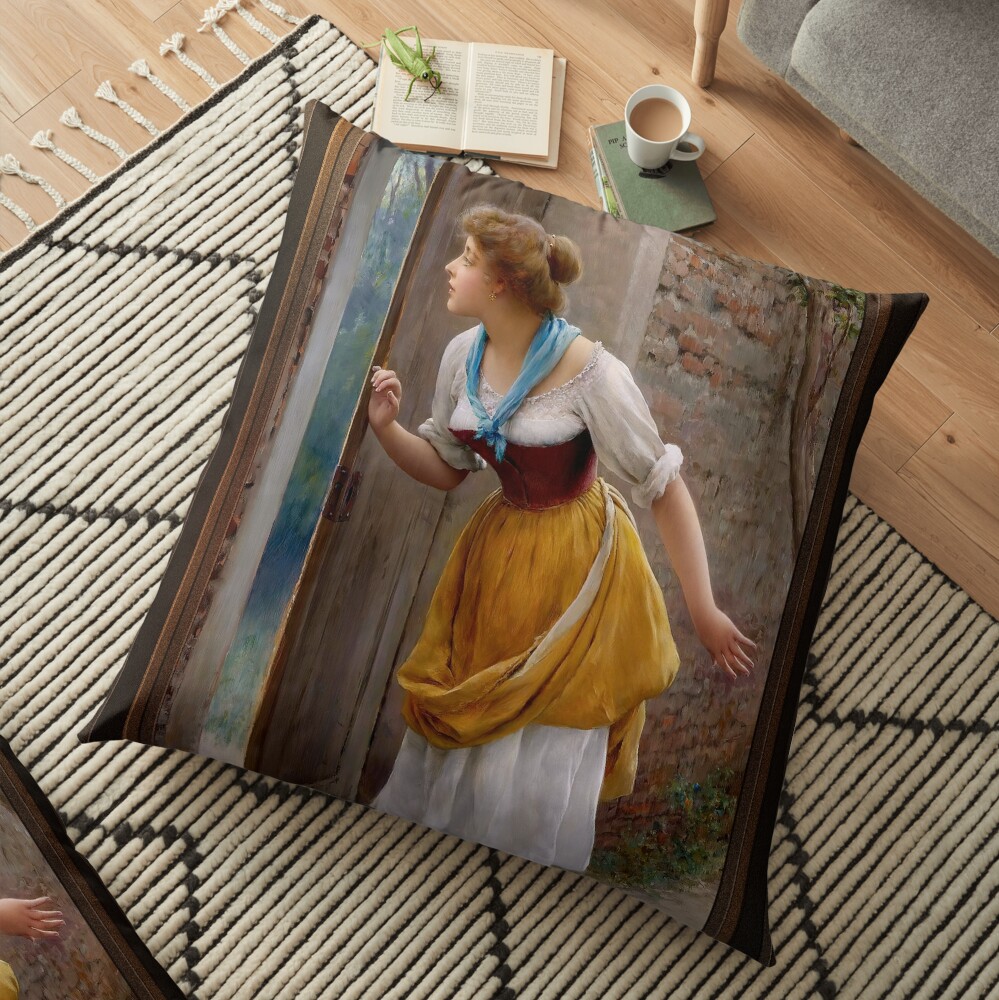
At the heart of this work is the young woman, her delicate form framed by the weathered doorway. She is dressed in a traditional European peasant outfit, a combination of earthy tones that contrasts sharply with the vibrancy of her striking blue scarf and soft white blouse. Kvinnans klädsel, her bodice tight and crimson, skirt flowing with a yellow hue, imbues her with both humility and grace.
The soft folds of her skirt and apron suggest that she is likely a domestic worker or a figure of modest social standing. Her posture is one of anticipation, her body angled towards the door, a slight tilt of the head giving the impression of listening intently to something she is not meant to hear.
Her hand is poised delicately on the door, as if she’s about to pull it open wider, but remains suspended in a moment of indecision. The figure is set in motion by her movement and the life-like quality that von Blaas has captured. The gaze of the woman is directed just beyond the edge of the door, her expression caught between curiosity and hesitation, her eyes seemingly searching for clues, seeking the source of whatever caught her attention. The focus on her facial expression adds to the intrigue, leaving the viewer wondering what she has overheard or glimpsed.
Föremål och detaljer
The woman’s presence in the scene is made even more striking by the surrounding environment. The setting is a narrow, rustic alleyway or courtyard, evident from the rough-hewn stonework and the rich texture of the brick wall behind her. The architecture and terrain of this backdrop reveal much about the time period and social setting. The wall is aged and weathered, lending the scene a sense of history, as though this moment of eavesdropping is taking place within a space that has witnessed many such private encounters before.
The door itself is also a key element in the composition, its wood dark and aged, showing visible signs of wear. A rusty metal handle contrasts with the rich textures of the bricks, bringing a level of realism to the artwork. The woman’s hand is almost in direct contact with this handle, emphasizing the fragility of the moment, she stands on the cusp of something unknown, a boundary between what is public and private.
Natur, för, plays an essential role in the painting. In the upper left corner, a small tree or shrub grows beside the stone wall, a gentle hint of greenery that adds a touch of life to an otherwise neutral-toned environment. Växterna, though sparse, help to temper the rigid, industrial feel of the brickwork, bringing warmth and organic balance to the composition.
Stil och teknik
Eugen von Blaas was known for his meticulous attention to detail and his ability to create paintings that seemed to almost breathe with life. “The Eavesdropper” is a prime example of this. The artist’s technique is deeply rooted in the realist tradition, with an emphasis on natural light, textur, and the precise rendering of human figures. The folds of the woman’s skirt and the fine fabric of her blouse are painted with great care, capturing every nuance of material and texture. The soft play of light across her face and the shadows around the door give depth and dimension, creating a believable three-dimensional space.
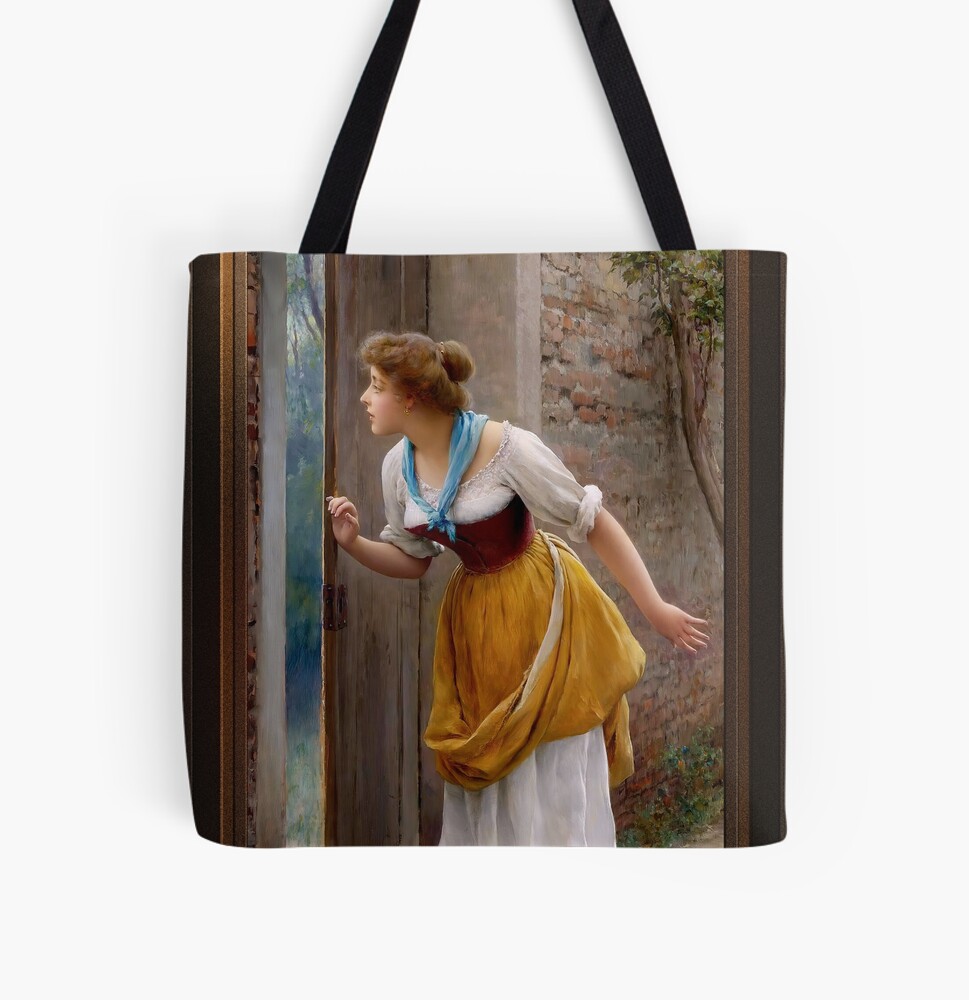
The colors in this piece are warm yet restrained, with the earthy tones of the bricks and the woman’s clothing forming a harmonious palette. The soft yellows and whites in her attire contrast with the more muted colors of the background, creating a focal point in the figure of the woman.
The blue scarf, tied around her neck, serves as a striking visual accent, drawing attention to her face and adding a sense of softness and tranquility. This color contrast enhances the overall emotional tone of the work, contributing to the mood of quiet suspense.
The brushwork in “The Eavesdropper” is both precise and fluid. The artist’s handling of textures, from the rustic bricks to the delicate folds of fabric, is incredibly detailed. The face of the woman is rendered with a softness that invites the viewer to connect emotionally with her, emphasizing the realism that von Blaas sought to achieve. The painting has a photographic quality, capturing a fleeting moment with such clarity that it almost seems as though it could have been a real scene witnessed by the artist.
Tema och humör
Temat för “The Eavesdropper” is one of curiosity, suspense, and perhaps even secrecy. The woman’s actions imply a sense of eavesdropping—something forbidden or private that she is trying to uncover. This sense of voyeurism adds an element of psychological depth to the piece, drawing the viewer into a narrative of hidden knowledge and the consequences of discovering something that was never meant to be heard.
The mood of the painting is one of quiet tension. While there is no overt action, the woman’s body language and her gaze create a sense of suspense. There is an implicit suggestion of something unfolding just beyond the door, something that the woman cannot see fully, but is nonetheless drawn to. The muted background and the stillness of the moment heighten the suspense, allowing the viewer to project their own interpretation onto the scene.
Slutsats
Eugen von Blaas’s “The Eavesdropper” is a masterful depiction of a fleeting moment in time, skillfully capturing the emotional nuances of curiosity and the tension between public and private spaces. The realism and attention to detail invite the viewer to contemplate not only the physical setting but also the internal world of the subject. In its quiet suspense, the painting speaks to universal themes of human nature—our desire to know what lies beyond the threshold, and the complex emotions that come with uncovering secrets not meant for our ears.
Detta är en remastrad digital konst-gamla mästare-reproduktion av en offentlig egendomsbild som är tillgänglig som en canvastavla online.
Detta digitala konstskapande, som med alla konstverk som kan hittas på Xzendor7-webbplatsen finns att köpa online i en mängd olika materialformat inklusive canvastavlor, akryltryck, metalltryck, trätryck, inramade tryck, affischer, och som rullade canvastryck i en mängd olika storlekar från 12 tum till 72 tum beroende på storleken på det faktiska konstverket och den print on demand-butik du väljer att köpa konsten från.
Konstverket är också tillgängligt på ett brett utbud av herr- och damkläder, muggar, väskor, halsdukar, anteckningsböcker och tidskrifter och många heminredningsprodukter.
Konstnärsbio
Info nedan härledd från Wikipedia.org
Han föddes i Albano, nära Rom, till en tyrolsk pappa och italiensk mamma. Hans far Karl, också en målare, var hans lärare. Hans mamma, Agnesina Auda, var en välbärgad romersk kvinna. Familjen flyttade till Venedig när Karl blev professor vid Venedigs akademi. Han målade ofta scener i Venedig, men också porträtt och religiösa målningar.
Bland hans verk finns bröllopsformen i sakristian; Bingo i Campielo i Venedig; En marionettscen i en skola; och La Ninetta. Konstkritikern Luigi Chirtani, när målningen visades på Mostra Nazionale di Venezia, beskrev det som vackert, smickrande, Söt, smekte, rengöras, polerad, tvättstuga i en målning av Mr.. Blåsa, favoritporträttisten av stora venetianska aristokrater, klädd i galasatiner, lysande smycken, de rika frisyrer.
Hans färgstarka och ganska teatraliska periodbilder av det venetianska samhället, t.ex. På balkongen (1877; Privat samling), var ganska olika jämfört med känsliga pasteller och etsningar av gårdarna, balkong och kanaler i det moderna Venedig.
Eugene de Blaas’ målningar ställdes ut på Royal Academy, Konstförening, New Gallery och Arthur Tooth and Sons Gallery i London, och även på Walker Art Gallery i Liverpool