

The Enchantress
The Enchantress c1927 by American Artist Rolf Armstrong (1889 – 1960); Pinup Artist, Pittore è illustratore, è chì hè cunsideratu u padrinu di l'Arte Pin-up Americana.
The Enchantress is an erotic Art Deco Pin-up styled painting that Armstrong created for the Brown & Editrice Bigelow.
The Enchantress features a sexy young lady lightly clad in a very sheer black cloth with glass beading along the entire length of one side of the cloth, that wraps from the back of her neck across her visible breast down around her abdomen and legs around towards the back as it trails behind her on the floor of the bridge she is walking on.
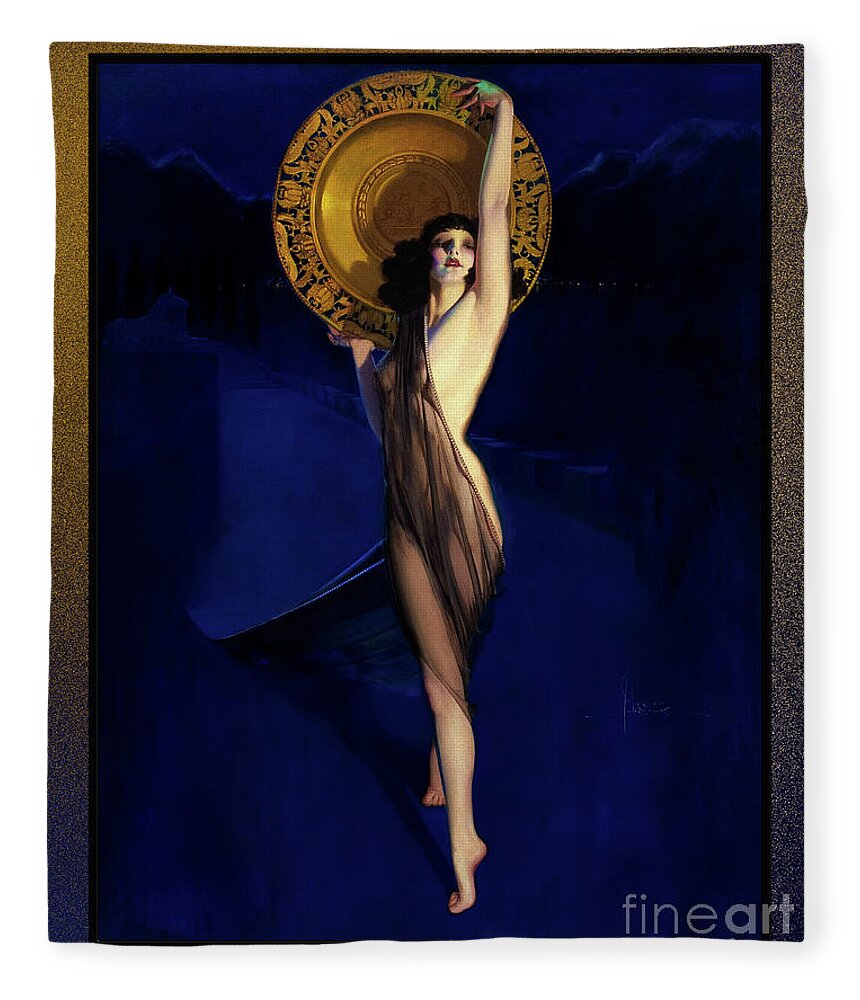
The young woman in The Enchantress, is supporting a large gold decorative plate situated behind her head, that has carvings of Egyptian Sphinx’s and Scarabs with her right hand and shoulder while her out stretched left hand that is above her head stabilizes the plate from the front end.
In the foreground we can see what appears to be a tree to her front left, and in the background we can see more trees that are situated near the shoreline of a large lake that meets up with a small town on the other side, with a large mountain range illuminated by moonlight dominates the dark blue skyline behind the town.
The Enchantress is a retouched digital art old masters reproduction of a public domain image that is available for purchase on a wide assortment of home decor products.
Info sottu Da Wikipedia.org
Rolf Armstrong hè natu John Scott Armstrong in Bay City, Michigan in aprile 21, 1889, à Richard è Harriet (Scott) Armstrong. U so babbu pussede u Boy-Line Fire Boat Company, chì includeva una linea di navi di passageru. Some were deployed in Chicago for use at the Chicago World’s Fair there in 1893.
Tuttavia, the father’s business and family were struggling, and the family homestead was lost to foreclosure. In 1899, the family moved to Detroit, Michigan. Rolf’s father died in 1903, and a year later he and his mother moved to Seattle, Washington, following the footsteps of his oldest brother, William, who had moved there a year earlier. By now Rolf’s artistic interests were emerging to more than a part-time pleasure.
He moved to Chicago in 1908, where he later studied at the Art Institute. He then went on to New York, where he studied with Robert Henri. After a trip to Paris in 1919 to study at the Académie Julian, he returned to New York and established a studio. In 1921 he went to Minneapolis to study calendar production at Brown & Bigelow.
Duranti l'anni 1920 è 1930, u so travagliu apparsu nantu à parechji pezzi di partitura, è ancu nantu à e copertine di parechje riviste, u più famosu per i riviste di fan di cinema cum'è Photoplay è Screenland. U so travagliu hè principalmente custituitu di donne; Maria Pickford, baby daniels, è Greta Garbo sò solu uni pochi di i numerosi ch'ellu hà pittatu.
Armstrong’s work for the Pictorial Review was largely responsible for that magazine achieving a circulation of more than two million by 1926. Un annu dopu, era l'artista di calendariu più vendutu in Brown & Bigelow. In 1930, RCA l'hà assuciatu per pintà pin-ups per publicità i so prudutti, è in 1933 Thomas D. Murphy Calendar Company hà firmatu per pruduce una seria di dipinti per a so linea.
In March 1940, Jewel Flowers, a girl from Lumberton, North Carolina, sent a picture of herself to Armstrong in response to an advert he had placed in the New York Times. Armstrong, 50 at the time, had been based at the Hotel des Artistes on West 67th Street in Manhattan since 1939, and was looking for new models.
He invited Flowers for an interview. On March 25, 1940, Flowers started modeling for Armstrong. Their professional collaboration and friendship lasted for two decades. The first painting, intitulé “How am I doing?”, reportedly because Flowers, unused to modeling, repeatedly asked Armstrong “How am I doing?” during the modeling session, was first published after World War II had started.
It was Brown & Bigelow’s best selling calendar for 1942 at a time when the company sold millions of calendars in America, and it became one of Armstrong’s most reproduced pictures. Flowers was popular with American servicemen during World War II, some of whom sent her letters proposing marriage. Armstrong’s calendars and silhouettes of Flowers were copied onto bombers and other planes as nose art and painted on tank turrets.
She became so well known during the war, although more as a famous face than by name, that a serviceman’s letter addressed simply as “Jewel Flowers, New York City” was delivered correctly. For many American servicemen abroad, she represented the “Why We Fight” spirit. U.S. President Franklin D. Roosevelt’s government enlisted her to help promote war bonds.
The January 1, 1945 edition of TIME magazine included Armstrong’s “Toast of the Town” painting of Flowers in an article about Calendar Art. The article noted that calendars with “girl paintings” were “bought heavily by foundries, machine shops, auto-supply dealers.”
Flowers married in 1946. She and her husband lived in several places while he tried a number of business ventures, including Laguna Beach, California, Greenville, South Carolina, Reno, Nevada, where she reportedly worked in as a card dealer for a time, and New York City. According to Michael Wooldridge, coauthor of Pin up Dreams: The Glamour Art of Rolf Armstrong, Armstrong called her a number of times during the period she was following her husband from place to place, to try to persuade her to return to New York and model for him.
Her modeling career ended with Armstrong’s death in 1960. He left a large proportion of his personal wealth to Flowers. In total, Armstrong created around fifty to sixty works using Flowers as the model.
Rolf Armstrong hè mortu in 1960 nantu à l'isula di Oahu, Hawaii as one of the best “pin-up” artisti di a prima mità di u XXmu seculu.