

The Flood Destroying The World
The Flood Destroying The World c1866 by French Painter Gustave Doré (1832 – 1883); embora ele tenha trabalhado principalmente como gravador de madeira, ele também era gravador, caricaturista, artista de quadrinhos, ilustrador e escultor.
This is another harrowing scene of the Great Flood story told in the Christian Bible and that is part of Gustave’s Bible Illustration tales.
In this scene we can see in the far distance Noah’s Ark; the only place on the planet earth of salvation; while in the foreground we see all the non believers and sinners.
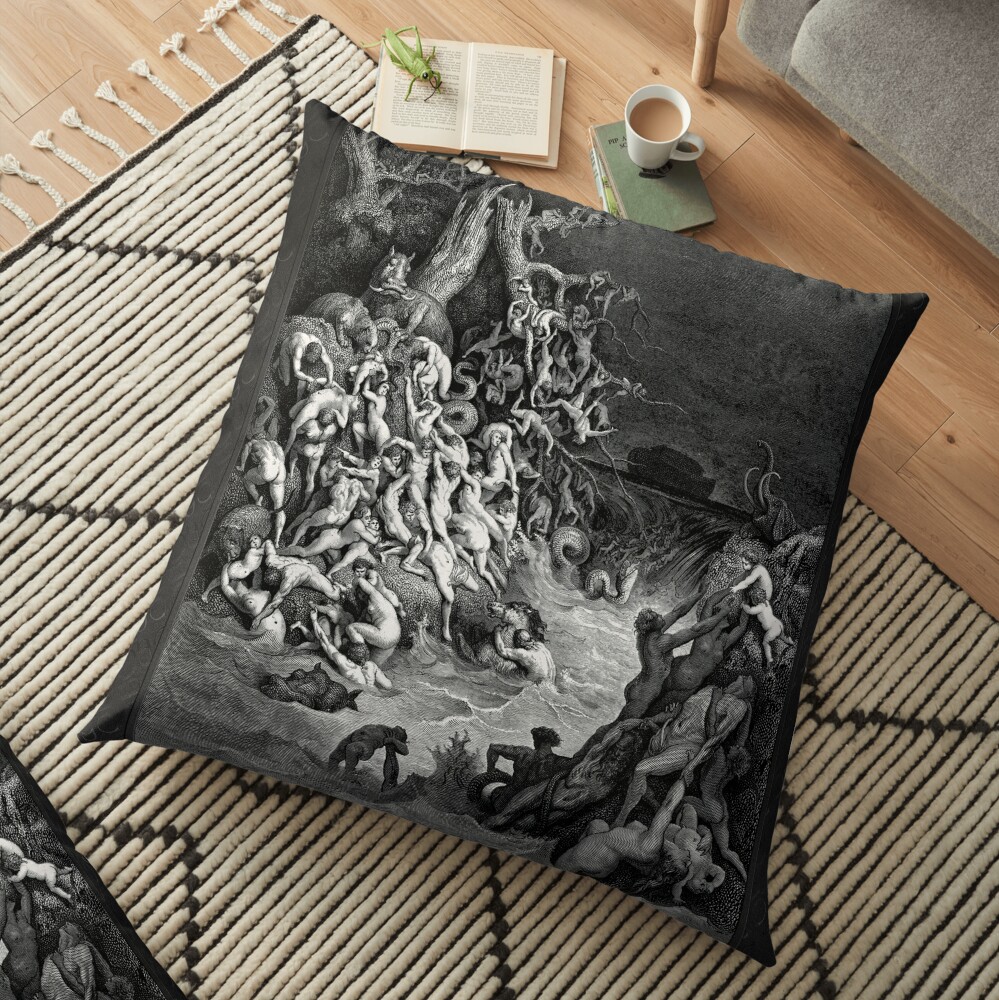
These individuals a grasping on rocks and trees trying to save themselves from the deluge of on coming water, as mothers and fathers try to pull and lift their children to safety; and children already on the rocks try to help their parents climb on top of them.
In the water are people and animals such as snakes and horses and on what little land that there is left that everyone is scrambling for are dozens of men, women and children, along with various animals such as wild cats, buffalo and elephants; with more people dangling off broken trees as the end approaches quickly.
The Flood Destroying The World is a remastered digital art old masters reproduction of a public domain image that is available as a impressão em tela on-line.
Informações abaixo derivadas de Wikipédia.org
Doré nasceu em Estrasburgo, França e com a idade de 5 era uma criança prodígio artista; criando desenhos que estavam maduros além de sua idade. Então, com a idade de 12, ele começou a esculpir em pedra, e por 15, iniciou sua carreira trabalhando como caricaturista para o jornal francês Le Journal pour Rire.
In the beginning wood engraving was his primary method of artistic expression during the late 1840s and early 1850s, fazendo vários quadrinhos de texto, como Os Trabalhos de Hércules (1847), Três artistas incompreendidos e insatisfeitos (1851), As desvantagens de uma viagem de prazer (1851) e A História da Santa Rússia (1854).
Doré subsequently went on to win commissions to depict scenes from books by Cervantes, Rabelais, Balzac, Milton, and Dante. He also illustrated “Gargantua et Pantagruel” em 1854; when he was just 22 years old.
Em 1853 Doré was asked to illustrate the works of Lord Byron; and this commission led to additional work for British publishers, including a new illustrated Bible, and three years later he would produced 12 folio-size illustrations of The Legend of The Wandering Jew, which propagated longstanding antisemitic views of the time, for a short poem which Pierre-Jean de Béranger had derived from a novel of Eugène Sue of 1845.
During the 1860s Doré illustrated a French edition of Cervantes’s Don Quixote, and his depictions of the knight and his squire, Sancho Panza, have become so famous that they have influenced subsequent readers, artists, and stage and film directors’ ideas of the physical “look” of the two characters.
He also illustrated an oversized edition of Edgar Allan Poe’s “The Raven”, an endeavor that earned him 30,000 francs from the publisher Harper & Brothers in 1883.
His illustrations for the Bible (1866) were highly successful, e em 1867 Doré had a major exhibition of his work in London, that led to the foundation of the Doré Gallery in Bond Street, Londres. Em 1869, Blanchard Jerrold, the son of Douglas William Jerrold, suggested that they work together to produce a comprehensive portrait of London.
Jerrold had obtained the idea from The Microcosm of London produced by Rudolph Ackermann, William Pyne, and Thomas Rowlandson (published in three volumes from 1808 para 1810). Doré assinou contrato de cinco anos com a editora Grant & Co que envolveu sua estadia em Londres durante três meses por ano, e ele recebeu a grande soma de £ 10.000 por ano para o projeto.
Embora Doré tenha sido celebrado principalmente por suas pinturas durante sua época, e embora permaneçam mundialmente conhecidos até hoje, são suas xilogravuras e gravuras, como aqueles que ele fez para Jerrold, o que demonstrou é um talento artístico excepcional como um artista com uma visão individual.