

The Gleaner c1841
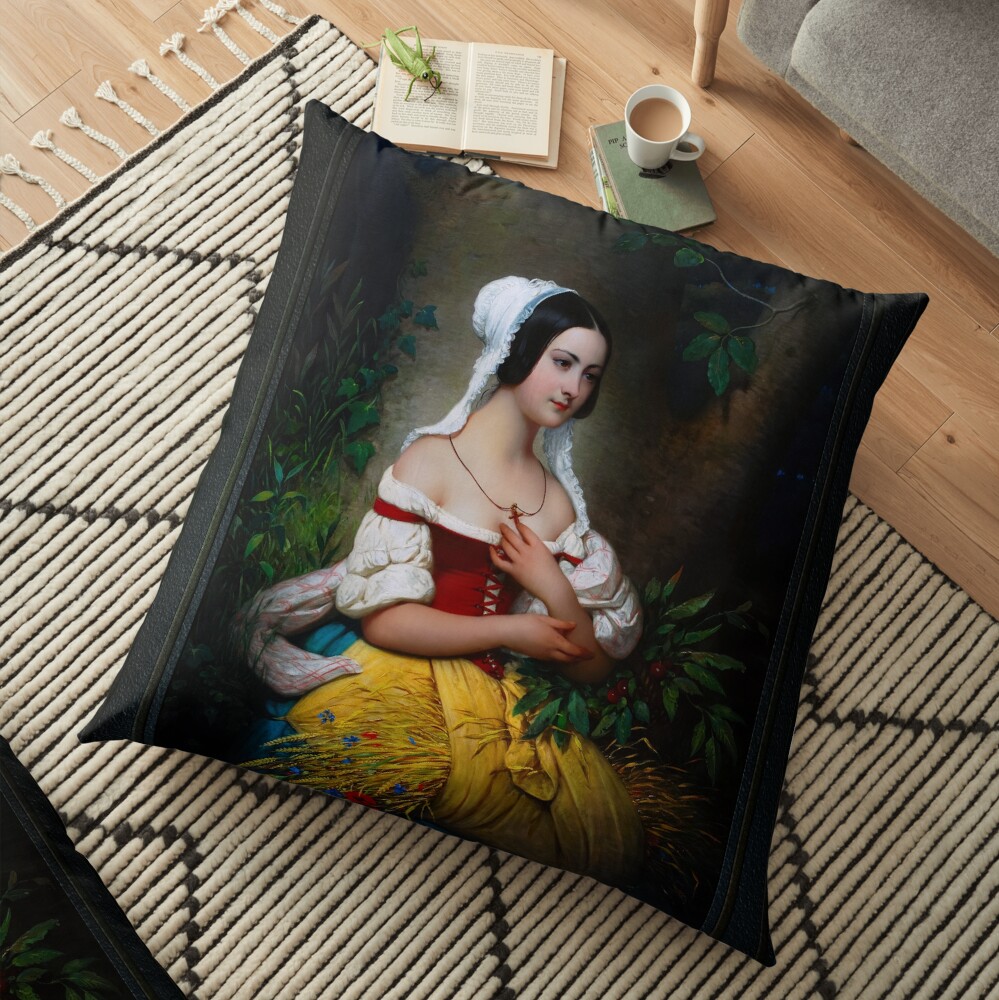
“The Gleaner,” búið til í 1841 by the French painter Joseph Désiré Court (1797 – 1865), presents a striking and emotionally resonant portrayal of rural life, which offers a unique lens through which the social and economic conditions of the time can be observed. Þetta listaverk, influenced by Court’s romantic style, encapsulates both the delicate beauty and laborious nature of rural work. Viðfangsefni málverksins, a woman engaged in the act of gleaning, is placed in the forefront against a richly detailed landscape. Court’s careful attention to detail and use of light enhances the artwork’s emotive power, allowing viewers to feel the warmth of the sunlight on the figures and the texture of the surroundings.
Efnisyfirlit
Aðalviðfangsefnið og samsetningin
Aðalpersónan í “The Gleaner” is a young woman, portrayed in a moment of rest amidst her laborious task. She is depicted with a dignified yet humble demeanor, dressed in traditional peasant attire, consisting of a red bodice, a white blouse with puffed sleeves, and a yellow skirt that flows outward, highlighting the fullness of the fabric and the labor of her work.
The woman is wearing a simple white headscarf, typical of the period, which frames her face delicately, showcasing her serene expression as she pauses to gather the remnants of crops. Í hægri hendi hennar, she gently holds a bundle of wheat she has collected, while her left hand touches her chest in a gesture that suggests quiet contemplation. This pause between tasks offers a poignant moment, symbolizing the dignity found in manual labor, a theme that was increasingly relevant during the social movements of the 19th century.
The composition is balanced, with the woman placed slightly off-center, allowing for a wide expanse of the field and surrounding landscape to be visible. The background depicts a rural landscape with a mix of crops, including wheat and other forms of vegetation, which appear to stretch out towards the horizon. This vast terrain surrounding the subject suggests the relationship between the laborer and the land she works, which forms the core of the artwork’s narrative. There is a contrast between the vastness of the land and the small, solitary figure of the woman, emphasizing the scale of the work and the humble nature of her task.
The Landscape and Terrain
Court’s handling of the terrain in “The Gleaner” is another remarkable aspect of the painting. The landscape is painted with a keen eye for realism, offering a lush depiction of the agricultural setting. The colors are earthy, with tones of greens, gulir, and browns predominating the composition. This naturalistic treatment of the environment enhances the sense of tranquility and harmony between the figure and the surrounding nature.
The fertile field extends behind the woman, while trees frame the edges of the scene, contributing to the depth and spatial composition. The sky is serene, with hints of sunlight filtering through, which imbues the scene with a peaceful and contemplative mood.
Á sama tíma, the terrain of the field and its undulating contours provide an understanding of the agricultural work that is central to the woman’s life. The earth, while fertile, is still demanding, and the presence of scattered sheaves of wheat left behind by the harvesters highlights the laborious task of gleaning—the act of collecting leftover grain after the harvest. The earthy ground, the overgrown grasses, and the scattered wheat convey both the richness and the hardship of the rural laborer’s life.
The Materials and Artistic Techniques
Joseph Désiré Court, known for his romantic approach, employs oil on canvas to create a rich, textured surface that captures the subtleties of the light and the natural beauty of the rural environment. Court’s skillful brushwork is evident in the way he handles the fabrics, the skin tones, and the vegetation. The softness of the woman’s clothing contrasts with the rougher textures of the field, demonstrating his ability to portray different materials with tactile realism. The smoothness of her skin, contrasted with the more rugged texture of her surroundings, draws attention to her figure as the focal point of the composition.
The artist uses light to profound effect, with warm tones casting a soft glow over the woman’s face and body, while the shadows play over the folds of her clothing and the terrain. This interplay between light and shadow enhances the emotional resonance of the painting, suggesting both a physical and metaphorical contrast between the hard work of the woman and the beauty of her surroundings.
The Theme and Mood of the Artwork
The overarching theme of “The Gleaner” revolves around the dignity of rural labor, the connection between human beings and the land, and the cyclical nature of work. The woman in the painting, with her laborious yet serene posture, is depicted with a quiet strength and grace, reflecting the romantic idealization of rural life.
Hins vegar, there is an underlying message about the hardships faced by those who toil in the fields, particularly the gleaners, who were often among the poorest members of society. Mjúkt, warm light and the peaceful expression on the woman’s face contrast with the backbreaking nature of her task, suggesting both the beauty and the difficulty inherent in this form of work.
Court’s portrayal of the gleaner challenges the viewer to consider the role of the working poor in society and their contribution to the agricultural economy. There is no direct commentary on the social inequalities of the time, but the viewer cannot help but reflect on the juxtaposition of the woman’s quiet labor and the vast, seemingly indifferent landscape.
Niðurstaða
“The Gleaner” by Joseph Désiré Court is a masterful example of 19th-century romantic realism, capturing both the beauty and the struggle of rural life. Through his sensitive portrayal of the gleaner, Court explores the intimate relationship between labor and nature, while offering a poignant meditation on the dignity found in hard work. The lush, naturalistic landscape, combined with the artist’s deft handling of light and texture, creates an immersive and emotional experience for the viewer, making this artwork a powerful commentary on both the personal and collective nature of labor in rural France.
This is a remastered digital art old masters reproduction of a public domain image that is available as an acrylic, Málmur, rolled, framed, strigaprentun á netinu.
Information About The Artwork Courtesy The Matthiesen Gallery
It is thought that the portrait, sem vísað er til í 1838 Salon verslun sem Portrait of Miss W, gæti ef til vill verið af dóttur trúnaðarmanns Louis-Philippe, George White. Það var „Mademoiselle White“ í þjónustu á þriðja áratug síðustu aldar sem vinnukona Adélaïde d'Orléans., systur Louis Philippe og það hefði ekki verið óalgengt að barn trausts þjóns fengi vinnu á heimili annars meðlims konungsfjölskyldunnar..
George White hafði sjálfur upphaflega verið ráðinn hjá bróður konungs, hertoginn af Montpensier, og eftir dauða hans í 1807 hafði verið tekið við af Louis-Philippe. Talið er að George While hafi gengið í þjónustu konungsfjölskyldunnar í fyrstu útlegð sinni í Englandi, frá 1800-1815, og reis upp til að vera næst persónulegum þjónum. George átti herbergi bæði í Randan-kastalanum og Trianon í Versölum og var veittur vasapeningur á 3000 franka í annarri útlegð Louis-Philippe, 1848-1850.
Það er líka vitað að George hafði auga fyrir list, innkaup á verkum fyrir hönd Louis-Philippe í nokkur skipti. Although this portrait may seem grand for a servant, það sýnir kannski bæði þá virðingu sem fjölskyldan naut innan konungsheimilisins og einnig tengsl George innan listræna bræðralagsins.. Hvort hann var persónulega þekktur við dómstólinn erum við ekki viss um, hins vegar hljóta langvarandi umsvif dómstólsins í Versölum í júlí konungsveldinu að hafa komið þeim tveimur til kynnis síns..