

The Gleaner c1841
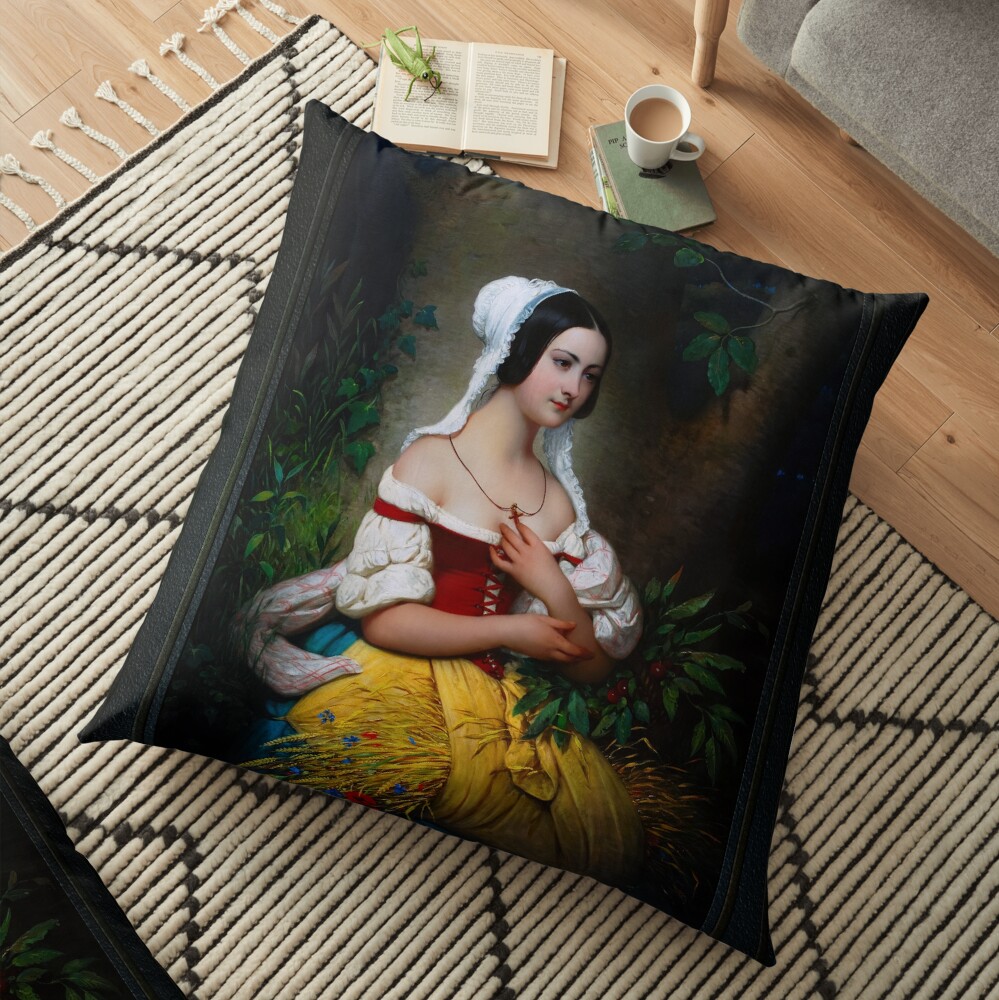
“The Gleaner,” 다음에서 생성됨 1841 프랑스 화가의 Joseph Désiré Court (1797 – 1865), presents a striking and emotionally resonant portrayal of rural life, which offers a unique lens through which the social and economic conditions of the time can be observed. 이 작품, influenced by Court’s romantic style, encapsulates both the delicate beauty and laborious nature of rural work. 그림의 주제, a woman engaged in the act of gleaning, is placed in the forefront against a richly detailed landscape. Court’s careful attention to detail and use of light enhances the artwork’s emotive power, allowing viewers to feel the warmth of the sunlight on the figures and the texture of the surroundings.
목차
주요 주제와 구성
의 중심 인물 “The Gleaner” 젊은 여성입니다, portrayed in a moment of rest amidst her laborious task. She is depicted with a dignified yet humble demeanor, dressed in traditional peasant attire, consisting of a red bodice, a white blouse with puffed sleeves, and a yellow skirt that flows outward, highlighting the fullness of the fabric and the labor of her work.
The woman is wearing a simple white headscarf, typical of the period, which frames her face delicately, showcasing her serene expression as she pauses to gather the remnants of crops. 그녀의 오른손에, she gently holds a bundle of wheat she has collected, while her left hand touches her chest in a gesture that suggests quiet contemplation. This pause between tasks offers a poignant moment, symbolizing the dignity found in manual labor, a theme that was increasingly relevant during the social movements of the 19th century.
구성이 균형있게 구성되어 있어요, with the woman placed slightly off-center, allowing for a wide expanse of the field and surrounding landscape to be visible. The background depicts a rural landscape with a mix of crops, including wheat and other forms of vegetation, which appear to stretch out towards the horizon. This vast terrain surrounding the subject suggests the relationship between the laborer and the land she works, which forms the core of the artwork’s narrative. There is a contrast between the vastness of the land and the small, solitary figure of the woman, emphasizing the scale of the work and the humble nature of her task.
풍경과 지형
Court’s handling of the terrain in “The Gleaner” is another remarkable aspect of the painting. The landscape is painted with a keen eye for realism, offering a lush depiction of the agricultural setting. The colors are earthy, with tones of greens, 노란색, and browns predominating the composition. This naturalistic treatment of the environment enhances the sense of tranquility and harmony between the figure and the surrounding nature.
The fertile field extends behind the woman, while trees frame the edges of the scene, contributing to the depth and spatial composition. The sky is serene, with hints of sunlight filtering through, which imbues the scene with a peaceful and contemplative mood.
동시에, the terrain of the field and its undulating contours provide an understanding of the agricultural work that is central to the woman’s life. The earth, while fertile, is still demanding, and the presence of scattered sheaves of wheat left behind by the harvesters highlights the laborious task of gleaning—the act of collecting leftover grain after the harvest. The earthy ground, the overgrown grasses, and the scattered wheat convey both the richness and the hardship of the rural laborer’s life.
The Materials and Artistic Techniques
Joseph Désiré Court, known for his romantic approach, employs oil on canvas to create a rich, textured surface that captures the subtleties of the light and the natural beauty of the rural environment. Court’s skillful brushwork is evident in the way he handles the fabrics, the skin tones, and the vegetation. The softness of the woman’s clothing contrasts with the rougher textures of the field, demonstrating his ability to portray different materials with tactile realism. The smoothness of her skin, contrasted with the more rugged texture of her surroundings, draws attention to her figure as the focal point of the composition.
The artist uses light to profound effect, with warm tones casting a soft glow over the woman’s face and body, while the shadows play over the folds of her clothing and the terrain. This interplay between light and shadow enhances the emotional resonance of the painting, suggesting both a physical and metaphorical contrast between the hard work of the woman and the beauty of her surroundings.
작품의 주제와 분위기
가장 중요한 주제 “The Gleaner” revolves around the dignity of rural labor, the connection between human beings and the land, and the cyclical nature of work. The woman in the painting, with her laborious yet serene posture, is depicted with a quiet strength and grace, reflecting the romantic idealization of rural life.
하지만, there is an underlying message about the hardships faced by those who toil in the fields, particularly the gleaners, who were often among the poorest members of society. 부드러운, warm light and the peaceful expression on the woman’s face contrast with the backbreaking nature of her task, suggesting both the beauty and the difficulty inherent in this form of work.
Court’s portrayal of the gleaner challenges the viewer to consider the role of the working poor in society and their contribution to the agricultural economy. There is no direct commentary on the social inequalities of the time, but the viewer cannot help but reflect on the juxtaposition of the woman’s quiet labor and the vast, seemingly indifferent landscape.
결론
“The Gleaner” by Joseph Désiré Court is a masterful example of 19th-century romantic realism, capturing both the beauty and the struggle of rural life. Through his sensitive portrayal of the gleaner, Court explores the intimate relationship between labor and nature, while offering a poignant meditation on the dignity found in hard work. 무성한, naturalistic landscape, combined with the artist’s deft handling of light and texture, creates an immersive and emotional experience for the viewer, making this artwork a powerful commentary on both the personal and collective nature of labor in rural France.
This is a remastered digital art old masters reproduction of a public domain image that is available as an acrylic, 금속, 압연, 액자, 캔버스 프린트 온라인.
Information About The Artwork Courtesy 마티센 갤러리
초상화라고 생각된다., 에 언급된 1838 미스 W의 초상화로 살롱 카탈로그, 아마도 Louis-Philippe의 신뢰할 수 있는 대리인의 딸일 것입니다., 조지 화이트. 1830년대에는 Adélaide d'Orléans의 하녀로 근무한 'Mademoiselle White'가 있었습니다., 루이 필립의 누이이자 믿을 수 있는 하인의 아이가 왕실의 다른 식구의 집에 취직하는 것은 드문 일이 아니었을 것입니다..
조지 화이트 자신은 원래 왕의 형제에 의해 고용되었습니다., 듀크 드 몽팡시에, 그리고 그의 죽음 이후 1807 Louis-Philippe에 의해 인수되었다.. George While은 영국에서 첫 번째 망명 기간 동안 왕가의 서비스에 들어간 것으로 믿어집니다., ~에서 1800-1815, 가장 가까운 개인 하인으로 부상. George는 Randan성과 Versailles의 Trianon에 방을 가지고 있었고 3000 루이 필립의 두 번째 망명 기간 동안의 프랑, 1848-1850.
또한 조지는 예술에 대한 안목이 있는 것으로 알려져 있습니다., 여러 경우에 Louis-Philippe를 대신하여 작품을 구매합니다.. 비록 이 초상화가 하인에게는 웅장해 보일지 모르지만, 그것은 아마도 왕실 내에서 가족이 가진 존경심과 예술적 형제애 내에서 조지의 연결을 모두 보여줍니다.. 그가 법원에 개인적으로 알려졌는지 여부는 확실하지 않습니다., 그러나 7월 군주제 기간 동안 베르사유에서 궁정의 확장된 활동으로 인해 두 사람은 서로를 알게 되었을 것입니다..