

Den uskyldige svanen (Svanen; Uskyld)
“Den uskyldige svanen (Svanen; Uskyld)” is a remarkable work created by Elisabeth Sonrel (1874 – 1953), i 1905, encapsulating the graceful and serene qualities associated with the Symbolist movement that defined much of the late 19th and early 20th centuries. Født i 1874 og går bort i 1953, Sonrel was a French artist whose works often blended the ethereal and the earthly, producing dreamlike scenes that were deeply influenced by mythology and the natural world. This specific piece, infused with both tranquility and delicate beauty, perfectly exemplifies Sonrel’s ability to combine the elegance of natural forms with symbolic richness.
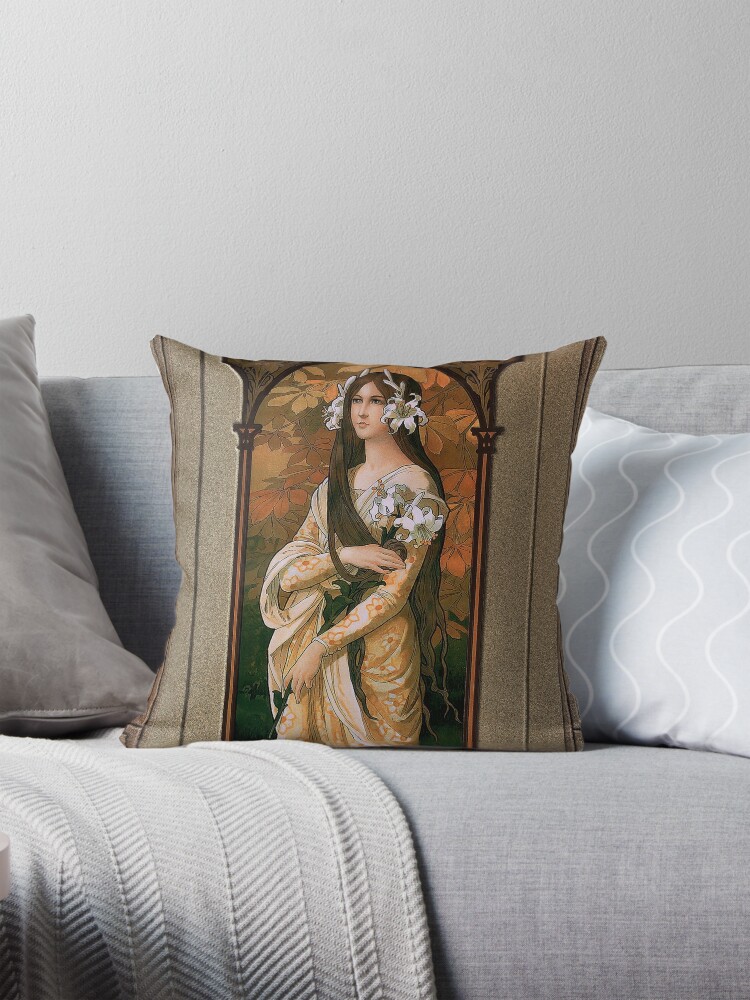
The central figure of the painting is a young woman dressed in an opulent yellow gown adorned with soft floral patterns. Her long brown hair cascades past her shoulders, entwined with white lilies that give her a pure and almost mystical appearance. She stands in a calm, poised stance with a swan at her feet, symbolizing the innocence and grace attributed to both the bird and the figure she represents. The soft rendering of her face, with an expression of contemplation, invites the viewer to ponder her thoughts while gazing upon the tranquil setting that surrounds her.
Innholdsfortegnelse
Composition and Surroundings
The composition of the painting is characterized by a harmonious blend of the natural and the human, with the figure of the woman placed in a vertical format that emphasizes the elongated style of the subject. She is situated against a lush, verdant background, where delicate autumn leaves in shades of orange, gull, and green suggest the time of year and create a backdrop that contrasts beautifully with the pale, luminous gown she wears. The subtle inclusion of the swan further elevates the symbolic aspect of the work, as swans are traditionally linked with themes of purity, uskyld, and beauty, reinforcing the title of the piece.
The swan, which rests at the woman’s feet, seems to mirror her own graceful posture. Its neck curves delicately, almost as if echoing the lines of her figure. This visual connection between the human and the bird further deepens the symbolism of the painting, suggesting a harmonious relationship between humanity and nature. The swan’s white feathers reflect the woman’s innocence, offering a serene presence that balances the vibrancy of the autumn leaves in the background.
Color Palette and Technique
Sonrel’s use of color is one of the most striking aspects of the painting. The soft pastel tones of the yellow gown are balanced by the earthier tones of the foliage behind the figure, creating a warm and inviting ambiance. The yellows, Gull, and subtle greens of the dress blend with the oranges and reds of the autumn leaves, evoking a sense of calm serenity that is further reflected in the softness of the background. The subdued hues work together to draw attention to the figure of the woman, allowing her to remain the focal point of the piece.
The technique employed by Sonrel showcases her skill in using soft brushstrokes and a gentle application of light and shadow. Penselen, though precise, retains an air of fluidity that enhances the overall delicacy of the scene. There is an almost translucent quality to the woman’s skin, suggesting her ethereal nature, while the details in the gown, blomster, and leaves are rendered with a subtle yet deliberate attention to texture and form. This blending of realism with a dreamy, almost otherworldly quality is characteristic of Sonrel’s approach to painting.
Symbolism and Meaning
The swan in “Den uskyldige svanen” is not just a decorative element, but rather a powerful symbol. In various cultures, the swan is associated with purity, transformasjon, og det guddommelige. In Greek mythology, for eksempel, swans were often connected to gods and goddesses, embodying both grace and the higher realms of beauty. Her, the swan’s purity is reflected in the figure of the young woman, who is portrayed with an expression of innocence and calm. The lily flowers, which intertwine with her hair, further reinforce this symbolism of purity and innocence.
The combination of the woman’s serene posture, the swan’s graceful presence, and the natural elements around them creates a timeless scene of tranquility, emphasizing the connection between humanity and nature. The autumnal setting could be seen as a representation of the fleeting nature of innocence and beauty, reminding the viewer of the transient moments in life. The gentle curve of the woman’s figure and the soft tones of the piece give the painting a nostalgic quality, evoking a sense of longing for a simpler, purer time.
Style and Artistic Influence
“Den uskyldige svanen” is a prime example of the Symbolist style, which was marked by an emphasis on emotions, the imagination, and an exploration of the mystical and metaphysical realms. Sonrel’s work is deeply embedded in this tradition, capturing moments that evoke a sense of reverie and contemplation. The fine lines, oppmerksomhet på detaljer, and use of symbolic imagery also tie her work to the Art Nouveau movement, which was flourishing in France during her time. The floral motifs, flytende linjer, and organic forms in the painting align it with the decorative and ornamental elements that defined Art Nouveau.
In terms of mood, the painting exudes a quiet, peaceful atmosphere, filled with an air of timeless grace. The subject’s expression, the soft light, and the harmonious relationship between the figure and the swan all contribute to a sense of calm and purity. It is a work that encourages the viewer to pause, to appreciate the subtle beauty of the scene, and to reflect on the deeper symbolism that lies beneath the surface.
Konklusjon
I “Den uskyldige svanen (Svanen; Uskyld),” Élisabeth Sonrel captures the delicate beauty of innocence through the portrayal of a young woman in a serene, dreamlike setting. The careful composition, combined with the symbolic imagery of the swan and the soft palette, creates a work that is both visually captivating and emotionally resonant. Through her meticulous rendering of natural forms and the symbolic interplay between the human and the animal, Sonrel invites the viewer into a world of tranquil reverie, where innocence, renhet, and beauty are forever preserved in time.
Den uskyldige svanen (Svanen; Uskyld) av fransk maler Elisabeth Sonrel (1874 – 1953); og illustratør av jugendstil; hvem som arbeider inkluderte allegoriske fag, mystikk og symbolikk, portretter og landskap.
The Innocent Swan er en retusjert digital kunst gamle mestere gjengivelse av et offentlig domene.
Denne digitale kunstkreasjonen, som med alle kunstverkene som finnes på Xzendor7-nettstedet, er det tilgjengelig for kjøp online i en rekke materialformater, inkludert lerretstrykk, akryltrykk, metalltrykk, treutskrifter, innrammede trykk, plakater, og som rullede lerret utskrifter i en rekke størrelser fra 12 tommer til 72 tommer avhengig av størrelsen på det faktiske kunstverket og print on demand-butikken du velger å kjøpe kunsten fra.
Kunstverket er også tilgjengelig på et bredt utvalg av herre- og dameklær, krus, totes, skjerf, notatbøker og journaler og mange hjemmeinnredningsprodukter.
Kunstnerbiografi
Info nedenfor Hilsen Wikipedia.org
Elisabeth Sonrel (1874 Turer - 1953 Sel) var en fransk maler og illustratør i jugendstil. Verkene hennes inkluderte allegoriske emner, mystikk og symbolikk, portretter og landskap.
Hun var datter av Nicolas Stéphane Sonrel, en maler fra Tours, og mottok hennes tidlige opplæring av ham. For videre studier fortsatte hun til Paris som student ved Jules Lefebvre ved Ecole des Beaux-Arts.
I 1892 hun malte diplomarbeidet, 'Pax et Labour', et verk å se på Musée des Beaux-Arts de Tours. Fra da av stilte hun ut på Salon des Artistes Français mellom 1893 og 1941, hennes signaturstykker er store akvareller på en pre-Raphaelite-måte, som hun adopterte etter en tur til Firenze og Roma, å oppdage renessansemalerne – noen av hennes arbeider har klare overtoner av Botticelli. Maleriene hennes ble ofte inspirert av Arthurian romantikk, Dante Alighieris 'Guddommelige komedie’ og 'Det nye livet', bibelske temaer, og legender fra middelalderen. Hennes mystiske verk inkluderer 'Ames errantes’ (Salong av 1894) og ‘Spirits of the Abyss’’ (Salong av 1899) og "Ung kvinne med tapet".
På Exposition Universelle of 1900, hovedtemaet var Art Nouveau, henne 1895 maleriet "Jomfruens søvn’ (Jomfruens søvn), ble tildelt en bronsemedalje, og Henri Lehmann -prisen av 3000 franc av The Academy of Fine Arts.[3] Fra 1900 videre begrenset hun maleriet til portretter, naturskjønne Bretagne -landskap, og en og annen blomsterundersøkelse.
Hun gjorde jevnlige malerturer til Bretagne, inspirert av skogen i Brocéliande, og fra 1910 til forskjellige steder på kysten som Concarneau, Plougastel, Pont-l'Abbé og Loctudy, bor ofte på vertshus og ledsages av en eller to studenter. Hun malte flere verk i Le Faouët før hun konstruerte en villa i La Baule på 1930 -tallet. Jobber hovedsakelig i akvarell og gouache, hun oppdaget en klar forsyning av modeller blant unge jenter i området, og syntes Bretons generelt var vennlige, ærlig og selvsikker.
Hennes siste utstilling på salongen var i 1941 i en alder av 67. Det er også en oversikt over at hun hadde stilt ut i Liverpool. I de første årene produserte Sonrel plakater, postkort og illustrasjoner, i jugendstil.