

The Irritating Gentleman
The Irritating Gentleman (An cavalier neònach) c1874 leis a’ pheantair Gearmailteach Berthold Woltze (1829 – 1896); gnè, peantair agus dealbhadair.
Ann an “The Irritating Gentleman”, German painter Berthold Woltze presents an intimate yet vividly expressive portrayal of a moment captured within the confines of a late 19th-century train compartment. Completed in 1874, the painting offers a glimpse into the nuances of human interaction and emotion, expertly rendered through the lens of genre painting, a popular movement during this period. An neach-ealain, known for his ability to capture the intricacies of ordinary life, invites viewers into this enclosed, quiet world with careful attention to detail, sgrìobhadh, agus mood.
Clàr-innse
The Main Subject and Characters
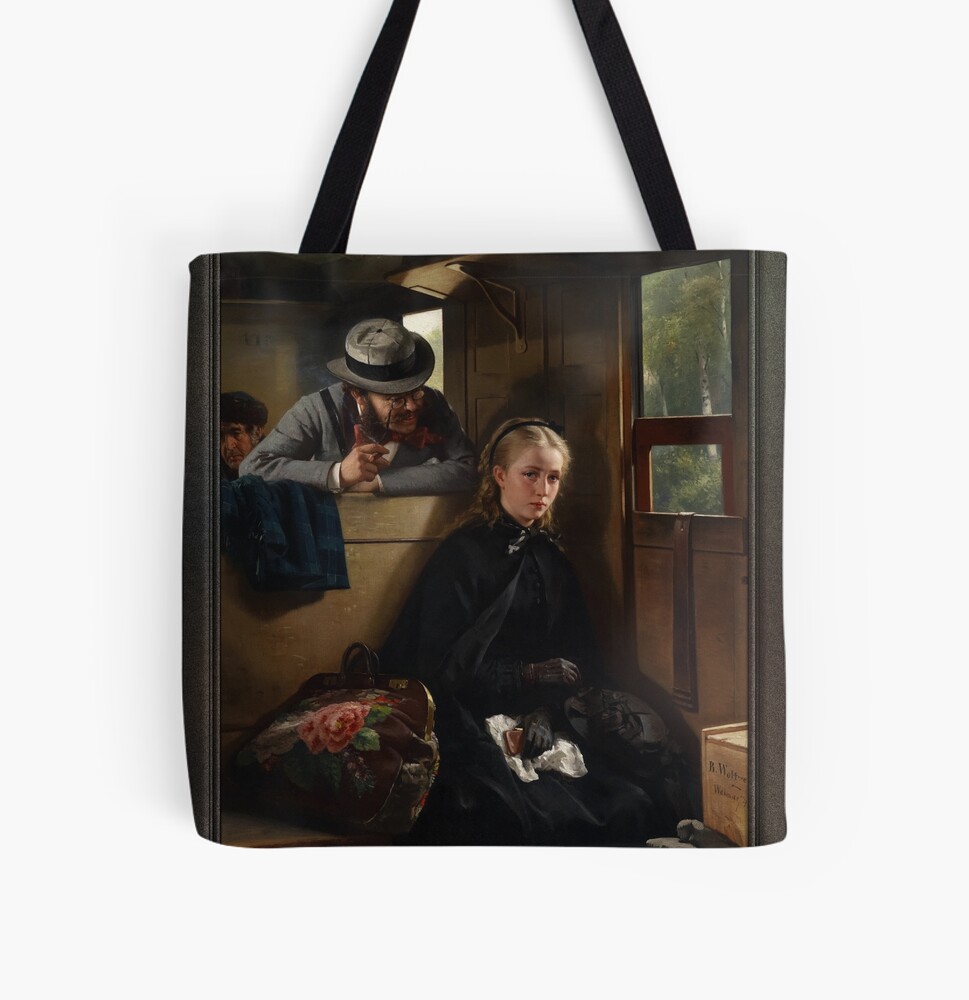
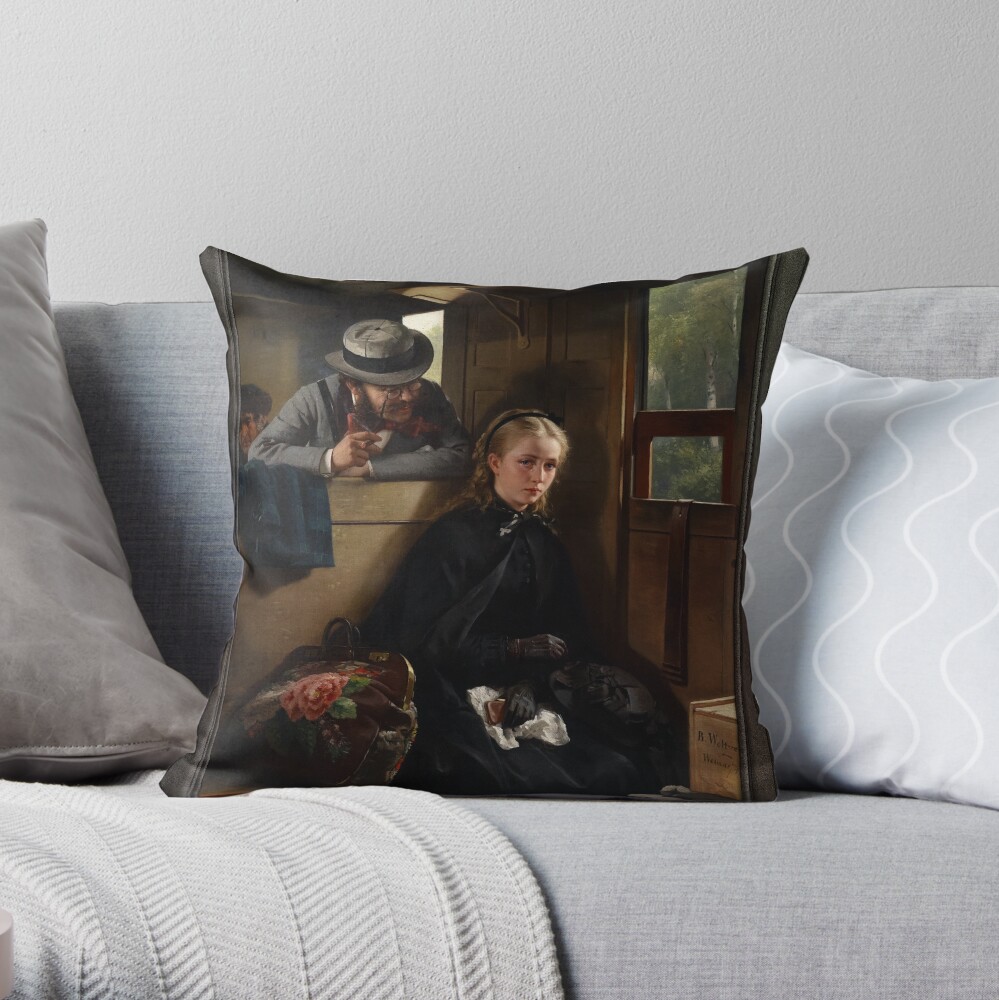
At the heart of the artwork is the interaction between two figures, a boireannach òg and a man, who occupy the small space of a wooden train compartment. Am boireannach, dressed in an elegant but somber black outfit, gazes off to the side with a composed yet distant expression. Her figure is seated on a cushioned bench, with her posture slightly turned, suggesting a sense of detachment or even discomfort. The presence of a large, floral-patterned bag resting on the seat next to her adds to her refined demeanor, implying she is a woman of some means or social standing.
Her delicate hands, clothed in gloves, hold a handkerchief, further emphasizing her status and the social expectations of the time. Her serene yet distant gaze suggests a quiet introspection or a subtle anxiety about the unfolding interaction.
An duine, positioned directly behind her, leans into the scene with an air of intrusive familiarity. His exaggerated, almost cartoonish features—round spectacles, a bushy beard, and a bowler hat—suggest a character out of place in this refined setting. His mannerisms are conspicuous and unrefined, as he leans in close to the woman, interrupting her personal space and thus breaking the unspoken boundaries of propriety.
His face is turned toward the woman, with an exaggerated gesture of speech, his hand raised to punctuate his words. His intrusive nature and his physical proximity to the woman evoke feelings of irritation, creating the tension that gives the painting its title. His exaggerated posture and expression communicate a clear sense of discomfort for the viewer, as he seems unaware—or indifferent—to the effect his behavior is having on the woman.
The Objects in the Scene
The interior of the train compartment is filled with objects that subtly contribute to the mood and atmosphere of the painting. The woman’s floral-patterned bag is prominently placed on the bench, providing a contrast to her otherwise somber attire. The vibrant flowers on the bag may symbolize an inner beauty or softness in the woman’s character, serving as a sharp juxtaposition to the intrusive behavior of the man.
Air cùlaibh na boireannaich, a wooden crate is visible with the letters “B. Woltze” faintly printed on it, a possible reference to the artist’s name or a subtle self-reference, suggesting Woltze’s personal connection to the scene or his involvement in transporting his own work. The crate’s appearance in the background lends an additional layer of realism to the scene, offering a snapshot of the everyday objects typical of the time.
The light filtering through the window introduces an element of natural beauty into the otherwise tense atmosphere. Am bog, warm glow illuminates the woman’s face, highlighting her poised yet tired expression, and contrasts with the darker tones of the interior of the compartment.
The rays of light seeping through the window symbolize not just the passing of time but also an escape, possibly reflecting the woman’s desire for freedom from the encroaching figure of the man.
The Setting and Terrain
Suidheachadh a 'pheantadh, a train compartment, is reflective of the societal changes that were taking place in Europe during the late 19th century. The industrial revolution had made rail travel more accessible, and the train represented a symbol of both progress and personal isolation. This confined space becomes a microcosm for human interaction and social dynamics. The solid, dark wood paneling of the compartment and the sparse furniture emphasize the restrictive, almost claustrophobic nature of the environment. The painted light filtering in through the window provides a contrast to this, serving as a visual metaphor for a sense of freedom and escape that seems just beyond the reach of the woman.
Stoidhle, Cuspair, agus Mood
Woltze’s technique in this painting is highly detailed, capturing the textures of the fabric, the lightness of the woman’s gloves, and the subtle variations in the tones of the wood and the floral pattern of the bag. His use of light and shadow enhances the realistic quality of the painting, immersing the viewer in the world he has created. The composition is traditional, with the figures placed in the foreground, allowing the viewer to focus on the interaction between the characters.
'S e cuspair an dealbh, as the title suggests, revolves around the concept of irritation or unwanted intrusion. The tension between the two characters is palpable—on the one hand, the man’s loud, overly familiar behavior disrupts the otherwise tranquil atmosphere of the compartment, while on the other hand, the woman’s poised yet weary demeanor subtly suggests her inability to escape or confront the situation.
This interplay between intrusion and retreat creates a sense of tension that resonates with the viewer, as the figures’ silent communication speaks volumes about the complexities of human interaction. The mood is one of discomfort and unease, heightened by the stark contrast between the man’s boisterous energy and the woman’s subdued, passive reaction.
Uile gu lèir, the painting is a powerful commentary on the social dynamics of the period, portraying the nuances of personal space, the often-unspoken boundaries of social interaction, and the delicate dance of human behavior in confined spaces.
This is a remastered digital art old masters reproduction of a public domain image, that is, mar a tha leis a h-uile obair-ealain a gheibhear air làrach-lìn Xzendor7 ri fhaighinn airson a cheannach air-loidhne ann an grunn chruthan stuth a’ gabhail a-steach clò-bhualaidhean canabhas, dealbhan acrylic, clò-bhualaidhean meatailt, clò-bhualaidhean fiodha, lèileagan frèam, postairean, agus mar clò-bhualaidhean canabhas rollaichte ann an caochladh mheudan bho 12 òirlich gu 72 òirlich a rèir meud an fhìor obair-ealain agus a’ bhùth clò-bhualaidh air iarrtas a thaghas tu airson an ealain a cheannach.
Fiosrachadh gu h-ìosal bho Wikipedia.org
Bha Berthold Woltze na àrd-ollamh aig Sgoil Ealain Grand Ducal Weimar Saxon. Anns an ùine bho 1871 gu 1878 dh'fhoillsich e grunn de na h-obraichean aige anns a ’phàipear-naidheachd Gartenlaube. Is e aon de na h-obraichean as ainmeil aige Der lästige Kavalier, eadar-theangachadh mar “The Irritating Gentleman” no “An Cavalier annasach.”
Is e athair a ’pheantair ailtireachd Peter Woltze (1860–1925).