

The Judgment of Solomon
The Judgment of Solomon (1Kings 3_16-28) c1866 by French Painter Gustave Doré (1832 – 1883); though he primarily worked as a wood engraver, he also was a printmaker, caricaturost, comics artist, illustrator and a sculptor.
The Judgment of Solomon is an engraving that depicts the Biblical tale of King Solomon and the two mothers each claiming to be and fighting over an infant son; with both claiming to be the mother of the baby.
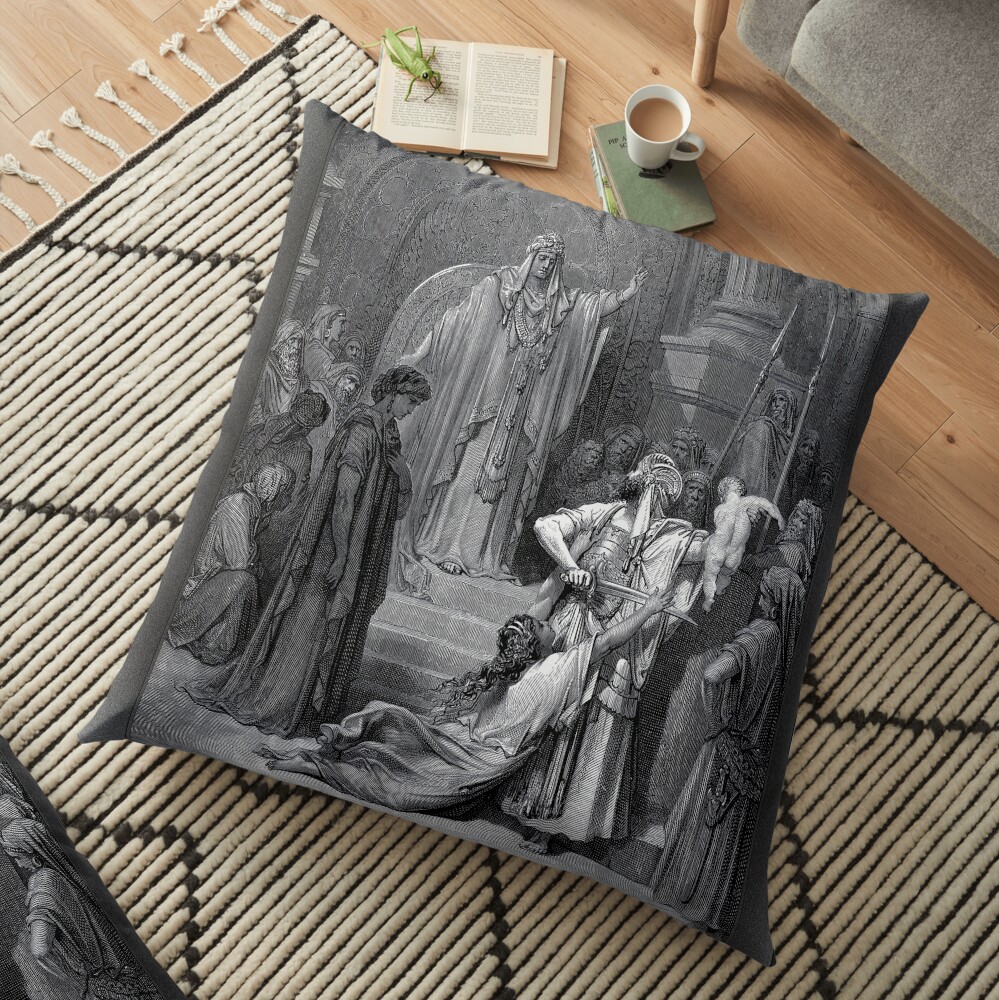
In order to solve this dilemma the women and the baby are brought before King Solomon to each plead their case; and to resolve this life altering dispute, King Solomon orders his soldier to cut the baby in half, and give each women a half of the baby.
Upon hearing this the true mother of the child tells the King that the other women can have the child and please not kill; and then Solomon orders the soldier to give the baby to the woman that is willing to give up the child to save its life, as this is the true mother of the baby.
The Judgment of Solomon scene shows the throne room with the members of the court and others along its perimeter and King Solomon standing in front of his throne dealing out the justice of his wisdom.
There at the front of the throne is a soldier holding the baby up in his left hand, and a sword in his right; while the true mother of the child is on her knees begging for the child’s life and the other woman just stands there looking down at her
The Judgment of Solomon is a remastered digital art old masters reproduction of a public domain image that is available as a lerretstrykk online.
Info nedenfor avledet fra Wikipedia.org
Doré was born in Strasbourg, Frankrike og ved alder av 5 var en vidunderbarnskunstner; lage tegninger som var modne utover hans år. Så i en alder av 12, han begynte å hugge i stein, og av 15, begynte sin karriere som karikaturtegner for den franske avisen Le journal pour rire.
I begynnelsen var tregravering hans primære metode for kunstnerisk uttrykk på slutten av 1840-tallet og begynnelsen av 1850-tallet, lage flere tegneserier, like Les Travaux d’Hercule (1847), Tre misforståtte og misfornøyde artister (1851), Les Dés-agréments d’un voyage d’agrément (1851) and L’Histoire de la Sainte Russie (1854).
Doré fortsatte deretter med å vinne oppdrag for å skildre scener fra bøker av Cervantes, Rabelais, Balzac, Milton, og Dante. He also illustrated “Gargantua et Pantagruel” i 1854; da han bare var 22 år gammel.
I 1853 Doré ble bedt om å illustrere verkene til Lord Byron; og denne kommisjonen førte til ekstra arbeid for britiske forlag, inkludert en ny illustrert bibel, og tre år senere skulle han produsere 12 illustrasjoner i foliostørrelse av The Legend of The Wandering Jew, som forplantet langvarige antisemittiske syn på tiden, for et kort dikt som Pierre-Jean de Béranger hadde hentet fra en roman av Eugène Sue av 1845.
During the 1860s Doré illustrated a French edition of Cervantes’s Don Quixote, og hans skildringer av ridderen og hans godsmann, Sancho Panza, har blitt så kjent at de har påvirket påfølgende lesere, kunstnere, og scene- og filmregissører’ ideas of the physical “look” av de to karakterene.
He also illustrated an oversized edition of Edgar Allan Poe’s “The Raven”, et forsøk som tjente ham 30,000 franc fra forlaget Harper & Brødre i 1883.
Hans illustrasjoner for Bibelen (1866) var svært vellykkede, og i 1867 Doré hadde en stor utstilling av arbeidet sitt i London, som førte til grunnleggelsen av Doré Gallery i Bond Street, London. I 1869, Blanchard Jerrold, sønn av Douglas William Jerrold, foreslo at de skulle jobbe sammen for å produsere et omfattende portrett av London.
Jerrold hadde fått ideen fra The Microcosm of London produsert av Rudolph Ackermann, William Pyne, og Thomas Rowlandson (utgitt i tre bind fra 1808 til 1810). Doré signerte en femårskontrakt med utgiverne Grant & Co som innebar at han ble i London i tre måneder i året, og han mottok den enorme summen av £10.000 i året for prosjektet.
Selv om Doré hovedsakelig ble feiret for maleriene sine i løpet av sin tid, og selv om de forblir verdenskjente til denne dag, det er hans tresnitt og graveringer, som de han gjorde for Jerrold, som demonstrerte er eksepsjonelt kunstnerisk talent som kunstner med en individuell visjon.