

The Monuments of Paris (Les Monuments de Paris) c1789
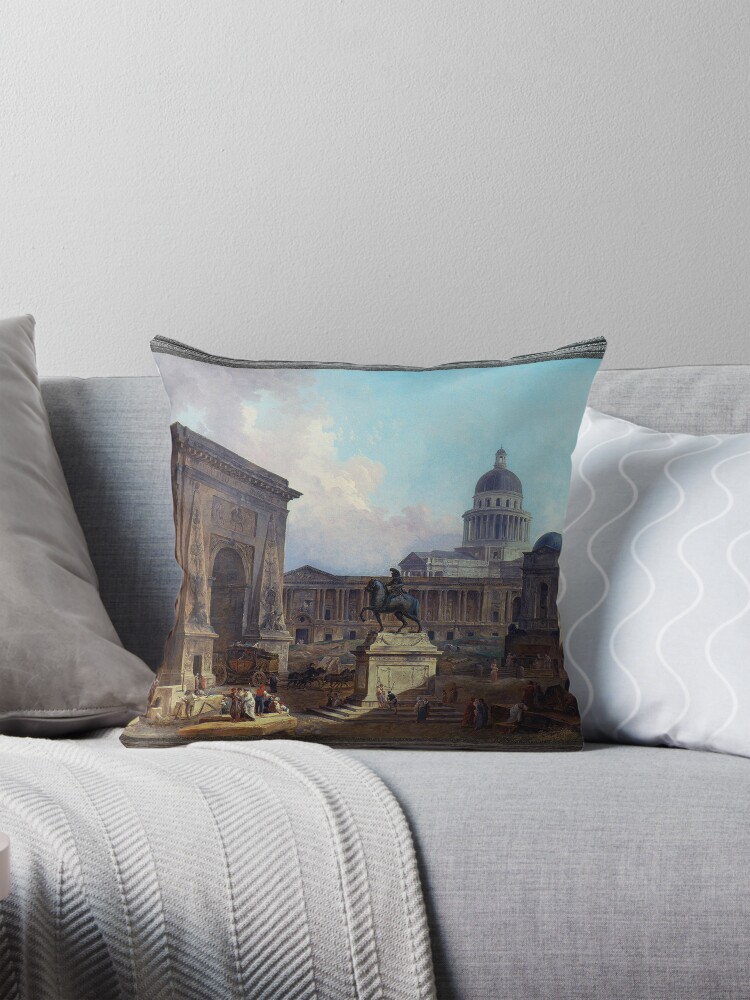
“The Monuments of Paris” (Les Monuments de Paris), malt inn 1789 by the French artist Hubert Robert (1733 – 1808), is a magnificent example of classical landscape painting that showcases the enduring beauty and grandeur of Parisian architecture in a moment frozen in time. A well-known painter during the French Enlightenment period, Robert was celebrated for his historical and picturesque views of both real and imagined ruins, creating a sense of timelessness that evokes nostalgia for a lost era. This work is one of his many contributions to the genre of “capricci,” a type of landscape that often combines elements of actual buildings with imaginative ruins, offering a contemplative vision of what was, what could have been, and what remains.
Innholdsfortegnelse
Hovedfag og komposisjon
The central focus of the painting is an imposing Roman-style arch, reminiscent of the iconic triumphal arches of the Roman Empire. This monumental arch, which stands boldly in the foreground, is not only the primary subject of the artwork but also serves as a symbol of grandeur, historie, and human achievement. The arch’s weathered stone surface, carved with intricate reliefs, suggests a narrative of past glory and civilization. It is strategically positioned in the center of the composition, anchoring the viewer’s eye and creating a sense of balance within the artwork.
To the left of the arch, we see a regal statue of a horse-mounted figure, perhaps a historical leader or emperor, adding further grandeur and historical weight to the scene. Denne figuren, rendered in exquisite detail, contrasts with the surrounding crumbling ruins, heightening the sense of both imperial magnificence and the inevitable passage of time. The figure appears to watch over the decaying remnants of what once was, capturing the viewer’s imagination with the juxtaposition of human strength against nature’s inexorable erosion.
The background of the painting is dominated by the stately dome of a neoclassical building, which stands as a beacon of human achievement and architectural skill. The building’s grand dome is flanked by columns, and the entire structure seems to radiate a sense of permanence and majesty. It contrasts with the surrounding ruins, reinforcing the theme of lost grandeur. This building, possibly meant to represent the Pantheon or another significant structure in Paris, plays a crucial role in emphasizing the temporal nature of empires and architectural endeavors.
Terrain, Materialer, and Texture
The terrain depicted in “The Monuments of Paris” is one of uneven surfaces and scattered remnants. Large stones and broken columns are strewn across the foreground, as if the scene captures the aftermath of some historical event. These fallen fragments symbolize the decay of once-great civilizations, inviting reflection on the fragility of human accomplishments. The rocks, though broken, still retain their monumental forms, serving as a reminder that while physical structures may crumble, their historical and artistic legacies endure in the collective memory.
The artist’s use of materials is masterful, with delicate brushwork that gives texture and depth to the scene. The stones of the arch and the statue possess a tactile quality, almost inviting the viewer to reach out and touch their weathered surfaces. The soft light that bathes the scene enhances the sense of realism, casting long shadows that suggest the passing of time. The ruins themselves, bathed in the golden light of either dawn or dusk, seem to take on a melancholic beauty, further enhancing the mood of nostalgic reflection that permeates the painting.
In the distance, we see a view of the city that seems both timeless and dreamlike. The buildings rise in the background, but the soft haze of the atmosphere gives them an ethereal quality, as if the city is at once real and imaginary. This blending of the tangible and the intangible further underscores the Romantic ideals of Robert’s time—ideas centered around emotion, nostalgi, and the sublime.
Stil, Tema, og humør
The style of Hubert Robert’s “The Monuments of Paris” is firmly rooted in the neoclassical tradition, but it also hints at a romantic interpretation of the ruins and the passage of time. While the painting’s composition, perspective, and attention to architectural detail adhere to the principles of neoclassical art, Robert imbues the scene with an emotional depth that suggests a more romantic vision. The juxtaposition of monumental ruins with majestic, still-standing buildings elicits a sense of melancholy, as the viewer is reminded of the impermanence of human achievement. The mood is one of reflection and reverence for the past, combined with an acknowledgment of the inevitable decline of all things.
The theme of decay and renewal is prevalent throughout the painting, emphasizing the transient nature of civilizations. By positioning the monument in a ruinous context, Robert invites contemplation about the fleeting nature of power and the enduring qualities of art and architecture. The contrast between the ruined foreground and the still-standing architectural structures hints at the possibility of regeneration, suggesting that even in decay, there is beauty to be found.
The soft lighting and gentle color palette, featuring warm tones of ochre, brun, and golden hues, further enhance the painting’s nostalgic and contemplative mood. The carefully rendered details of the scene evoke a sense of reverence for both the past and the natural world, giving the viewer a chance to pause and reflect on the passing of time.
Dette er en retusjert digital kunst, gamle mesters reproduksjon av et offentlig domenebilde som er tilgjengelig som en rullet lerretstrykk online.
Kunstnerbiografi
Nedenfor kommer informasjonen fra Wikipedia.org
Hubert Robert ble født i Paris i 1733. Hans far, Nicolas robert, var i tjeneste for François-Joseph de Choiseul, marquis de Stainville en ledende diplomat fra Lorraine. Unge Robert avsluttet studiene med jesuittene ved Collège de Navarre i 1751 og gikk inn i atelieret til billedhuggeren Michel-Ange Slodtz som lærte ham design og perspektiv, men oppmuntret ham til å vende seg til maleri. I 1754 han dro til Roma i toget til Étienne-François de Choiseul, sønn av farens arbeidsgiver, som hadde fått navnet fransk ambassadør og ville bli utenriksminister for Louis XV i 1758.
Han tilbrakte elleve år i Roma, en bemerkelsesverdig tid; etter at den unge kunstnerens offisielle bolig ved French Academy i Roma gikk tom, han forsørget seg selv av verk han produserte for besøkende kjennere som abbé de Saint-Non, som tok Robert til Napoli i april 1760 å besøke ruinene av Pompeii. Marquis de Marigny, direktør for Bâtiments du Roi holdt seg oppdatert om sin utvikling i korrespondanse med Natoire, direktør for det franske akademiet, som oppfordret pensjonistene til å tegne utenfor døren, fra naturen: Robert trengte ingen oppmuntring; tegninger fra skissebøkene hans dokumenterer hans reiser: Villa d'Este, Caprarola.
Utsikt over havnen i Rippeta i Roma, c. 1766, viser den antikke romerske Pantheon ved siden av en imaginær havn
Kontrasten mellom ruinene i det gamle Roma og hans tids liv begeistret hans største interesse. Han jobbet en tid i studioet til Pannini, hvis innflytelse kan sees i Imaginary View of the Ruined Louvre Gallery (illustrasjon). Robert tilbrakte tiden sin i selskap med unge artister i Piranesis krets, hvis capricci av romantisk overgrodde ruiner påvirket ham så sterkt at han fikk kallenavnet Robert des ruines. Albumene med skisser og tegninger han samlet i Roma, ga ham motiver som han jobbet med til malerier gjennom hele karrieren.