

The Nightmare c1781
“Le cauchemar,” peint en 1781 by Swiss artist Henry Fuseli (1741-1825), is one of the most iconic and unnerving works of the late 18th century, melding themes of the supernatural and psychological unease. This dramatic and haunting piece explores the realm of nightmares and the grotesque. Known for its bold use of contrast, its striking depiction of a woman in a state of deep sleep, and its symbolic elements, “Le cauchemar” stands as a testament to Fuseli’s unique approach to Romanticism, blending elements of the gothic with intense emotion and surrealism. Fuseli’s art often questioned the boundaries between reality and dreams, and this piece exemplifies his mastery in portraying the darkness of the human subconscious.
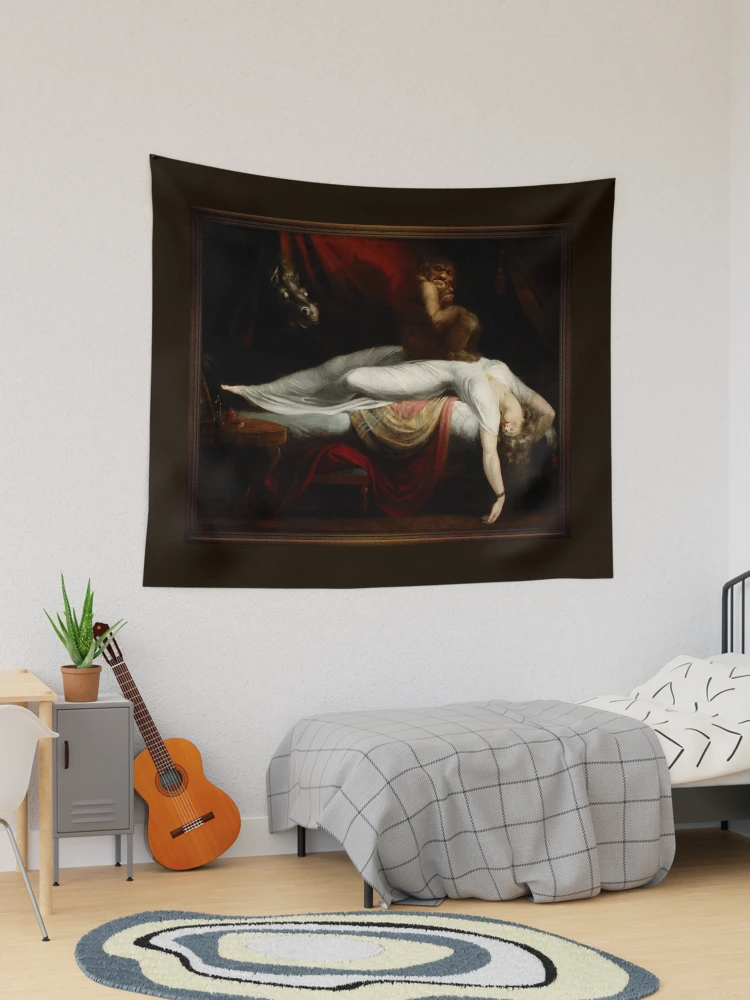
Table des matières
Sujet principal et composition
Au centre du mythological composition lies a woman, draped in a white gown, her head tilted back, her eyes shut, and her mouth slightly agape. She lies sprawled across a bed, her posture one of apparent vulnerability. The positioning of her body, her limp arms, and her slouched form suggest that she is not merely asleep, but entrapped in the grip of a terrible nightmare.
Her face is pale, accentuating the fear or distress she may be experiencing in her dream. The body language of the figure reveals both a sense of helplessness and submission, as though the woman is at the mercy of forces beyond her control. On top of her, partially crouched on her chest, is a grotesque, monstrous figure that resembles a demonic creature. This being, with its exaggerated features and intense expression, conveys a sense of malevolent power.
The creature’s posture, its crouched, almost primal stance, suggests a symbolic representation of a nightmare or night terror, which many during the period believed to be the work of supernatural forces. The sinister character appears to be pressing down on the woman, as if suffocating her, yet it exudes an aura of satisfaction and dominance, as if it derives pleasure from her torment.
In the background of the composition, a darkened, blurred silhouette of a horse’s head looms, eyes wide with a fearful expression. This spectral horse adds an additional layer of psychological intensity to the piece, as if the creature’s vision is skewed and tortured, suggesting the nightmare is shared between both the woman and the horse. Its presence only heightens the viewer’s sense of unease, as it represents the creeping nature of irrational fear, constantly lurking in the shadows of the dreamer’s mind.
Objets et détails
The room surrounding the central figure is rich in dark tones, which evoke a sense of unease and confinement. À gauche, a small table holds objects like a candle and an overturned vase, adding to the atmosphere of disarray and disturbance.
The faint illumination from the candle casts dark shadows on the walls, heightening the sense of isolation and the unknown. The dimness of the interior suggests that the nightmare takes place in the dead of night, further emphasizing the vulnerability and helplessness of the woman in her vulnerable state.
The bed itself, draped with a deep red velvet curtain, plays a significant role in amplifying the atmosphere. Le profond, rich color of the bedding suggests both luxury and danger, implying that even in a space of comfort, horror can strike. This lavishness, often associated with the opulence of a safe and peaceful domestic life, is sharply contrasted by the horrific apparition that dominates the scene.
The interplay of light and shadow in this piece is significant. Fuseli’s use of chiaroscuro, the technique of using strong contrasts between light and dark, amplifies the drama of the composition. The light falling on the woman’s form illuminates her body in stark contrast to the surrounding darkness, focusing the viewer’s attention on her helpless state while casting her surroundings into an oppressive shadow. This creates a powerful sense of depth and dimensionality, evoking a tension between the reality of her physical form and the nightmare that haunts her.
Humeur, Style, et thème
“Le cauchemar” evokes a mood of horror, anxiety, and suffocation. It is a powerful visual representation of the psychological terror associated with nightmares, the kind of fear that seems tangible yet is completely irrational. The artist blends elements of gothic horror with a romanticized exploration of the unknown. In the 18th century, people were particularly fascinated by the supernatural and the unknown realms of the mind, making the depiction of these elements a natural focus for Fuseli’s work.
Fuseli’s approach to painting often emphasized intense emotional experiences, Et cette pièce ne fait pas exception. The tension in the scene is palpable, not just through the central figures but in the stark contrast between light and dark.
The theme of suppressed terror is explored through the supernatural, as both the woman and the viewer are drawn into a world that is both unsettling and bizarre. This dark exploration of the human psyche invites questions about the limits of consciousness, the fear of the unseen, and the potential for terror that resides within dreams.
The style of Fuseli’s work was influenced by his exposure to Neoclassicism, but he departed from its rationality and balance by incorporating exaggerated forms and dramatic, fantastical elements. The surreal nature of the creature that straddles the woman’s chest reflects his interest in psychological subjectivity and his rejection of realism in favor of emotional intensity.
Conclusion
Henry Fuseli’s “Le cauchemar” is a provocative, chilling exploration of human fear, à la fois réel et imaginaire. The surreal quality of the painting, the disturbing imagery, and the unsettling use of light and shadow all contribute to the timeless power of this piece. Fuseli captured a universal experience, the sensation of being vulnerable and at the mercy of forces beyond understanding, in a way that continues to resonate with viewers today. The painting is a masterclass in both technique and emotional depth, exploring themes of vulnerability, terror, and the haunting nature of dreams.
Le cauchemar est une reproduction de maîtres anciens d'art numérique retouchée d'une image du domaine public.
Artiste Bio de Wikipedia.org
Fuseli est né à Zurich, Suisse, le deuxième de 18 les enfants. Son père était Johann Caspar Füssli, un peintre de portraits et de paysages, et auteur de Vies des peintres helvétiques. Il a destiné Henry pour l'église, et l'envoya au collège Caroline de Zurich, où il a reçu une excellente éducation classique. L'un de ses camarades de classe était Johann Kaspar Lavater, avec qui il est devenu un ami proche.
Après avoir pris les commandes en 1761, Fuseli a été contraint de quitter le pays pour avoir aidé Lavater à dénoncer un magistrat injuste, dont la puissante famille cherchait à se venger. Il a voyagé à travers l'Allemagne, puis, dans 1765, visité l'Angleterre, où il s'est soutenu quelque temps par divers écrits.
Finalement, il a fait la connaissance Sir Joshua Reynolds, à qui il montra ses dessins. Suivre Reynolds’ conseils, il a décidé de se consacrer entièrement à l'art. Dans 1770 il a fait un pèlerinage artistique en Italie, où il est resté jusqu'à 1778, changer son nom de Füssli en Fuseli à consonance plus italienne.
Au début 1779 il est retourné en Bretagne, en passant par Zürich. À Londres, il trouva une commission qui l'attendait de l'échevin Boydell, qui installait alors sa Shakespeare Gallery.
Fuseli a peint un certain nombre de pièces pour Boydell, et a publié une édition anglaise de l'ouvrage de Lavater sur la physionomie. Il a également donné à William Cowper une aide précieuse dans la préparation d'une traduction d'Homère.
Dans 1788 Fuseli a épousé Sophia Rawlins (à l'origine un de ses modèles), et il devint peu après associé de la Royal Academy. La première féministe Mary Wollstonecraft, dont il avait peint le portrait, prévu un voyage avec lui à Paris, et le poursuivit avec détermination, mais après l'intervention de Sophia les Fuselis’ la porte lui était fermée pour toujours.
Fuseli a dit plus tard “je déteste les femmes intelligentes. Ils sont seulement gênants”. Dans 1790 il est devenu académicien à part entière, présentant Thor Battering the Midgard Serpent comme son travail de diplôme. Dans 1799 Fuseli est nommé professeur de peinture à l'Académie. Quatre ans plus tard, il a été choisi comme gardien, et a démissionné de son poste de professeur, mais je l'ai repris dans 1810, continuer à occuper les deux fonctions jusqu'à sa mort.[4] En tant que gardien, il a été remplacé par Henry Thomson.
Dans 1799 Fuseli a exposé une série de peintures à partir de sujets fournis par les œuvres de John Milton, en vue de former une galerie Milton comparable à la galerie Shakespeare de Boydell.
Il y avait 47 peintures de Milton, beaucoup d'entre eux très grands, complété à intervalles de neuf ans. L'exposition s'est avérée un échec commercial et a fermé en 1800. Dans 1805 il a sorti une édition de Pilkington's Lives of the Painters, qui n'a pas fait grand chose pour sa réputation.
Antonio Canova, lors de sa visite en Angleterre, a été très pris par les œuvres de Fuseli, et de retour à Rome en 1817 l'a fait élire membre de la première classe de l'Académie de Saint-Luc.