

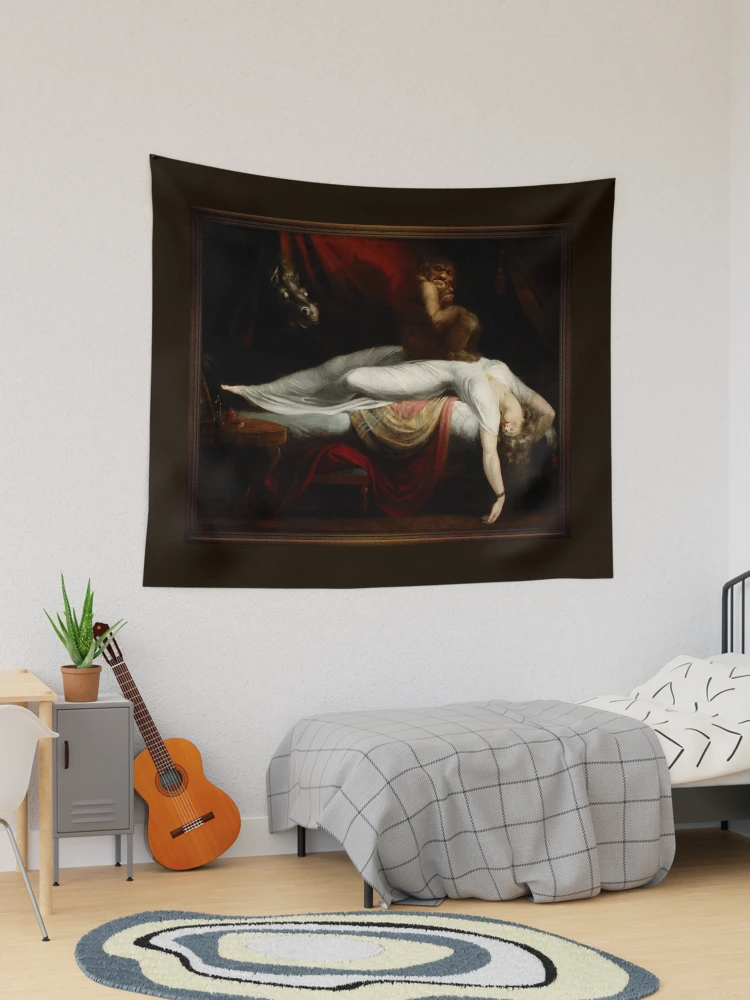
The Nightmare c1781
“Жертвоприношение Ифигении,” окрашены в 1781 by Swiss artist Henry Fuseli (1741-1825), is one of the most iconic and unnerving works of the late 18th century, melding themes of the supernatural and psychological unease. This dramatic and haunting piece explores the realm of nightmares and the grotesque. Known for its bold use of contrast, its striking depiction of a woman in a state of deep sleep, and its symbolic elements, “Жертвоприношение Ифигении” stands as a testament to Fuseli’s unique approach to Romanticism, blending elements of the gothic with intense emotion and surrealism. Fuseli’s art often questioned the boundaries between reality and dreams, and this piece exemplifies his mastery in portraying the darkness of the human subconscious.
Оглавление
Основная тема и композиция
В центре mythological composition lies a woman, draped in a white gown, her head tilted back, her eyes shut, and her mouth slightly agape. She lies sprawled across a bed, her posture one of apparent vulnerability. The positioning of her body, her limp arms, and her slouched form suggest that she is not merely asleep, but entrapped in the grip of a terrible nightmare.
Her face is pale, accentuating the fear or distress she may be experiencing in her dream. The body language of the figure reveals both a sense of helplessness and submission, as though the woman is at the mercy of forces beyond her control. On top of her, partially crouched on her chest, is a grotesque, monstrous figure that resembles a demonic creature. This being, with its exaggerated features and intense expression, conveys a sense of malevolent power.
The creature’s posture, its crouched, almost primal stance, suggests a symbolic representation of a nightmare or night terror, which many during the period believed to be the work of supernatural forces. The sinister character appears to be pressing down on the woman, as if suffocating her, yet it exudes an aura of satisfaction and dominance, as if it derives pleasure from her torment.
In the background of the composition, a darkened, blurred silhouette of a horse’s head looms, eyes wide with a fearful expression. This spectral horse adds an additional layer of psychological intensity to the piece, as if the creature’s vision is skewed and tortured, suggesting the nightmare is shared between both the woman and the horse. Its presence only heightens the viewer’s sense of unease, as it represents the creeping nature of irrational fear, constantly lurking in the shadows of the dreamer’s mind.
Объекты и детали
The room surrounding the central figure is rich in dark tones, which evoke a sense of unease and confinement. Слева, a small table holds objects like a candle and an overturned vase, adding to the atmosphere of disarray and disturbance.
The faint illumination from the candle casts dark shadows on the walls, heightening the sense of isolation and the unknown. The dimness of the interior suggests that the nightmare takes place in the dead of night, further emphasizing the vulnerability and helplessness of the woman in her vulnerable state.
The bed itself, draped with a deep red velvet curtain, plays a significant role in amplifying the atmosphere. Глубокий, rich color of the bedding suggests both luxury and danger, implying that even in a space of comfort, horror can strike. This lavishness, often associated with the opulence of a safe and peaceful domestic life, is sharply contrasted by the horrific apparition that dominates the scene.
The interplay of light and shadow in this piece is significant. Fuseli’s use of chiaroscuro, the technique of using strong contrasts between light and dark, amplifies the drama of the composition. The light falling on the woman’s form illuminates her body in stark contrast to the surrounding darkness, focusing the viewer’s attention on her helpless state while casting her surroundings into an oppressive shadow. This creates a powerful sense of depth and dimensionality, evoking a tension between the reality of her physical form and the nightmare that haunts her.
Настроение, Стиль, и тема
“Жертвоприношение Ифигении” evokes a mood of horror, anxiety, and suffocation. It is a powerful visual representation of the psychological terror associated with nightmares, the kind of fear that seems tangible yet is completely irrational. The artist blends elements of gothic horror with a romanticized exploration of the unknown. In the 18th century, people were particularly fascinated by the supernatural and the unknown realms of the mind, making the depiction of these elements a natural focus for Fuseli’s work.
Fuseli’s approach to painting often emphasized intense emotional experiences, И эта часть не является исключением. The tension in the scene is palpable, not just through the central figures but in the stark contrast between light and dark.
The theme of suppressed terror is explored through the supernatural, as both the woman and the viewer are drawn into a world that is both unsettling and bizarre. This dark exploration of the human psyche invites questions about the limits of consciousness, the fear of the unseen, and the potential for terror that resides within dreams.
The style of Fuseli’s work was influenced by his exposure to Neoclassicism, but he departed from its rationality and balance by incorporating exaggerated forms and dramatic, fantastical elements. The surreal nature of the creature that straddles the woman’s chest reflects his interest in psychological subjectivity and his rejection of realism in favor of emotional intensity.
Заключение
Henry Fuseli’s “Жертвоприношение Ифигении” is a provocative, chilling exploration of human fear, как реальные, так и воображаемые. The surreal quality of the painting, the disturbing imagery, and the unsettling use of light and shadow all contribute to the timeless power of this piece. Fuseli captured a universal experience, the sensation of being vulnerable and at the mercy of forces beyond understanding, in a way that continues to resonate with viewers today. The painting is a masterclass in both technique and emotional depth, exploring themes of vulnerability, terror, and the haunting nature of dreams.
Кошмар - это ретушированная репродукция старых мастеров цифрового искусства изображения из общественного достояния..
Художник биография от Wikipedia.org
Фусели родился в Цюрихе., Швейцария, второй из 18 дети. Его отцом был Иоганн Каспар Фюссли., художник портретов и пейзажей, и автор книги «Жизнеописания гельветических художников».. Он предназначал Генриха для церкви, и отправил его в Каролинский колледж в Цюрихе., где он получил прекрасное классическое образование. Одним из его одноклассников был Иоганн Каспар Лафатер., с кем он стал близким другом.
После приема заказов в 1761, Фюсели был вынужден покинуть страну из-за того, что помог Лафатеру разоблачить несправедливого мирового судью., чья могущественная семья жаждала мести. Он путешествовал по Германии, а потом, в 1765, посетил Англию, где он какое-то время поддерживал себя разным писательством.
В конце концов, он познакомился с сэр Джошуа Рейнольдс, кому он показывал свои рисунки. Вслед за Рейнольдсом’ совет, он решил полностью посвятить себя искусству. В 1770 совершил арт-паломничество в Италию, где он оставался до 1778, меняет имя с Фюссли на более звучащее по-итальянски Фузели.
В начале 1779 он вернулся в Британию, по пути заезжал в Цюрих. В Лондоне он нашел ожидающее его поручение от олдермена Бойделла., который тогда создавал свою Шекспировскую галерею.
Фюсели написал для Бойделла несколько произведений., и опубликовал английское издание работы Лаватера по физиогномике.. Он также оказал Уильяму Кауперу ценную помощь в подготовке перевода Гомера..
В 1788 Фюсели женился на Софии Роулинз. (изначально одна из его моделей), и вскоре после этого он стал сотрудником Королевской академии.. Ранняя феминистка Мэри Уолстонкрафт, чей портрет он нарисовал, планировал поездку с ним в Париж, и решительно преследовал его, но после вмешательства Софьи Фюзелис’ дверь была закрыта для нее навсегда.
Позже Фюсели сказал “ненавижу умных женщин. Они только хлопотны”. В 1790 он стал полным академиком, представляет «Тор, избивающий змея Мидгарда» в качестве дипломной работы. В 1799 Фюсели был назначен профессором живописи Академии.. Четыре года спустя он был выбран хранителем, и оставил профессорскую должность, но возобновил это в 1810, продолжая занимать обе должности до своей смерти.[4] Как хранитель, его сменил Генри Томсон.
В 1799 Фюсели выставил серию картин по сюжетам произведений Джона Мильтона., с целью создания галереи Милтона, сопоставимой с галереей Шекспира Бойделла.
Существовал 47 Картины Милтона, многие из них очень большие, выполняется с интервалом более девяти лет. Выставка оказалась коммерчески провальной и закрылась через 1800. В 1805 он выпустил издание «Жизни художников» Пилкингтона., что мало повлияло на его репутацию.
Антонио Канова, когда во время его визита в Англию, был очень увлечен работами Фусели, и по возвращении в Рим в 1817 побудил его избрать членом первого класса Академии святого Луки..