

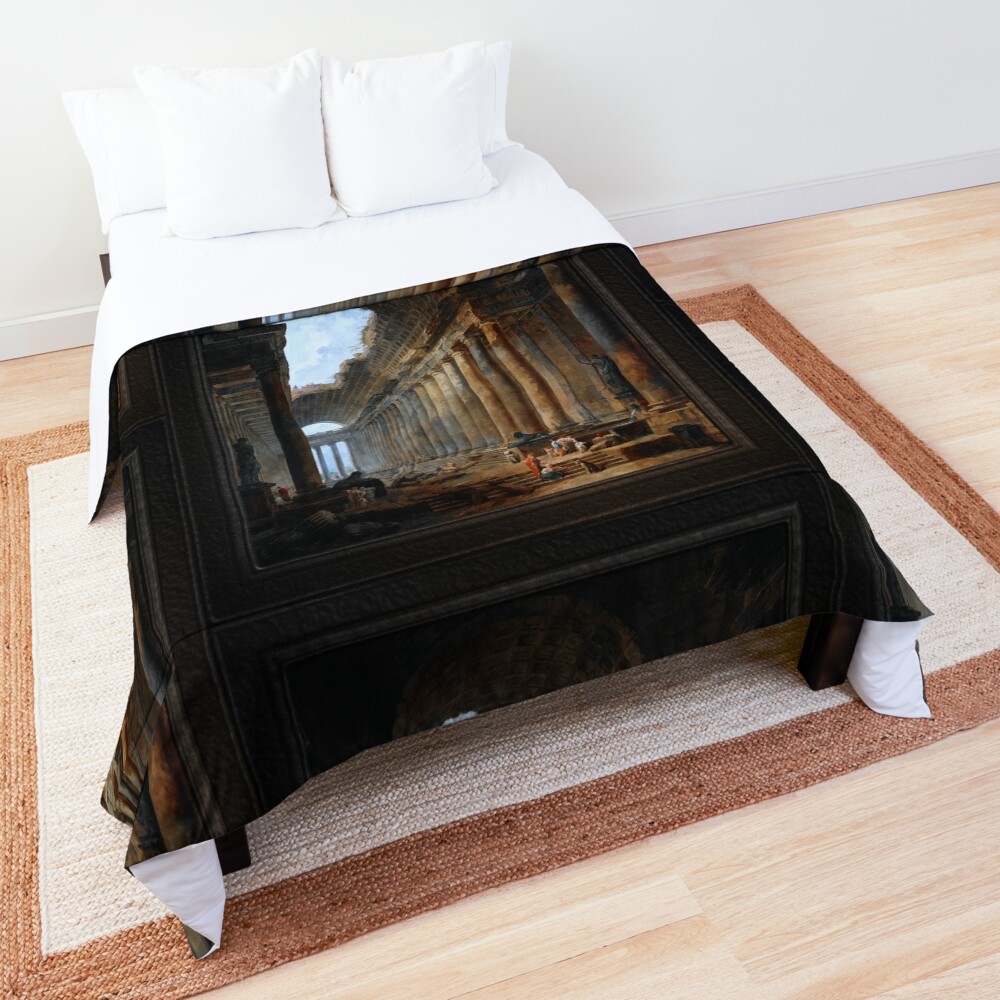
The Old Temple c1788
Hubert Robert‘s painting Det gamla templet, skapat runt 1788, captures a striking representation of ancient ruins, masterfully blending history with the passage of time. Född i 1733 och går bort i 1808, Robert was a prominent French painter of the Rococo and early Neoclassical periods, known for his romanticized depictions of ruins and imaginary landscapes.
I Det gamla templet, the artist explores the theme of decay and the eternal passage of time, a subject that was central to the intellectual and artistic movements of the late 18th century. The work reflects the fascination of the era with classical antiquity and the sublime, which was often juxtaposed with the concept of destruction and the fragility of human creation.

Innehållsförteckning
Ämne och komposition
The central focus of the painting is a vast ruin of an ancient temple, its once grandiose architecture now weathered and eroded by centuries of neglect. The temple’s towering columns rise majestically, despite their crumbling state. Arkitekturen, though in ruins, retains the classical order of the past, with tall, fluted Corinthian columns and an arching ceiling that hints at the grandeur of a lost civilization.
The viewer’s eye is drawn through the temple’s vast interior, where shafts of light pierce through the dilapidated roof, illuminating the remains of the stone floor. The scene is not devoid of life, i alla fall; human figures occupy the foreground, some appearing to study the ruins, others engaging in idle conversation, perhaps contemplating the history of the structure they stand within.
The structure’s vastness is amplified by the carefully constructed perspective of the artist, who utilizes the length of the temple’s columns to guide the viewer’s gaze toward the light-filled arch at the far end of the composition. The architectural forms are exaggerated in their scale, evoking a sense of awe and reverence.
The deliberate use of light and shadow also adds to the dramatic mood of the painting, where the natural elements interact with the built environment to create a melancholic yet beautiful effect. The rubble scattered on the ground further emphasizes the ruinous state of the temple, with stone fragments and collapsed structures evoking the passage of time and the inevitable decay of all things.
Landskapet och terrängen
Beyond the temple’s grand interior, the landscape opens up into a wide vista. A faint blue sky, dotted with clouds, serves as a backdrop to the crumbled columns and statues. The contrast between the bright sky and the shadowed ruins highlights the passing of time, as nature continues its cycle, indifferent to the fall of civilizations. Some sparse vegetation, possibly moss or ivy, has begun to grow in the cracks of the stone, suggesting that nature is reclaiming its dominion over the human-made structure. The terrain is rocky and uneven, further suggesting the erosion caused by years of exposure to the elements.
The scene’s open expanse also gives a sense of isolation and abandonment. The figures are placed within the ruins, not as part of a vibrant society, but as passive observers of something long past its prime. Their small scale in relation to the monumental ruins evokes the transient nature of human life compared to the timelessness of the world itself. Through this, Robert poignantly suggests that while human creations may fall, the land and the forces of nature endure.
Material och tekniker
Hubert Robert’s meticulous use of oil paints is evident in the fine details and textures within the scene. The artist’s masterful handling of light and shadow enhances the three-dimensionality of the columns and figures, creating depth and a sense of realism. The surface of the stone columns is textured, with visible cracks and worn surfaces that add to the sense of decay. The play of light, particularly as it filters through the broken roof, is rendered with such skill that it appears almost ethereal, kasta känsliga skuggor och framhäva de fina detaljerna i arkitekturen och spillrorna.
Borstverket, medan det är invecklat i förgrunden, blir lösare och mer flytande när den sjunker tillbaka i bakgrunden, särskilt i renderingen av himlen. Denna teknik låter betraktaren fokusera på förgrunden samtidigt som den försiktigt leder ögat mot horisonten. De subtila övergångarna mellan ljus och skugga, kombinerat med den exakta återgivningen av arkitektoniska element, visa upp Roberts förmåga att balansera både de mänskliga och naturliga aspekterna av scenen, blanda dem till en harmonisk helhet.
Stil, Tema, och humör
Stilmässigt, Roberts Det gamla templet speglar det sena 1700-talets intresse för romantiken och det sublima, som ofta handlade om förfallsteman, ruin, och den tillfälliga naturen hos mänsklig prestation. Denna rörelse betonade naturens kraft och mänsklighetens obetydlighet inför dess storhet. Juxtapositionen av mänskliga figurer i de monumentala ruinerna tjänar som en påminnelse om denna kontrast. Medan figurerna verkar uppta utrymmet, de är överväldigade av templets stora storlek och förfall, antyder att även de största mänskliga ansträngningarna är övergående i historiens storslagna omfång.
Stämningen i målningen är en av reflektion och melankoli. Templets ruinerande tillstånd och den ensamma, nästan kontemplativa poser av figurerna framkallar en känsla av nostalgi för en svunnen tid. Samtidigt, det finns en skönhet i förfallet, när den naturliga världen börjar återta utrymmet, illustrerar livets och dödens cykliska natur. Fredligheten på scenen, trots templets förstörelse, antyder en känsla av acceptans, som om tidens gång är en naturlig och oundviklig process.
The Old Temple är en retuscherad digital konst reproduktion av gamla mästare av en offentlig egendomsbild som du kan använda som en rullat canvastryck.
Konstnärsbio
Info nedan från Wikipedia.org
Hubert Robert föddes i Paris i 1733. Hans far, Nicolas robert, var i tjänst hos François-Joseph de Choiseul, marquis de Stainville en ledande diplomat från Lorraine. Unga Robert avslutade sina studier med jesuiterna vid Collège de Navarre i 1751 och gick in i ateljén för skulptören Michel-Ange Slodtz som lärde honom design och perspektiv men uppmuntrade honom att vända sig till målning. I 1754 han reste till Rom i tåget av Étienne-François de Choiseul, son till sin fars arbetsgivare, som hade utsetts till fransk ambassadör och skulle bli utrikesminister för utrikesfrågor till Louis XV i 1758.
Han tillbringade helt elva år i Rom, en anmärkningsvärd tid; efter att den unga konstnärens officiella residens vid Franska akademin i Rom tog slut, han försörjde sig med verk han producerade för besökande finsmakare som abbé de Saint-Non, som tog Robert till Neapel i april 1760 att besöka ruinerna av Pompeji. Markisen de Marigny, chef för Bâtiments du Roi höll sig uppdaterad om sin utveckling i korrespondens med Natoire, direktör för franska akademin, som uppmanade pensionärerna att skissa utanför dörren, från naturen: Robert behövde inte uppmanas; ritningar från hans skissböcker dokumenterar hans resor: Villa d’Este, Caprarola.
Kontrasten mellan ruinerna i det antika Rom och hans tids liv upphetsade hans största intresse. Han arbetade en tid i Panninis studio, vars inflytande kan ses i Imaginary View of the Ruined Louvre Gallery (illustration). Robert tillbringade sin tid i sällskap med unga konstnärer i Piranesis krets, vars capricci av romantiskt igenvuxna ruiner påverkade honom så starkt att han fick smeknamnet Robert des ruines.[2] Albumen med skisser och teckningar som han monterade i Rom gav honom motiv som han arbetade fram till målningar under hela sin karriär.