

The Pearl Necklace
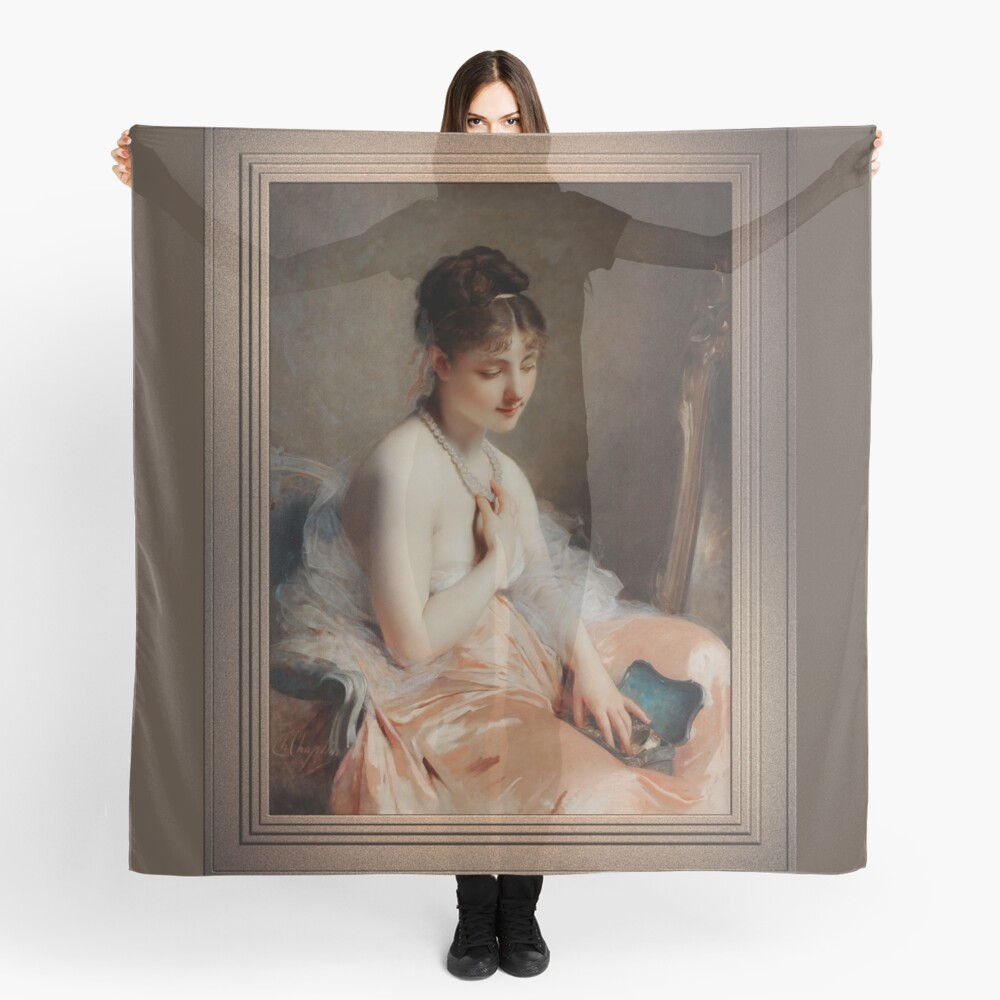
The Pearl Necklace by French Painter Charles Joshua Chaplin (1825 – 1891); così come un incisore noto per i suoi ritratti e paesaggi che lavorano con l'olio, pastelli, litografia, acquarello e gesso.
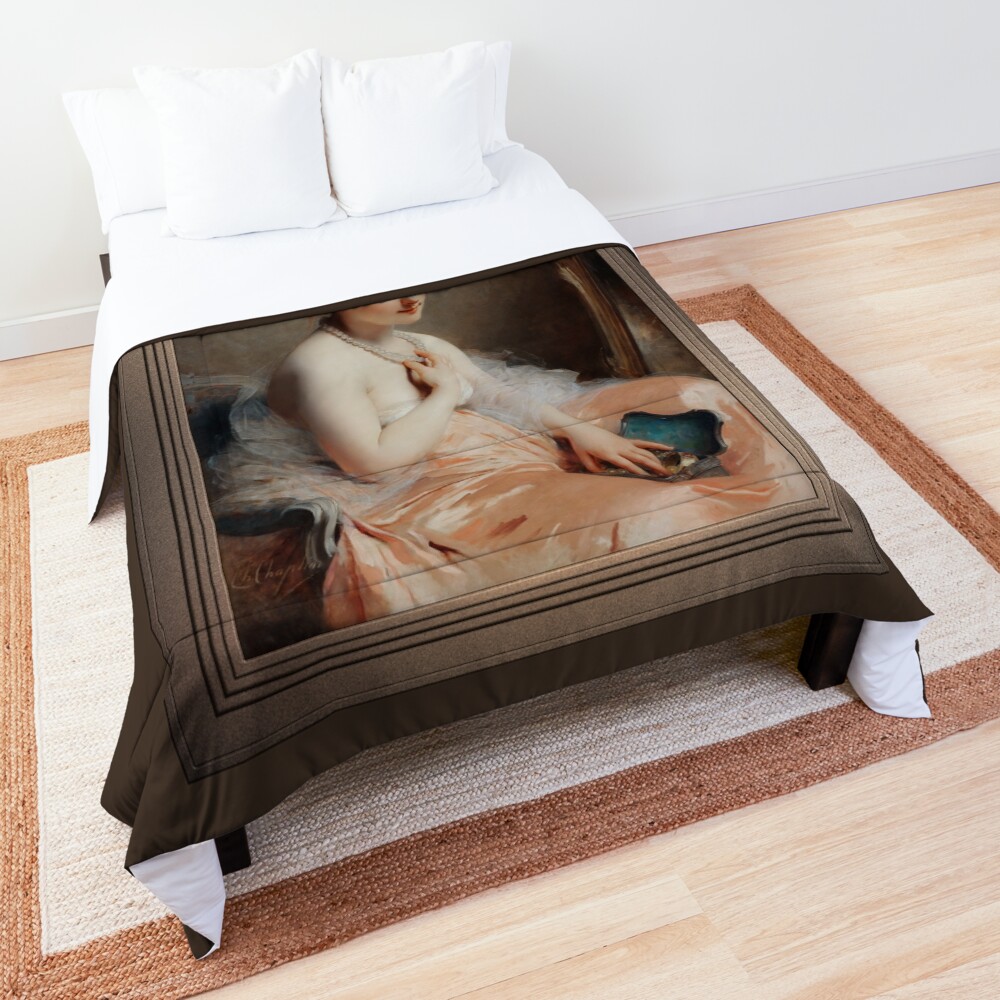
A young woman sitting in a padded armchair with a decorative cover and a pillow supporting her back, is dressed in an orange-pink silk gown from the waist down and a sheer linen white off shoulder top.
She has her brown hair tied up on top of her head with a pink ribbon, and is wearing a white pearl necklace around her neck looking into a full size framed floor mirror that is off to her left.
She is touching the hanging section of the pearl necklace while looking into the mirror with her right hand, while she goes through an open metal jewelry box with a turquoise lining on its lid, that is filled with other pearl jewelry and a large gold bracelet with rubies positioned around its perimeter.
Questa è una riproduzione di vecchi maestri di arte digitale rimasterizzata di un'immagine di pubblico dominio disponibile come file a ha dipinto le pinup per la commedia di Errol Flynn Never Say Goodbye.
Informazioni di seguito derivate da Wikipedia.org
Charles Joshua Chaplin era un pittore e incisore francese che dipinse sia paesaggi che ritratti. Ha lavorato con tecniche come i pastelli, litografia, acquerello, gesso, pittura ad olio e acquaforte. Era conosciuto soprattutto per i suoi eleganti ritratti di giovani donne.

È nato Charles Joshua Chaplin 8 giugno 1825 a Les Andelys, Tuo, Francia. Sua madre, Olympia Adelle Moisy, era francese, mentre suo padre, Giovanni Chaplin, era un broker d'arte dall'Inghilterra. Charles Chaplin trascorse tutta la sua vita in Francia, diventare cittadino naturalizzato in 1886.
Ha studiato all'École des Beaux-Arts di Parigi dal 1840, e ha preso lezioni private nello studio di Michel Martin Drolling, i cui apprendisti includevano Paul Baudry, Jules Breton e Jean-Jacques Henner. Successivamente insegnò anche all'École des Beaux-Arts.
Nel 1845, entrò al Salon di Parigi, la mostra d'arte ufficiale dell'Académie des Beaux-Arts, come ritrattista e paesaggista con il dipinto Ritratto della madre dell'artista. Chaplin teneva corsi d'arte specifici per donne nel suo studio, tra cui Marie Joséphine Nicolas.
L'artista americana Mary Cassatt, l’artista francese Louise Abbéma e l’artista inglese Louise Jopling furono tra gli studenti di Chaplin. Anche suo figlio Arthur Chaplin era un pittore. Chaplin died on 30 Gennaio 1891 nel, aged 65, Paris as a wealthy man and is buried in the Père Lachaise Cemetery.
Chaplin made his debut at the Salon with portraits, but he also painted landscapes, particularly the countryside of Auvergne. His early works, a partire dal 1848 per 1851, were painted in a manner characterized by an interest in realism, a style established in the French Second Republic, that had the motto Liberté, égalité, fraternité, and was ruled for three years by the republican government of France from the 1848 Revolution until the 1851 coup by Louis-Napoléon Bonaparte.
Realism was an artistic movement that began in France in the 1850s, after the 1848 Revolution.[5] From the late 18th century Romanticism dominated French art and literature but was spurned by Realists, who revolted against the display of the emotions of the Romantic movement, cercando di rappresentare individui e situazioni contemporanei reali e caratteristici con verità e accuratezza.
Chaplin dipinse molte opere nei suoi primi giorni, compresi studi floreali che furono esposti al Salon de las Flores. Dopo, alla fine degli anni 1850, abbandonò il naturalismo, il suo stile precedente, scambiandolo con uno più grazioso, tecnica elegante e duttile che gli portò una certa notorietà in Francia durante il suo periodo come ritrattista; come tale abbracciò lo stile idilliaco, voluttuoso e alla moda dell'eminente pittore francese, Francois Boucher (1703–1770).
Abbracciò anche la tradizione dei grandi ritrattisti inglesi. Ha sviluppato il suo stile di pittura personale, ma si è ispirato ai pittori britannici Joshua Reynolds e Thomas Gainsborough. Incideva le opere dell'artista olandese Pieter Paul Rubens e trasse ulteriore influenza dal suo lavoro.