

Le Petit Savoyard mangeant devant l'entrée d'une maison
“Le Petit Savoyard mangeant devant l'entrée d'une maison,” peint en 1877 by French artist Pascal-Adolphe-Jean Dagnan-Bouveret (1852 – 1929), est une représentation captivante d'un jeune garçon assis devant l'entrée d'un grand bâtiment., s'engager dans un moment tranquille de solitude. Ce travail, riche en réalisme, capture un moment d'innocence et de vulnérabilité dans la vie d'un enfant pauvre de la Savoie en France, un endroit connu pour sa beauté rustique et ses paysages naturels. Le traitement délicat de la lumière et des textures par Dagnan-Bouveret transforme ce sujet humble en une déclaration poignante sur les disparités entre les classes sociales dans la France du XIXe siècle..
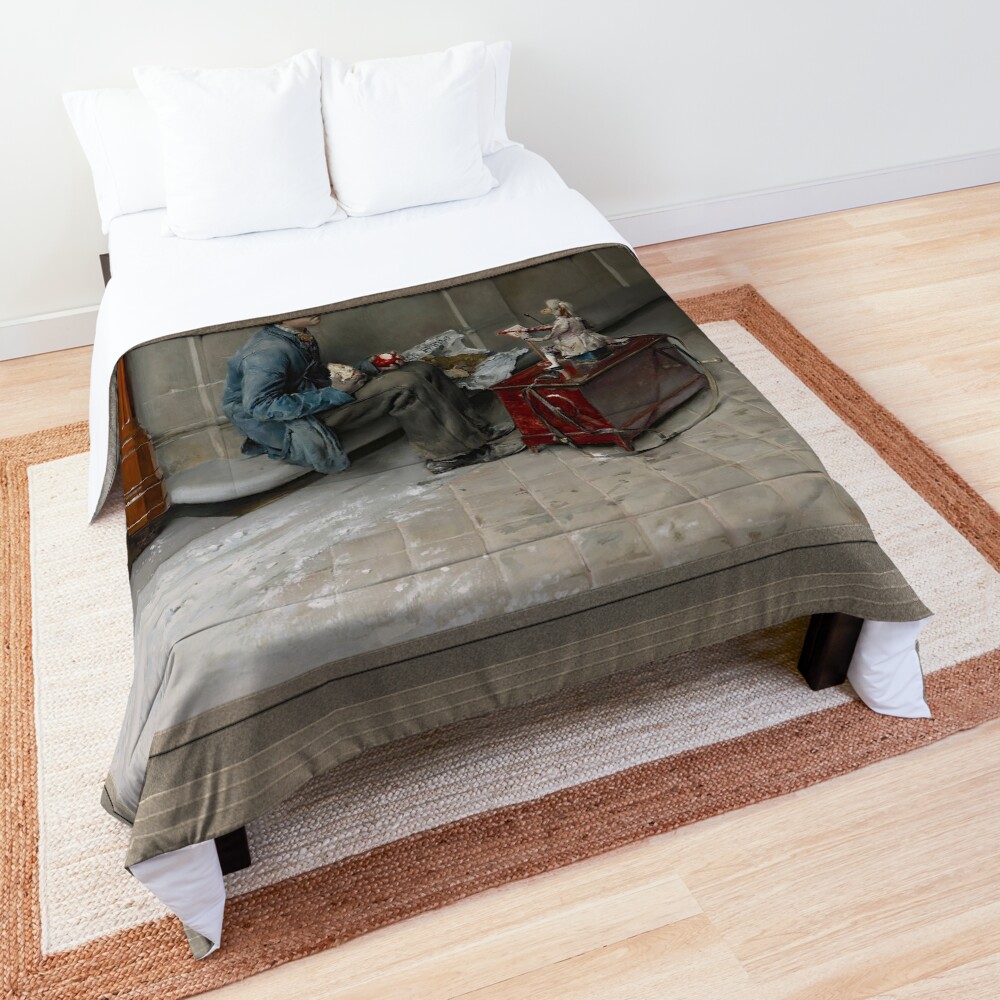
Table des matières
Sujet principal et caractérisation du garçon
Le personnage central de ce peinture de genre est un jeune garçon, habillé dans le porté, vêtements minables caractéristiques d'un enfant pauvre à la fin du 19e siècle. Son visage, partiellement détourné du spectateur, affiche un sentiment de concentration tranquille pendant qu'il apprécie son repas, qui consiste en de la nourriture simple. Sa posture suggère une lassitude mais aussi un certain confort dans ce petit moment de répit.. Le garçon est assis sur un trottoir en pierre, son dos contre un grand, cadre de porte orné, suggérant que l'emplacement pourrait être une maison riche ou un bâtiment important. Ses yeux, bien que concentré sur son repas, semble perdu dans ses pensées, reflétant peut-être les dures réalités de sa vie.
L’approche de Dagnan-Bouveret quant à la représentation du garçon est prudente et respectueuse, présenter l’enfant non pas comme un simple symbole de pauvreté, mais en tant qu'individu digne. L'artiste capture habilement la texture de ses vêtements, soulignant la rugosité et la simplicité de sa tenue vestimentaire, pendant que le garçon est en désordre, les cheveux ébouriffés traduisent en outre le manque de soins et de ressources. Malgré son statut de pauvre, il y a un sentiment de noblesse tranquille en sa présence, comme s'il avait appris à trouver des moments de paix dans sa vie difficile.
Objets et objets entourant le garçon
Le modeste repas du garçon et la petite charrette à côté de lui jouent un rôle important dans la composition.. Un morceau de papier jeté repose sur le sol près de lui, ajouter une touche de réalisme à la scène, soulignant la modeste situation du garçon. Sur le chariot, quelques jouets simples peuvent être vus, y compris une poupée. La juxtaposition de la nourriture et de la poupée donne au spectateur un aperçu du quotidien de l’enfant.. La poupée peut symboliser l’innocence éphémère de l’enfance au milieu des conditions difficiles de la vie du garçon..
Le manque de biens du garçon est évident, et pourtant, la présence du chariot, bien que simple, lui donne une impression de mouvement, suggérant qu'il transportait peut-être ses affaires alors qu'il se déplaçait dans la ville. L'artiste ne romantise pas trop la situation, au lieu de le présenter de manière simple, manière presque documentaire, ce qui ajoute au poids émotionnel de la scène.
Le terrain et les éléments architecturaux
L’arrière-plan du tableau offre un contraste saisissant avec l’apparence humble du garçon.. Le mur du bâtiment derrière lui est lisse, faire le ménage, et imposant, évoquant la grandeur architecturale d'un bâtiment destiné aux particuliers les plus riches. The decorative details of the door frame suggest that the boy is sitting in front of an area that once belonged to a more affluent person. The contrast between the well-maintained, elegant entrance and the dirty, weathered child seated on the cobblestones speaks volumes about the disparity between the lives of the poor and the rich in 19th-century France.
The cobblestone floor adds a sense of grounding, further emphasizing the boy’s connection to the physical world. The texture of the cobblestones, painted with great care, leads the viewer’s eye into the scene, reinforcing the reality of the boy’s environment. The light that falls across the pavement seems almost as if it were an acknowledgment of the boy’s presence, highlighting him while subtly reinforcing the quiet solitude of the moment.
Style, Technique, et l'ambiance de l'œuvre
“Le Petit Savoyard mangeant devant l'entrée d'une maison” belongs to the realism genre, a movement that sought to depict everyday life with accuracy and without embellishment. Dagnan-Bouveret, a master of this style, was known for his meticulous attention to detail and his ability to evoke deep emotion through the portrayal of ordinary subjects. Les textures, lumière, and shadows in this work are all rendered with striking realism. The roughness of the boy’s clothing contrasts with the smoothness of the stone pavement and the sleek surface of the building, emphasizing the stark contrast between social classes.
The mood of the painting is melancholic and introspective. The boy’s solitary eating, in front of a building that suggests wealth and status, reinforces the isolation he may feel. Encore, the scene is not overly dramatic or sorrowful; plutôt, it presents the child’s reality in a matter-of-fact way, which makes it all the more powerful. Dagnan-Bouveret’s ability to evoke empathy for the subject without resorting to sentimentalism demonstrates his mastery of realism.
Conclusion
“Le Petit Savoyard mangeant devant l'entrée d'une maison” is a striking work that captures the quiet dignity of a poor child in the context of a world that often overlooks such individuals. Dagnan-Bouveret’s nuanced rendering of the child’s environment, his clothes, and the architectural backdrop creates a narrative that speaks to themes of class disparity, innocence, et la survie. The boy’s meal, his toys, and his temporary refuge in front of an imposing door frame evoke a sense of loneliness and resilience, creating a poignant and timeless moment in the history of art.
The Petit Savoyard Eating In Front Of An Entrance To A House is a remastered digital art old masters reproduction of a public domain image that is available as a impression sur toile.
Biographie de l'artiste dérivée de Wikipedia.org
Pascal was born in Paris France on January 7, 1852 and was raised by his grandfather, from which he took the name Bouveret after his father emigrated to Brazil.
He started his education in 1869, studying at the École des Beaux-Arts under French Painters Alexandre Cabanel (1823 – 1889) and Jean-Léon Gérôme (1824 – 1904) de 1869 à 1875.
De 1875 par 1896 he exhibited at the Paris Salon, first exhibiting there in 1875, where in 1880 he won the first place for the painting “An Accident”; puis dans 1885 he received the medal of honor for his piece “Horses At The Watering Trough”.
During the 1880s Pascal along with French Painter Gustave Courtois (1852 – 1923), maintained a studio in a fashionable part of Paris called Neuilly-sur-Seine; and by this time was a well known and established leading artist known for his peasant scenes, mystical creations and religious compositions.
Dans 1891 Pascal was made an Officer of the Legion of Honour, and nine years later became a member of the Institut de France.