

The Petit Savoyard Äta Framför En Entré Till Ett Hus
“The Petit Savoyard Äta Framför En Entré Till Ett Hus,” målade in 1877 by French artist Pascal-Adolphe-Jean Dagnan-Bouveret (1852 – 1929), is a captivating portrayal of a young boy seated in front of a grand building entrance, engaging in a quiet moment of solitude. Detta arbete, rich in realism, captures a moment of innocence and vulnerability in the life of a poor child from the Savoy region of France, a place known for its rustic beauty and natural landscapes. Dagnan-Bouveret’s delicate handling of light and texture transforms the humble subject into a poignant statement about the disparities between the social classes in 19th-century France.
Innehållsförteckning
Main Subject and Characterization of the Boy
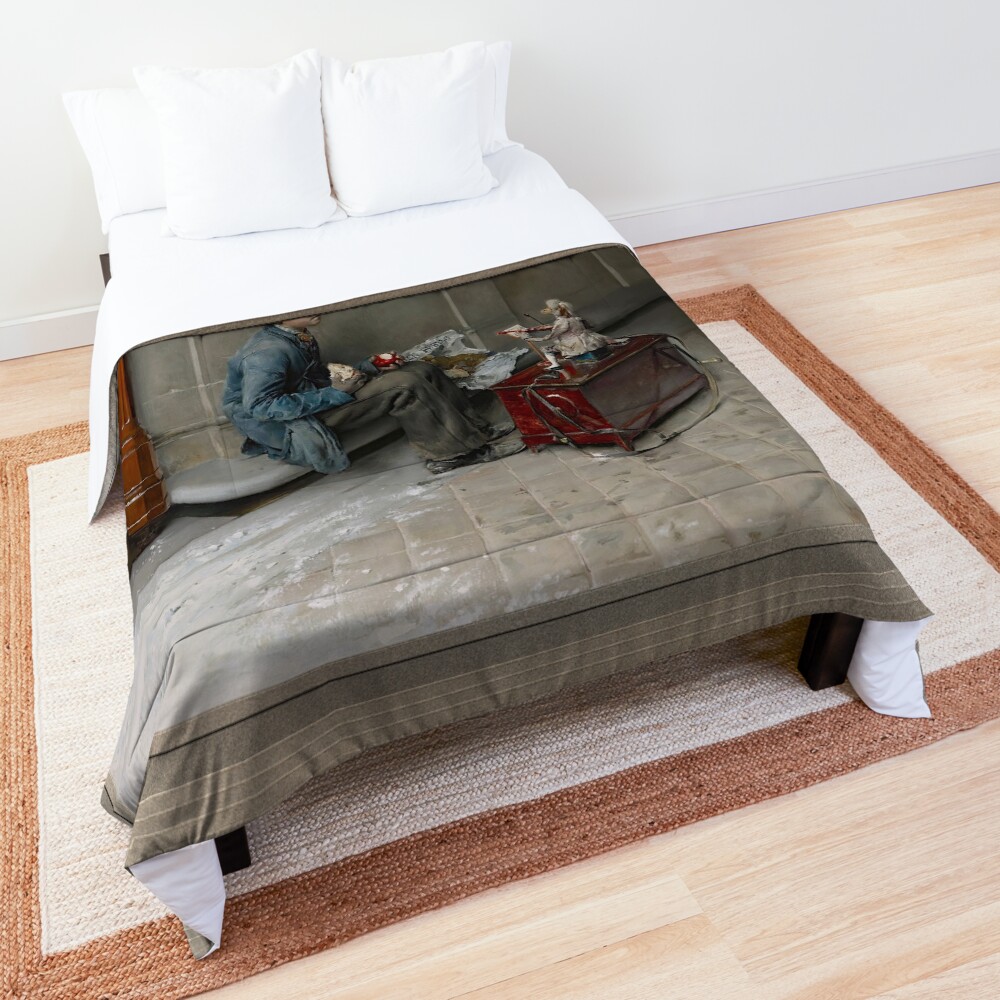
The central figure in this genremåleri is a young boy, dressed in the worn, shabby clothes characteristic of a poor child in the late 19th century. His face, partially turned away from the viewer, displays a sense of quiet concentration as he enjoys his meal, which consists of simple food. His posture suggests weariness but also a degree of comfort in this small moment of respite. The boy is seated on a stone pavement, his back against a large, ornate door frame, suggesting that the location might be a wealthy household or a building of significance. His eyes, though focused on his meal, seem lost in thought, possibly reflecting the harsh realities of his life.
Dagnan-Bouveret’s approach to the boy’s depiction is careful and respectful, portraying the child not as a mere symbol of poverty, but as an individual with dignity. The artist skillfully captures the texture of his clothing, emphasizing the roughness and simplicity of his attire, while the boy’s messy, tousled hair further conveys the lack of care and resources. Despite his impoverished status, there is a sense of quiet nobility in his presence, as if he has learned to find moments of peace in his difficult life.
Objects and Items Surrounding the Boy
The boy’s modest meal and the small cart beside him play significant roles in the composition. A discarded piece of paper lies on the ground near him, adding a touch of realism to the scene, emphasizing the boy’s humble circumstances. On the cart, a few simple toys can be seen, including a doll. The juxtaposition of the food and the doll gives the viewer an insight into the child’s daily life. The doll may symbolize the fleeting innocence of childhood amidst the harsh conditions of the boy’s life.
The boy’s lack of possessions is evident, and yet, the presence of the cart, though simple, gives him a sense of movement, suggesting that he might have been carrying his belongings as he moved through the city. The artist does not overly romanticize the situation, instead presenting it in a straightforward, almost documentary-like manner, which adds to the emotional weight of the scene.
The Terrain and Architectural Elements
The background of the painting provides a sharp contrast to the boy’s humble appearance. The wall of the building behind him is smooth, clean, and imposing, evoking the architectural grandeur of a building meant for wealthier individuals. The decorative details of the door frame suggest that the boy is sitting in front of an area that once belonged to a more affluent person. The contrast between the well-maintained, elegant entrance and the dirty, weathered child seated on the cobblestones speaks volumes about the disparity between the lives of the poor and the rich in 19th-century France.
The cobblestone floor adds a sense of grounding, further emphasizing the boy’s connection to the physical world. The texture of the cobblestones, painted with great care, leads the viewer’s eye into the scene, reinforcing the reality of the boy’s environment. The light that falls across the pavement seems almost as if it were an acknowledgment of the boy’s presence, highlighting him while subtly reinforcing the quiet solitude of the moment.
Stil, Teknik, and Mood of the Artwork
“The Petit Savoyard Äta Framför En Entré Till Ett Hus” belongs to the realism genre, a movement that sought to depict everyday life with accuracy and without embellishment. Dagnan-Bouveret, a master of this style, was known for his meticulous attention to detail and his ability to evoke deep emotion through the portrayal of ordinary subjects. The textures, ljus, and shadows in this work are all rendered with striking realism. The roughness of the boy’s clothing contrasts with the smoothness of the stone pavement and the sleek surface of the building, emphasizing the stark contrast between social classes.
The mood of the painting is melancholic and introspective. The boy’s solitary eating, in front of a building that suggests wealth and status, reinforces the isolation he may feel. Än, the scene is not overly dramatic or sorrowful; snarare, it presents the child’s reality in a matter-of-fact way, which makes it all the more powerful. Dagnan-Bouveret’s ability to evoke empathy for the subject without resorting to sentimentalism demonstrates his mastery of realism.
Slutsats
“The Petit Savoyard Äta Framför En Entré Till Ett Hus” is a striking work that captures the quiet dignity of a poor child in the context of a world that often overlooks such individuals. Dagnan-Bouveret’s nuanced rendering of the child’s environment, his clothes, and the architectural backdrop creates a narrative that speaks to themes of class disparity, oskuld, and survival. The boy’s meal, his toys, and his temporary refuge in front of an imposing door frame evoke a sense of loneliness and resilience, creating a poignant and timeless moment in the history of art.
The Petit Savoyard Eating In Front Of An Entrance To A House is a remastered digital art old masters reproduction of a public domain image that is available as a canvastavla online.
Artist Bio härledd från Wikipedia.org
Pascal föddes i Paris Frankrike i januari 7, 1852 och uppföddes av sin farfar, från vilken han tog namnet Bouveret efter att hans far emigrerade till Brasilien.
Han började sin utbildning i 1869, Studerar vid School of Fine Arts under franska målare Alexandre Cabanel (1823 – 1889) och Jean-Léon Gérôme (1824 – 1904) från 1869 till 1875.
Från 1875 genom 1896 Han ställde ut på Paris Salon, Först ställer ut där i 1875, var i 1880 Han vann första platsen för målningen “En olycka”; Sedan i 1885 Han fick medaljen för heder för sitt stycke “Hästar vid vattnet”.
Under 1880 -talet Pascal tillsammans med den franska målaren Gustave Courtois (1852 – 1923), upprätthöll en studio i en fashionabel del av Paris som heter Neuilly-sur-seine; och vid denna tid var en välkänd och etablerad ledande konstnär känd för sina bondescener, mystiska skapelser och religiösa kompositioner.
I 1891 Pascal blev en officer i Legion of Honor, och nio år senare blev medlem i Institut de France.