

The Red Hotline
The Red Hotline: A Celebration of Glamour and Playfulness
The Red Hotline le Peter Driben (1903 – 1968), an esteemed American pin-up artist of the mid-20th century, was celebrated for his ability to infuse vitality and charm into his works; and this piece is a quintessential example of his artistry, epitomizing the flirtatious yet wholesome essence of pin-up culture. Driben‘s vibrant palette, mastery of form, and knack for storytelling through visual art are on full display in this piece.

Clàr-innse
Prìomh chuspair: The Radiant Blonde in Blue
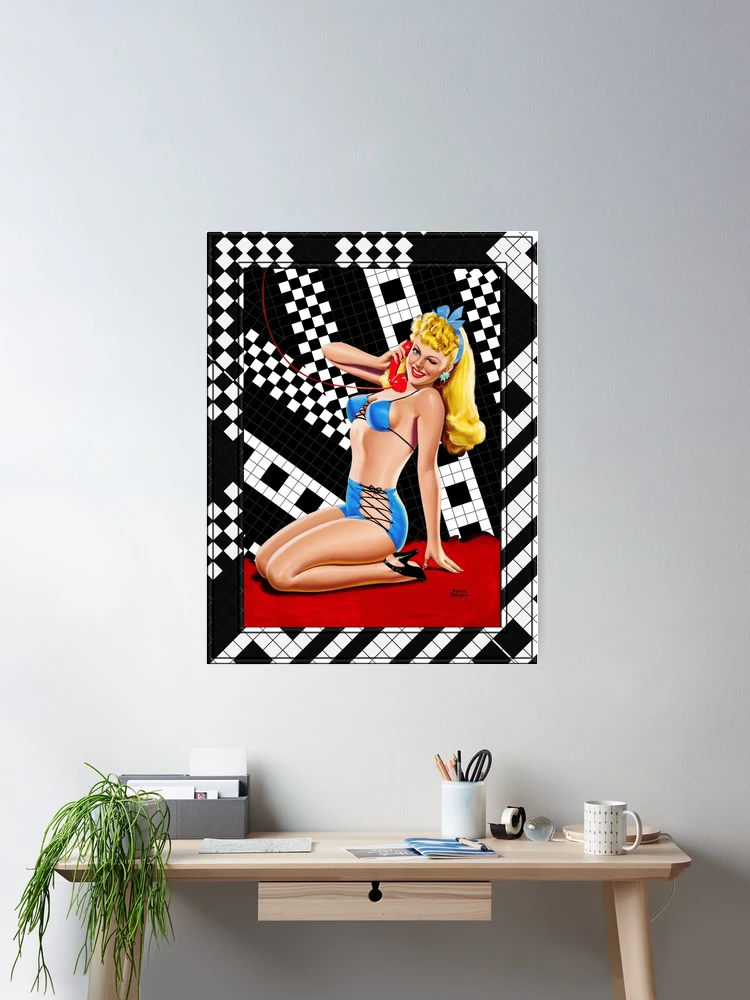
Aig cridhe na “The Red Hotline” lies a playful and coquettish depiction of a young blonde woman. Her golden hair cascades in carefully stylized waves, adorned with a large, cheerful blue bow that complements her swimsuit. The bright smile on her face, coupled with her winking eye, exudes an inviting charm, drawing viewers into the narrative. She holds a bright red telephone receiver, which lends the artwork its name and serves as a pivotal object within the composition.
The subject is dressed in a light blue bikini with black lace detailing. The high-waisted bottoms, characteristic of 1940s and 1950s fashion, are secured with crisscrossed laces, adding a touch of suggestive allure without compromising the overall playfulness of the scene. Her slender figure, accented by the pose, kneeling on a red carpet with one hand on the ground and the other holding the phone, demonstrates Driben’s skillful portrayal of anatomy and movement.
Background and Surrounding Objects
Cùl-fhiosrachadh a “The Red Hotline” is a dazzling geometric checkerboard pattern, executed in stark black and white. This graphic, almost optical illusion-like design provides a modernist contrast to the soft, feminine figure in the foreground. The abstract background evokes a sense of energy and boldness, reinforcing the dynamic quality of the composition.
The red telephone cord playfully winds across the frame, connecting the subject to an unseen caller and injecting a sense of narrative intrigue. The phone itself, a vibrant red, stands out sharply against the monochrome and blue elements, acting as both a visual and thematic anchor.
The red carpet beneath the woman serves a dual purpose. It frames her pose while adding a warm, inviting tone to the composition. This patch of red balances the cooler tones of her attire and ties back to the telephone, creating a cohesive color scheme.
Stoidhle agus innleachd
Driben’s work embodies the Golden Age of pin-up art, an era when illustrators captured an idealized, often cheeky depiction of femininity. His style is defined by bold colors, loidhnichean glan, and a high level of polish that recalls the glossy advertisements and magazine covers of his time.
Ann an “The Red Hotline,” Driben’s use of light and shadow is subtle but effective. The glossy sheen on the telephone and the laces of the swimsuit adds a sense of texture and realism, while the soft shadows along the figure’s curves enhance her three-dimensionality. The artist’s attention to detail—such as the precise rendering of her glossy black heels or the subtle highlights in her hair—showcases his technical prowess.
Cuspair agus mood
Cuspair “The Red Hotline” is lighthearted and playful, rooted in the optimism and cheeky humor that characterized mid-century pin-up art. The telephone introduces an element of storytelling, inviting viewers to imagine the conversation taking place. Is she flirting with a suitor? Sharing a laugh with a friend? The ambiguity allows for a range of interpretations, adding depth to the seemingly simple scene.
The mood is undeniably fun and flirtatious, yet it remains within the realm of innocent escapism. Driben’s pin-ups often walked the line between suggestiveness and wholesomeness, a balance that made them widely popular and accessible during their time. “The Red Hotline” tha eisgeachd, offering a playful fantasy that never veers into vulgarity.
Stuthan agus meadhanach
While the specific medium of this piece isn’t detailed here, Driben was known for his work in gouache and oil paints. These mediums allowed him to achieve the vibrant colors and smooth finishes seen in “The Red Hotline.” The level of precision in the lines and shading suggests that this artwork was originally created as an illustration, likely intended for print in a magazine, calendar, or poster.
Cultural Context and Legacy
“The Red Hotline” reflects the cultural zeitgeist of its era. Created during a time when pin-up art was at its peak, it embodies the idealized femininity and playful sensuality that appealed to audiences in the mid-20th century. Driben’s works were part of a broader movement that celebrated beauty, glamour, and the allure of the everyday woman.
As a piece of pin-up art, “The Red Hotline” carries with it the legacy of a genre that influenced fashion, sanasachd, and popular culture. An-diugh, it stands as a nostalgic reminder of a bygone era, appreciated both for its aesthetic qualities and its historical significance.
Co-dhùnadh
“The Red Hotline” by Peter Driben is a masterful example of mid-century pin-up art. Its captivating subject, bold design, and vibrant execution showcase the artist’s talent and creativity. Driben’s ability to combine playfulness with technical precision ensures that this artwork remains an enduring icon of its genre. It captures a moment in time when glamour and charm were celebrated, offering viewers a delightful glimpse into the world of vintage illustration.
Is e seo ath-riochdachadh seann mhaighstirean ealain didseatach ath-leasaichte de ìomhaigh raon poblach a tha ri fhaighinn mar a Meatailt clò-bhualadh air-loidhne.

Mu dheidhinn an Neach-ealain
Fiosrachadh gu h-ìosal bho Wikipedia.org
Rugadh Peter Dribe ann am Boston, Agus rinn e sgrùdadh aig Sgoil Gàbaid Sheòrais mus gluais e gu Paris a-steach 1925. Fhad 's a tha thu a' togail chlasaichean aig an Sorbone a-steach 1925, Thòisich e air sreath de dhealbhan Pen-and-Ink-in-in-Inter de Theatials a 'bhaile.
Sa Mhàrt de 1934 Chruthaich dribinn a 'chiad Pin-up a bha aithnichte a bha na chòmhdach do later; agus le 1935, bha e a 'dèanamh còmhdach airson snappy, PEP, Oidhcheannan ùra york, Beatha oidhche na Frainge agus CPPICE.
Mar a bha mòr-chòrdte diben ag èirigh aig deireadh nan troidsichean nach maireann chruthaich e barrachd chòmhdach airson irisean eile a 'toirt a-steach sgeulachdan a' togail sgeulachdan sìoghaidh sìoda, Film merry-go-round agus làn sgrion spòrs.
Leudaich dreuchd Dìben a-steach do sanasachd nuair a ghluais e gu New York aig deireadh 1936. An seo chruthaich e taisbeanaidhean uinneig fa-leth Die-Cut tùsail airson Rèidiogan Philco tùsail, Tuwels Bùth Cannon, agus a 'chompanaidh bèicearachd Weber.
Is dòcha gur e na h-obair as ainmeil a th 'aige air na postairean tùsail agus obair-ealain follaiseachd airson an Falcon Maltese. Bha Peter Dogven cuideachd na charaid dlùth de fhoillsichear Raibeart Harrison, agus a-steach 1941 Fhuair e cùmhnant a bhith a 'toirt air falbh còmhdach airson Caismeachd bhòidhchead New Harrison.
Bhon ann chaidh Pàdraig air adhart gu bhith a 'peantadh ceudan de chòmhdan airson an fhoillseachadh sin agus airson na seachd tiotalan deug higrishon air a chuir air bhog – Flirt, Uisge-beatha, Coimhead, Wink, Sùla, Giggles, agus Joker.
Bhiodh e gu tric cho mòr ri sia no seachd de na còmhdaichean aige air am foillseachadh gach mìos. Stèidhich obair an Dìben airson Harrison e mar aon de na luchd-ealain as aithnichte agus as soirbheachaile ann an Ameireagaidh. Dìreach mus tugadh e ag obair dha Harronon, Phòs diben an neach-ealain, Cleasaiche agus bàrd, Louise Kirby.
Ann an 1944 Chaidh a 'chothrom neo-àbhaisteach a thabhann dha, Airson neach-ealain PIN; bha sin gu bhith na stiùiriche ealain air a 'ghrian New York, post a ghlèidheadh gus 1946. Aig àm a 'chogaidh, Tha an dealbh mòr-chòrdte aige de shaighdearan Ameireaganach a 'togail a' bhratach aig Iwo Jaba air mòran aire nam meadhanan.
Ann an 1956, DRIBEN agus Louise a 'gluasad gu tràigh Miami, Far an do chuir e seachad a pheantadh bliadhnaichean cluaineas (a 'toirt a-steach aon de dwight d. Eisenhower) agus obraichean càin eile, a chaidh a chuir air dòigh ann an taisbeanaidhean soirbheachail le a bhean. Dh 'bhàsaich duriben ann an 1968, Louise a-steach 1984.