

The Russian Brides Attire
The Russian Brides Attire c1889 by Russian Painter Konstantin Makovsky (1839 – 1915); spesialiserer seg på russiske historiske malerier som viser et idealisert syn på russisk liv i tidligere århundrer.
Konstantin Makovsky’s The Russian Brides Attire (1889) presents a captivating glimpse into the ceremonial preparations of a Russian bride in a traditional 19th-century setting. The scene is set within an intimate, richly adorned room where the bride-to-be, poised in anticipation, is surrounded by her closest family and friends. This historical genre painting, rooted deeply in Russian culture, reflects both the bride’s personal moment and the social customs of the time.
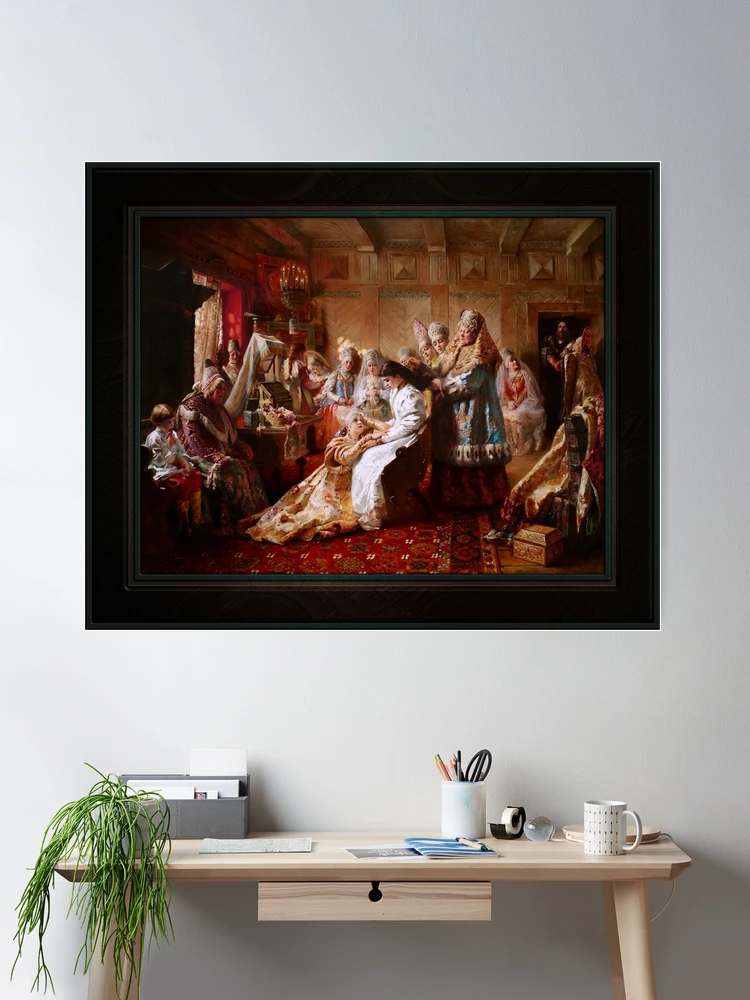
At the heart of the painting sits the young bride, dressed in an opulent, meticulously detailed gown of traditional Russian wedding attire. The intricacies of her attire are striking; every fold and embellishment in her richly embroidered dress echoes the skill and craftsmanship of the period. The gown’s texture, enhanced by the gentle play of light, emphasizes its luxurious fabric, hinting at the bride’s high social standing.
Kjolen, with its intricate patterns and vibrant colors, combines tradition with beauty, setting her apart as the central figure in the composition. Hennes uttrykk, serene yet tinged with the anticipation of the upcoming union, contributes to the painting’s overall sense of reverence for this momentous life event.
The surrounding figures enhance the emotional depth of the scene. Bridesmaids, family members, and an attentive mother are present, each contributing to the bride’s preparations. The bridal party’s clothing is also detailed, showcasing the opulence typical of the Russian aristocracy during the era.
These individuals are all engaged in the intimate tasks of finalizing the bride’s appearance, with one figure seated at the bride’s feet, holding her hands tenderly—a subtle gesture of familial connection and support. I kontrast, a young man, possibly the groom, appears at the threshold of the room, holding a gift box. His presence is restrained, his access to the bride’s space halted by a gentle but firm barrier, as custom would dictate.
The setting further complements the mood of the painting. The room is lavishly decorated, with dark, rich tones contrasting against the soft glow of candlelight and the bride’s radiant attire. This use of light symbolizes both the bride’s purity and the solemnity of the occasion.
The opulent, antique furniture and the delicate furnishings suggest an upper-class household, indicative of the wealth and status of the bride’s family. These elements come together to transport the viewer to the Russian nobility’s private spaces, where tradition and social rituals were deeply ingrained.
Makovsky’s approach to the painting reflects his expertise in academic art and historical realism, grounded in his training and experience with the Peredvizhniki (Vandrere) bevegelse. Known for portraying the everyday lives of Russians, Makovsky’s work in The Russian Bride’s Attire transcends mere documentation, offering an emotional portrait of a pivotal moment in a young woman’s life. His mastery of detail, farge, and light conveys a sense of reverence for the traditions of Russian weddings, while the gentle interactions between the figures in the scene imbue the work with a sense of warmth and familial love.
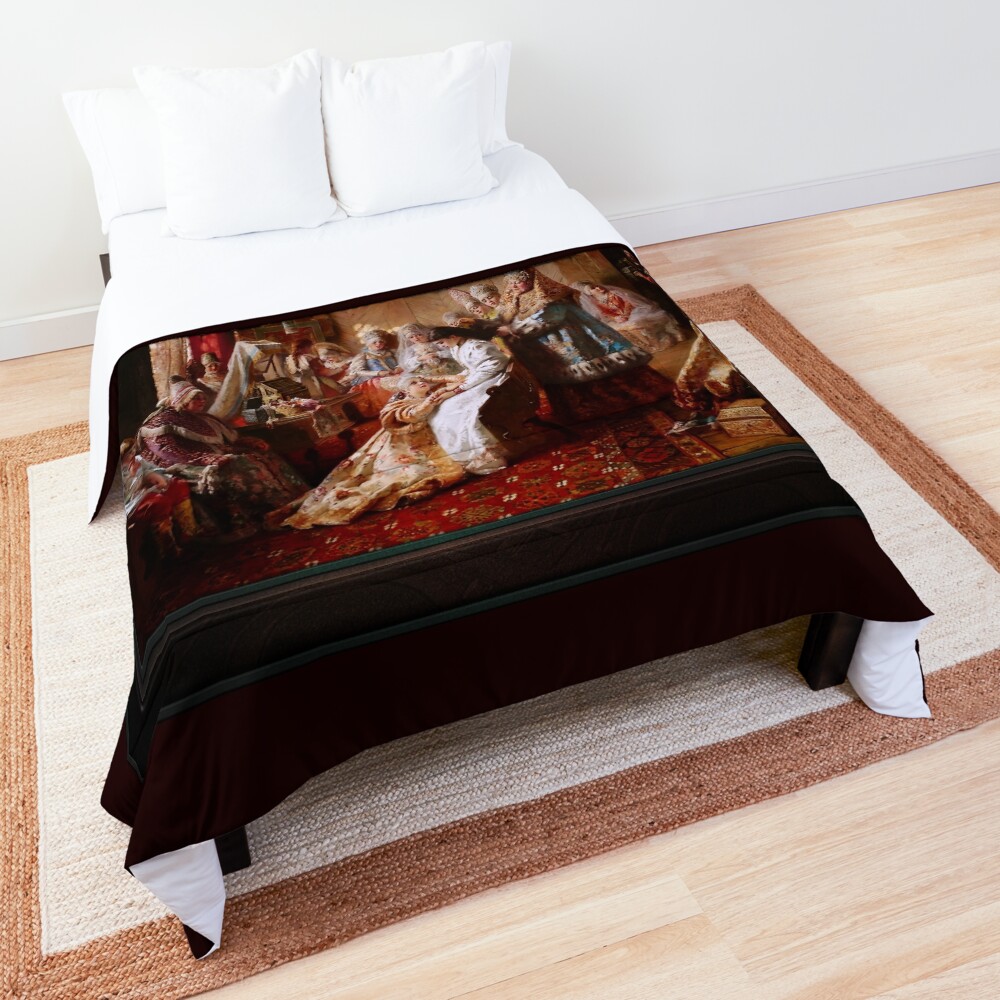
The mood of the painting is one of quiet anticipation, ceremonial dignity, and a deep respect for cultural traditions. The bride is presented not just as the central figure in a social ritual, but as a symbol of purity, continuity, and heritage.
The work conveys a mixture of joy and solemnity, emphasizing the gravity of the wedding ceremony while celebrating the familial bonds that are integral to it. The groom, awaiting his bride’s arrival, is a figure of patience and longing, and the space between the bride and groom symbolizes the sacredness and exclusivity of the pre-wedding ritual.
Når det gjelder stil, The Russian Bride’s Attire is a quintessential example of Russian academic realism. Makovsky’s technique, with its sharp focus on the textures of fabrics, the naturalism of facial expressions, and the subtle play of light, creates a vivid, almost tangible atmosphere.
The figures are carefully posed to convey a sense of unity and purpose, while the careful rendering of the bride’s dress and the surrounding details showcases the artist’s skill in depicting texture and material.
Tematisk, the work explores the cultural importance of the Russian wedding, which was more than just a personal event—it was a public and familial milestone. Through the artist’s portrayal of the bride’s attire, the familial interaction, and the ceremonial anticipation, the viewer is invited to witness an intimate, yet highly structured moment in Russian society. The painting also highlights the role of tradition in Russian culture, where customs surrounding marriage were highly ritualized and carefully observed.
The Russian Bride’s Attire is not only a visual narrative of a traditional wedding but also an insightful reflection of the values and customs of 19th-century Russian aristocracy. It stands as a testament to Konstantin Makovsky’s ability to blend historical accuracy with emotional depth, offering the viewer a vivid portrayal of Russian cultural heritage at its most beautiful and ceremonial.
Dette er en retusjert digital kunst som gamle mestere gjengir av et offentlig domenebilde.
Info nedenfor avledet fra Wikipedia.org
Konstantin Makovsky var en innflytelsesrik russisk maler, tilknyttet “Peredvizhniki (Vandrere)”. Mange av hans historiske malerier, for eksempel Beneath the Crown (1889) også kjent som The Russian Bride's Attire og Before the Wedding, viste et idealisert syn på russisk liv fra tidligere århundrer. Han regnes ofte som en representant for akademisk kunst.
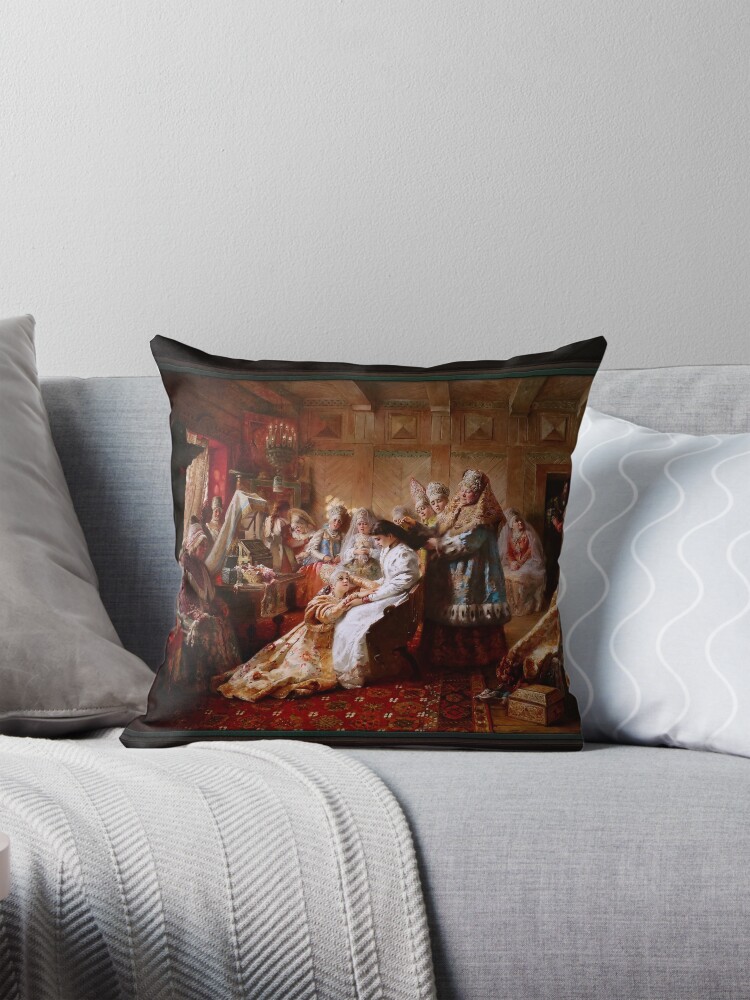
Konstantin Makovsky ble født i Moskva. Faren hans var den russiske kunstfiguren og amatørmaleren, Yegor Ivanovich Makovsky. Moren hans var komponist, og hun håpet at sønnen hennes en dag ville følge i hennes fotspor. Hans yngre brødre Vladimir og Nikolay og søsteren Alexandra ble også malere.
I 1851 Makovsky gikk inn på Moscow School of Painting, Skulptur og arkitektur hvor han ble toppstudent, enkelt å få alle tilgjengelige priser. Lærerne hans var Karl Bryullov og Vasily Tropinin. Makovskys tilbøyeligheter til romantikk og dekorative effekter kan forklares med påvirkning fra Bryullov.
Selv om kunsten var hans lidenskap, han vurderte også hva moren hadde ønsket at han skulle gjøre. Han satte seg for å lete etter komponister han kunne referere til, og dro først til Frankrike. Før, han hadde alltid vært en elsker av klassisk musikk, og lyttet til mange stykker. Han ønsket ofte at han kunne endre melodien, eller stilen til noen av dem for å gjøre dem morsommere. Later in his life it came true.
I 1858 Makovsky gikk inn på Imperial Academy of Arts i St. Petersburg. Fra 1860 han deltok i Akademiets utstillinger med malerier som Curing of the Blind (1860) og Agenter of the False Dmitry dreper sønnen til Boris Godunov (1862). I 1863 Makovsky og tretten andre studenter holdt en protest mot Akademiets innstilling av temaer fra skandinavisk mytologi i konkurransen om den store gullmedaljen for akademia; alle forlot akademiet uten et formelt vitnemål.
Makovsky ble medlem av et kooperativ (artel) av artister ledet av Ivan Kramskoi, produserer vanligvis Wanderers -malerier om hverdagen (Enke 1865, Sild-selger 1867, etc.). Fra 1870 han var et av grunnleggerne av Society for Traveling Art Exhibitions og fortsatte å jobbe med malerier viet hverdagen. Han stilte ut verkene sine på både Academia -utstillingene og Traveling Art Exhibitions of the Wanderers.
En betydelig endring i stilen hans skjedde etter å ha reist til Egypt og Serbia på midten av 1870-tallet. Interessene hans endret seg fra sosiale og psykologiske problemer til de kunstneriske problemene med farger og form.
På 1880 -tallet ble han en fasjonabel forfatter av portretter og historiske malerier. På verdensmessen i 1889 i Paris mottok han den store gullmedaljen for sine malerier Death of Ivan the Terrible, Dommen i Paris, og Demon og Tamara. Han var en av datidens mest verdsatte og høyt betalte russiske artister. Mange demokratiske kritikere betraktet ham som en renegade av Wanderers’ idealer, produserer (like Henryk Siemiradzki) striking but shallow works,[2] while others see him as a forerunner of Russian Impressionism.
Makovsky ble drept i 1915 da hans hestevogn ble truffet av en elektrisk trikk i St. Petersburg.