

The Russian Brides Attire
The Russian Brides Attire c1889 by Russian Painter Константин Маковский (1839 – 1915); специализируется на русских исторических картинах, демонстрирующих идеализированный взгляд на русскую жизнь прошлых веков..
Konstantin Makovsky’s The Russian Brides Attire (1889) presents a captivating glimpse into the ceremonial preparations of a Russian bride in a traditional 19th-century setting. The scene is set within an intimate, richly adorned room where the bride-to-be, poised in anticipation, is surrounded by her closest family and friends. This historical genre painting, rooted deeply in Russian culture, reflects both the bride’s personal moment and the social customs of the time.
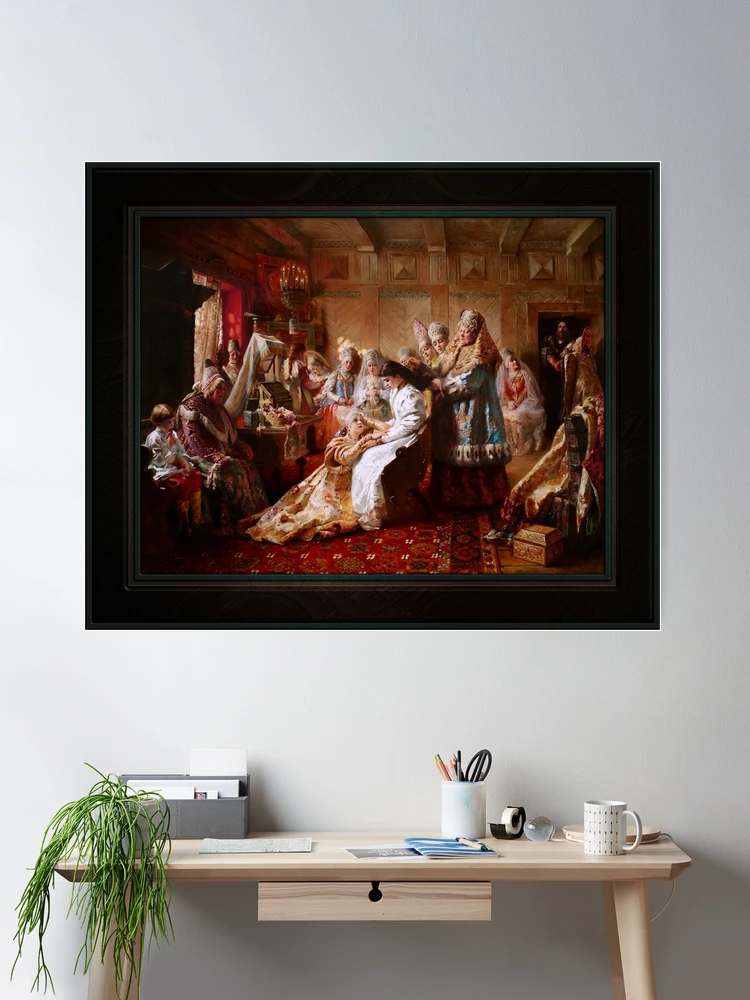
At the heart of the painting sits the young bride, dressed in an opulent, meticulously detailed gown of traditional Russian wedding attire. The intricacies of her attire are striking; every fold and embellishment in her richly embroidered dress echoes the skill and craftsmanship of the period. The gown’s texture, enhanced by the gentle play of light, emphasizes its luxurious fabric, hinting at the bride’s high social standing.
Платье, with its intricate patterns and vibrant colors, combines tradition with beauty, setting her apart as the central figure in the composition. Ее выражение, serene yet tinged with the anticipation of the upcoming union, contributes to the painting’s overall sense of reverence for this momentous life event.
The surrounding figures enhance the emotional depth of the scene. Bridesmaids, family members, and an attentive mother are present, each contributing to the bride’s preparations. The bridal party’s clothing is also detailed, showcasing the opulence typical of the Russian aristocracy during the era.
These individuals are all engaged in the intimate tasks of finalizing the bride’s appearance, with one figure seated at the bride’s feet, holding her hands tenderly—a subtle gesture of familial connection and support. В отличие, a young man, possibly the groom, appears at the threshold of the room, holding a gift box. His presence is restrained, his access to the bride’s space halted by a gentle but firm barrier, as custom would dictate.
The setting further complements the mood of the painting. The room is lavishly decorated, с темным, rich tones contrasting against the soft glow of candlelight and the bride’s radiant attire. This use of light symbolizes both the bride’s purity and the solemnity of the occasion.
The opulent, antique furniture and the delicate furnishings suggest an upper-class household, indicative of the wealth and status of the bride’s family. These elements come together to transport the viewer to the Russian nobility’s private spaces, where tradition and social rituals were deeply ingrained.
Makovsky’s approach to the painting reflects his expertise in academic art and historical realism, grounded in his training and experience with the Peredvizhniki (Странники) движение. Known for portraying the everyday lives of Russians, Makovsky’s work in Наряд русской невесты transcends mere documentation, offering an emotional portrait of a pivotal moment in a young woman’s life. His mastery of detail, цвет, and light conveys a sense of reverence for the traditions of Russian weddings, while the gentle interactions between the figures in the scene imbue the work with a sense of warmth and familial love.
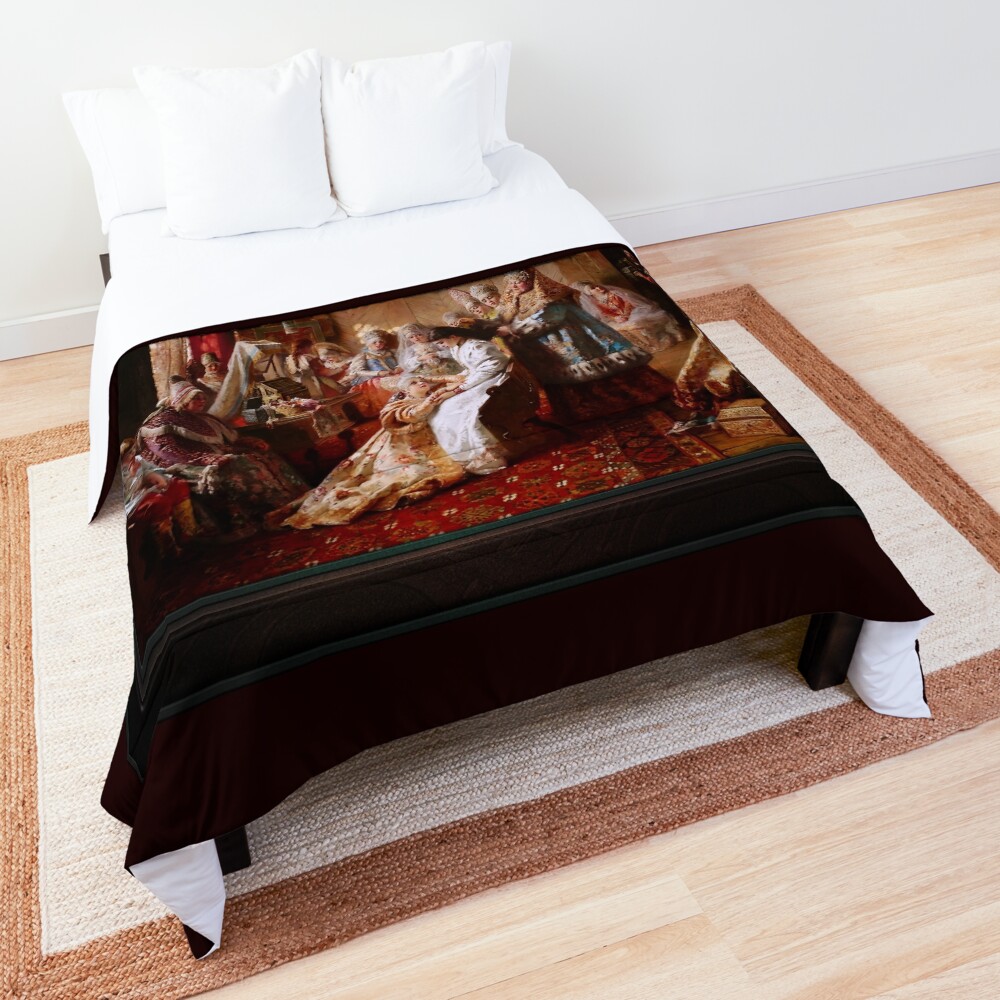
The mood of the painting is one of quiet anticipation, ceremonial dignity, and a deep respect for cultural traditions. The bride is presented not just as the central figure in a social ritual, but as a symbol of purity, преемственность, and heritage.
The work conveys a mixture of joy and solemnity, emphasizing the gravity of the wedding ceremony while celebrating the familial bonds that are integral to it. The groom, awaiting his bride’s arrival, is a figure of patience and longing, and the space between the bride and groom symbolizes the sacredness and exclusivity of the pre-wedding ritual.
С точки зрения стиля, Наряд русской невесты is a quintessential example of Russian academic realism. Makovsky’s technique, with its sharp focus on the textures of fabrics, the naturalism of facial expressions, and the subtle play of light, creates a vivid, almost tangible atmosphere.
The figures are carefully posed to convey a sense of unity and purpose, while the careful rendering of the bride’s dress and the surrounding details showcases the artist’s skill in depicting texture and material.
Тематически, the work explores the cultural importance of the Russian wedding, which was more than just a personal event—it was a public and familial milestone. Through the artist’s portrayal of the bride’s attire, the familial interaction, and the ceremonial anticipation, the viewer is invited to witness an intimate, yet highly structured moment in Russian society. The painting also highlights the role of tradition in Russian culture, where customs surrounding marriage were highly ritualized and carefully observed.
Наряд русской невесты is not only a visual narrative of a traditional wedding but also an insightful reflection of the values and customs of 19th-century Russian aristocracy. It stands as a testament to Konstantin Makovsky’s ability to blend historical accuracy with emotional depth, offering the viewer a vivid portrayal of Russian cultural heritage at its most beautiful and ceremonial.
Это ретушированная цифровая художественная репродукция старых мастеров изображения из общественного достояния..
Информация ниже получена из Wikipedia.org
Константин Маковский был влиятельным русским художником., связан с “Peredvizhniki (Странники)”. Многие его исторические картины, такие как Под короной (1889) также известный как «Наряд русской невесты» и «Перед свадьбой»., показал идеализированный взгляд на русскую жизнь предшествующих столетий. Его часто считают представителем академического искусства..
Константин Маковский родился в Москве.. Его отец был деятелем русского искусства и художником-любителем., Yegor Ivanovich Makovsky. Его мать была композитором, и она надеялась, что ее сын однажды пойдет по ее стопам. Его младшие братья Владимир и Николай и его сестра Александра также стали художниками..
В 1851 Маковский поступил в Московское художественное училище., Скульптура и архитектура, где он стал лучшим учеником, легко получить все доступные награды. Его учителями были Карл Брюллов и Василий Тропинин.. Склонность Маковского к романтизму и декоративным эффектам можно объяснить влиянием Брюллова..
Хотя искусство было его страстью, он также подумал о том, что его мать хотела, чтобы он сделал. Он отправился искать композиторов, на которых мог бы сослаться., и впервые отправился во Францию. До, он всегда был любителем классической музыки, и прослушал много произведений. Он часто хотел, чтобы он мог изменить мелодию, или стиль некоторых из них, чтобы сделать их более приятными. Позже в его жизни это сбылось.
В 1858 Маковский поступил в Императорскую Академию художеств в Санкт-Петербурге.. Из 1860 он участвовал в выставках Академии с такими картинами, как «Исцеление слепых». (1860) и агенты Лжедмитрия убивают сына Бориса Годунова (1862). В 1863 Маковский и еще тринадцать студентов провели акцию протеста против постановки Академией тем из скандинавской мифологии в конкурсе на Большую золотую медаль Академии.; все ушли из академии без формального диплома.
Маковский стал членом кооператива (артель) художников под руководством Ивана Крамского, обычно рисует картины Странников о повседневной жизни (вдова 1865, Селедка-продавец 1867, и т.п.). Из 1870 он был одним из основателей Общества передвижных художественных выставок и продолжал работать над картинами, посвященными быту.. Он выставлял свои работы как на выставках Академии, так и на Передвижных художественных выставках передвижников..
Значительное изменение в его стиле произошло после путешествия в Египет и Сербию в середине 1870-х гг.. Его интересы изменились с социальных и психологических проблем на художественные проблемы цвета и формы..
В 1880-х годах он стал модным автором портретов и исторических картин.. На Всемирной выставке г. 1889 в Париже получил Большую золотую медаль за картину «Смерть Ивана Грозного»., Суд Париса, и Демон и Тамара. Он был одним из самых уважаемых и высокооплачиваемых русских художников того времени.. Многие демократические критики считали его ренегатом передвижников.’ идеалы, производство (как Хенрик Семирадский) яркие, но поверхностные работы,[2] в то время как другие видят в нем предшественника русского импрессионизма.
Маковский был убит в 1915 когда его конный экипаж попал под электрический трамвай в Санкт-Петербурге.