

The Storm on the Sea of Galilee
The Storm on the Sea of Galilee, wedi'i greu yn 1633 by Dutch painter Rembrandt van Rijn (1606 – 1669), stands as one of the most celebrated works of the artist’s early career. This monumental painting captures a pivotal biblical moment with striking realism, emosiwn, and drama, showcasing the artist’s extraordinary talent in portraying light, cysgod, and human emotion. The painting was commissioned as part of a set of paintings for a wealthy patron and depicts the moment when Christ and his disciples, aboard a small boat, are caught in a violent storm on the Sea of Galilee, as described in the Gospel of Mark, Chapter 4. The turbulent scene resonates with powerful themes of faith, ofn, and divine intervention.
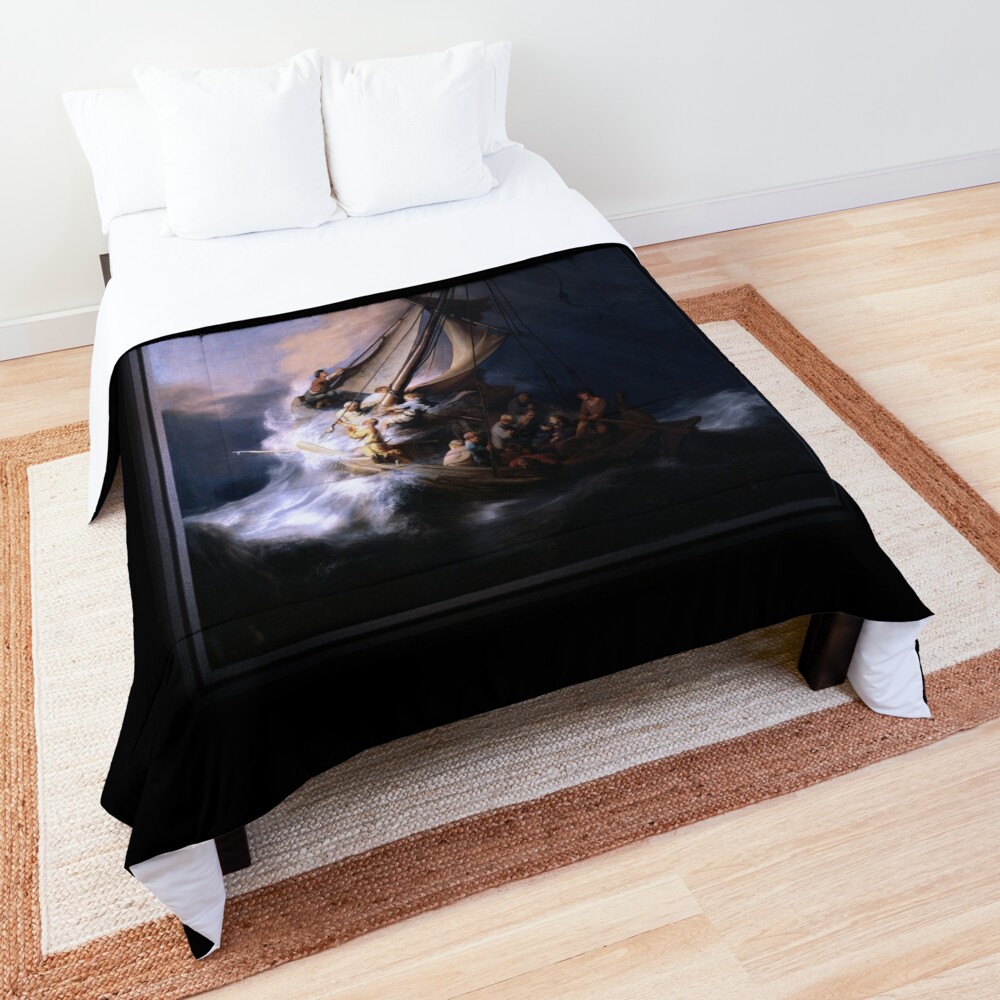
Tabl Cynnwys
Prif Bwnc: Christ and His Disciples
At the center of this chaotic scene is the figure of Jesus Christ, whose calm and serene posture provides a stark contrast to the raging storm surrounding him. He is depicted sitting at the stern of the boat, his hands resting on the side, unfazed by the wind and waves crashing against the boat. Christ’s gaze is forward, embodying a sense of divine assurance that transcends the chaos. His clothing, a simple tunic and robe, are rendered with fine detail, reflecting the painter’s skill in portraying fabric textures. The light falling on his face highlights his central role in the narrative, symbolizing his divine nature and the peace he offers amidst turmoil.
Around Christ are the disciples, each responding to the storm in their own distinct ways. Some are visibly frightened, their faces contorted with fear and anxiety, while others are actively attempting to control the boat. One disciple, gripping the sail tightly, appears as if he is trying to maintain control, while another, kneeling by the side of the boat, prays desperately for safety. The diversity of expressions adds to the intensity of the composition, emphasizing the human emotions that contrast with Christ’s calm demeanor. Rembrandt uses the disciples’ fear as a visual representation of mankind’s vulnerability in the face of the unknown, drawing viewers into the emotional heart of the scene.
Objects: The Boat, The Sea, and the Storm
The boat in the painting is a small fishing vessel, realistically depicted as a sturdy craft designed for traversing the turbulent waters of the Sea of Galilee. The boat’s detailed construction, including the visible planks of wood and ropes, is a testament to Rembrandt’s skill in capturing intricate textures. The boat tilts precariously to one side as the storm surges, with water pouring over the edges and into the boat, emphasizing the perilous nature of the situation.
Mae'r sea itself is depicted with dramatic intensity. Rembrandt masterfully renders the waves, using sweeping brushstrokes that convey their movement and violence. The water is frothy and turbulent, crashing against the boat and adding to the sense of impending disaster. The waves appear almost alive, reflecting the raw power of nature as it responds to the storm. The artist uses contrasting light and dark elements to heighten the drama, with the turbulent waters on the left side of the painting being darker and more menacing, while the right side of the composition contains a hint of light breaking through the clouds, suggesting hope and divine presence.
Yn y cefndir, y storm clouds swirl ominously in shades of dark blue and gray, filling the sky with an oppressive and foreboding atmosphere. The turbulence of the clouds mirrors the emotional storm taking place within the boat, as the disciples’ anxiety is mirrored by the chaotic environment around them. A small hint of light peeks through the clouds, but it is minimal, further reinforcing the tumultuous mood of the scene. The use of light and dark is a key feature of Rembrandt’s style, known as ciaroscuro, which he utilizes here to create a stark contrast between the dark, stormy elements and the calm serenity of Christ.
Deunyddiau a Thechneg: Oil on Canvas
Rembrandt’s choice of olew ar gynfas as his medium allows him to achieve a level of depth and detail that is both striking and evocative. His skillful use of oil paint enables him to render both the fine details of the figures and the broader, sweeping elements of the storm with equal precision. The light falling on the figures and the texture of the water are achieved through layered application of paint, with light hues reflecting the effects of the storm’s light and shadows giving depth to the scene. The dynamic quality of the painting, particularly the movement of the waves and the figures, is achieved through brushstrokes that appear energetic and alive, contributing to the intensity of the composition.
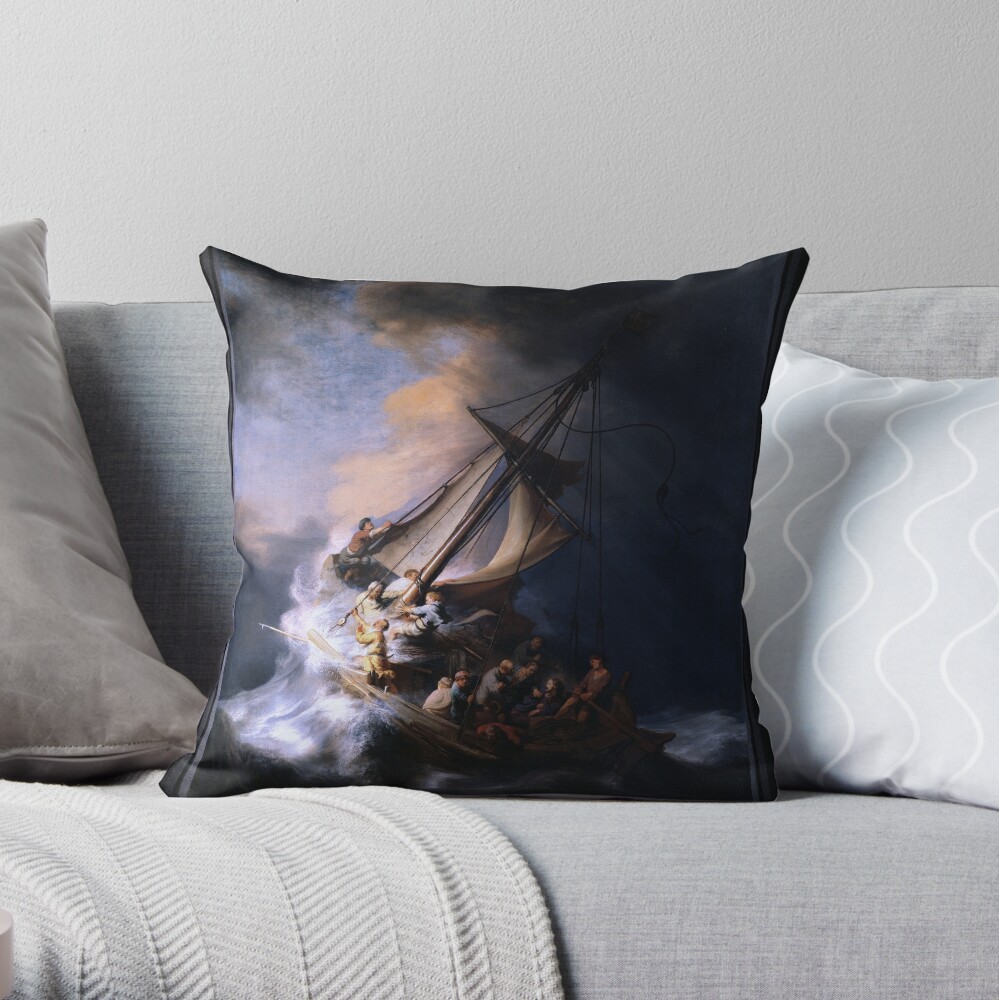
Mae'r gwead of the painting also serves to heighten the emotional impact. The rough, tumultuous sea is contrasted by the soft, almost ethereal rendering of Christ’s figure, whose calmness and serenity are made even more pronounced by the surrounding chaos. The figures of the disciples are given individual attention, with their expressions and movements captured with a remarkable sense of realism. Their facial expressions, the folds of their clothing, and their body language are portrayed with the utmost care, allowing the viewer to feel their fear, struggle, and desperation.
Arddull, Thema, a hwyliau: Dramatic Realism
Rembrandt’s signature style of dramatic realism is fully displayed in this painting. The focus on emotional depth and psychological complexity is a hallmark of his work, ac yn The Storm on the Sea of Galilee, he uses the moment of crisis to explore profound themes of faith, divine intervention, and human frailty. The storm is not just a physical event but a metaphor for the turmoil that can engulf the human spirit, while Christ represents the unwavering presence of divinity that offers comfort and peace.
Mae'r hwyliau of the painting is one of tension and contrast. The disciples’ fear and desperation are palpable, while Christ’s calmness offers a sense of hope and divine assurance. The viewer is drawn into the storm, both in terms of the physical intensity of the scene and the emotional struggle of the figures. The contrasting elements of light and dark, calm and chaos, gwahodd myfyrdod ar natur ffydd a’r ffordd y gall cred gynnig cysur ar adegau o drallod mwyaf.
Nghasgliad
Yn The Storm on the Sea of Galilee, Rembrandt van Rijn yn dal moment feiblaidd o arwyddocâd dwys gyda meistrolaeth artistig a dyfnder emosiynol. Trwy ei ddefnydd dramatig o olau a chysgod, sylw i fanylion, a phortread gofalus o emosiwn dynol, mae'r paentiad yn dod yn fwy na dim ond naratif gweledol, mae'n fyfyrdod ar natur ymyrraeth ddwyfol a grym ffydd yn wyneb ofn. Mae dwyster emosiynol y storm a phresenoldeb tawel Crist yn gwahodd gwylwyr i ystyried eu hymatebion eu hunain i stormydd bywyd, boed yn fewnol neu'n allanol.
Mae The Storm on the Sea of Galilea yn atgynhyrchiad hen feistr celf ddigidol wedi'i atgyffwrdd o ddelwedd parth cyhoeddus sydd ar gael fel print rholio ar-lein.
Y greadigaeth gelfyddyd ddigidol hon, fel gyda'r holl waith celf sydd i'w gael ar wefan Xzendor7 ar gael i'w brynu ar-lein mewn amrywiaeth o fformatau deunydd gan gynnwys printiau cynfas, printiau acrylig, printiau metel, printiau pren, printiau wedi'u fframio, posteri, ac fel printiau cynfas wedi'u rholio mewn amrywiaeth o feintiau o 12 modfedd i 72 modfeddi yn dibynnu ar faint y gwaith celf gwirioneddol a'r siop argraffu ar alw y byddwch yn dewis prynu'r celf ohoni.
Mae’r gwaith celf hefyd ar gael ar ystod eang o ddillad dynion a merched, mygiau, totes, sgarffiau, llyfrau nodiadau a chyfnodolion a llawer o gynhyrchion addurno cartref.
Bio artist
Gwybodaeth Isod O Wikipedia.org
Gweriniaeth newydd yr Iseldiroedd oedd y genedl fwyaf llewyrchus yn Ewrop ac arweiniodd fasnach Ewropeaidd, gwyddoniaeth, a chelf. Yn draddodiadol bu taleithiau gogledd yr Iseldiroedd a oedd yn rhan o’r dalaith newydd yn ganolfannau artistig llai pwysig na dinasoedd Fflandrys yn y de. Y cynnwrf a'r trosglwyddiadau mawr o boblogaeth y rhyfel, a'r toriad sydyn gyda'r hen draddodiadau diwylliannol brenhinol a Chatholig, yn golygu bod yn rhaid i gelfyddyd Iseldiraidd ailddyfeisio ei hun. Gostyngodd darlunio pynciau crefyddol yn sydyn, ond datblygodd marchnad fawr newydd ar gyfer llawer o bynciau seciwlar.
Er bod paentiad Iseldiroedd o'r Oes Aur wedi'i gynnwys yn y cyfnod Ewropeaidd cyffredinol o beintio Baróc, ac yn aml yn dangos llawer o'i nodweddion, nid oes gan y mwyafrif y delfrydiad a'r cariad at ysblander sy'n nodweddiadol o lawer o waith Baróc, gan gynnwys eiddo Fflandrys cyfagos. Mae'r rhan fwyaf yn gweithio, gan gynnwys y cyfnod y mae'r cyfnod yn fwyaf adnabyddus amdano, yn adlewyrchu'r traddodiadau o realaeth fanwl a etifeddwyd o beintio'r Iseldiroedd Cynnar.
Nodwedd arbennig o'r cyfnod yw'r toreth o genres gwahanol o baentiadau, gyda mwyafrif yr artistiaid yn cynhyrchu mwyafrif eu gwaith o fewn un o'r rhain. Gwelir datblygiad llawn yr arbenigedd hwn o ddiwedd y 1620au, a'r cyfnod o hyny hyd oresgyniad Ffrainc o 1672 yw craidd paentio Oes Aur. Artists would spend most of their careers painting only portraits, golygfeydd genre, tirweddau, seascapes and ships, or still life, and often a particular sub-type within these categories. Many of these types of subject were new in Western painting, ac yr oedd y modd y peintiodd yr Iseldiroedd hwynt yn y cyfnod hwn yn bendant ar gyfer eu datblygiad yn y dyfodol.