

La tempête sur la mer de Galilée
La tempête sur la mer de Galilée, créé dans 1633 du peintre hollandais Rembrandt van Rijn (1606 – 1669), stands as one of the most celebrated works of the artist’s early career. This monumental painting captures a pivotal biblical moment with striking realism, émotion, and drama, showcasing the artist’s extraordinary talent in portraying light, ombre, et l'émotion humaine. The painting was commissioned as part of a set of paintings for a wealthy patron and depicts the moment when Christ and his disciples, aboard a small boat, are caught in a violent storm on the Sea of Galilee, as described in the Gospel of Mark, Chapter 4. The turbulent scene resonates with powerful themes of faith, peur, et intervention divine.
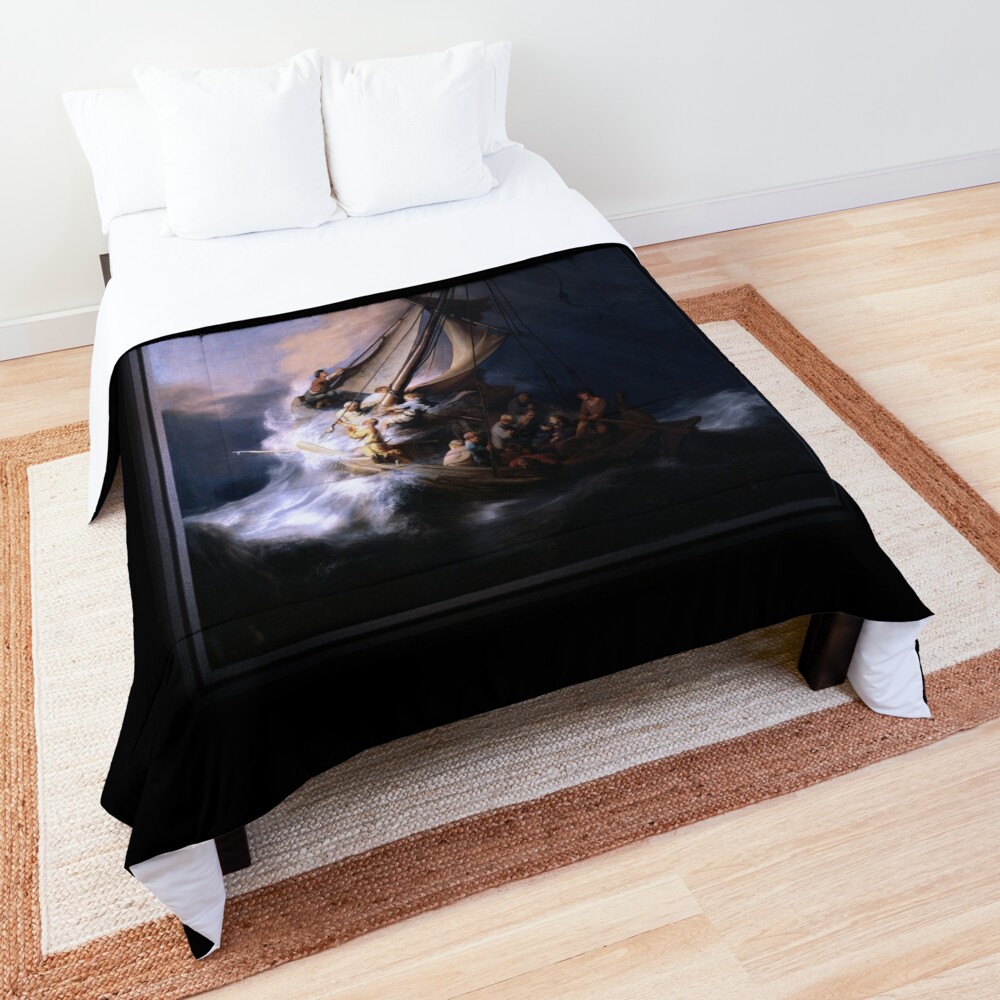
Table des matières
Sujet principal: Christ and His Disciples
At the center of this chaotic scene is the figure of Jesus Christ, whose calm and serene posture provides a stark contrast to the raging storm surrounding him. He is depicted sitting at the stern of the boat, his hands resting on the side, unfazed by the wind and waves crashing against the boat. Christ’s gaze is forward, embodying a sense of divine assurance that transcends the chaos. Ses vêtements, a simple tunic and robe, are rendered with fine detail, reflecting the painter’s skill in portraying fabric textures. The light falling on his face highlights his central role in the narrative, symbolizing his divine nature and the peace he offers amidst turmoil.
Around Christ are the disciples, each responding to the storm in their own distinct ways. Some are visibly frightened, their faces contorted with fear and anxiety, while others are actively attempting to control the boat. Un disciple, serrer fermement la voile, on dirait qu'il essaie de garder le contrôle, tandis qu'un autre, à genoux près du bateau, prie désespérément pour la sécurité. La diversité des expressions ajoute à l'intensité de la composition, mettant l’accent sur les émotions humaines qui contrastent avec l’attitude calme du Christ. Rembrandt utilise la peur des disciples comme représentation visuelle de la vulnérabilité de l’humanité face à l’inconnu., attirer les spectateurs au cœur émotionnel de la scène.
Objets: The Boat, The Sea, and the Storm
Le bateau dans le tableau est un petit bateau de pêche, représenté de manière réaliste comme un bateau robuste conçu pour traverser les eaux turbulentes de la mer de Galilée. La construction détaillée du bateau, y compris les planches de bois et les cordes visibles, est un témoignage de l'habileté de Rembrandt à capturer des textures complexes. Le bateau s'incline de manière précaire d'un côté alors que les ondes de tempête se lèvent., avec de l'eau qui coule sur les bords et dans le bateau, soulignant le caractère périlleux de la situation.
Le mer lui-même est représenté avec une intensité dramatique. Rembrandt rend magistralement flots, en utilisant des coups de pinceau amples qui transmettent leur mouvement et leur violence. L'eau est mousseuse et turbulente, s'écraser contre le bateau et ajouter au sentiment de désastre imminent. Les vagues semblent presque vivantes, reflétant la puissance brute de la nature alors qu'elle répond à la tempête. L'artiste utilise des éléments clairs et sombres contrastés pour intensifier le drame., les eaux turbulentes sur le côté gauche du tableau étant plus sombres et plus menaçantes, tandis que le côté droit de la composition contient un soupçon de lumière traversant les nuages., suggérant l'espoir et la présence divine.
En arrière-plan, les nuages d'orage tourbillonne de façon menaçante dans des tons de bleu foncé et de gris, remplissant le ciel d'une atmosphère oppressante et inquiétante. La turbulence des nuages reflète la tempête émotionnelle qui se déroule à bord du bateau., car l’anxiété des disciples se reflète dans l’environnement chaotique qui les entoure. Un petit soupçon de lumière apparaît à travers les nuages, mais c'est minime, renforçant encore l'ambiance tumultueuse de la scène. L’utilisation de la lumière et de l’obscurité est une caractéristique clé du style de Rembrandt, connu sous le nom biaroscuro, qu'il utilise ici pour créer un contraste saisissant entre l'obscurité, éléments orageux et la calme sérénité du Christ.
Matériaux et techniques: Oil on Canvas
Le choix de Rembrandt huile sur toile car son médium lui permet d'atteindre un niveau de profondeur et de détail à la fois saisissant et évocateur. Son utilisation habile de la peinture à l'huile lui permet de restituer à la fois les détails fins des personnages et l'ensemble du, balayer les éléments de la tempête avec la même précision. La lumière tombant sur les personnages et la texture de l'eau sont obtenues grâce à l'application de couches de peinture., avec des teintes claires reflétant les effets de la lumière et des ombres de la tempête donnant de la profondeur à la scène. La qualité dynamique de la peinture, notamment le mouvement des vagues et des personnages, est obtenu grâce à coups de pinceau qui semblent énergiques et vivants, contribuant à l'intensité de la composition.
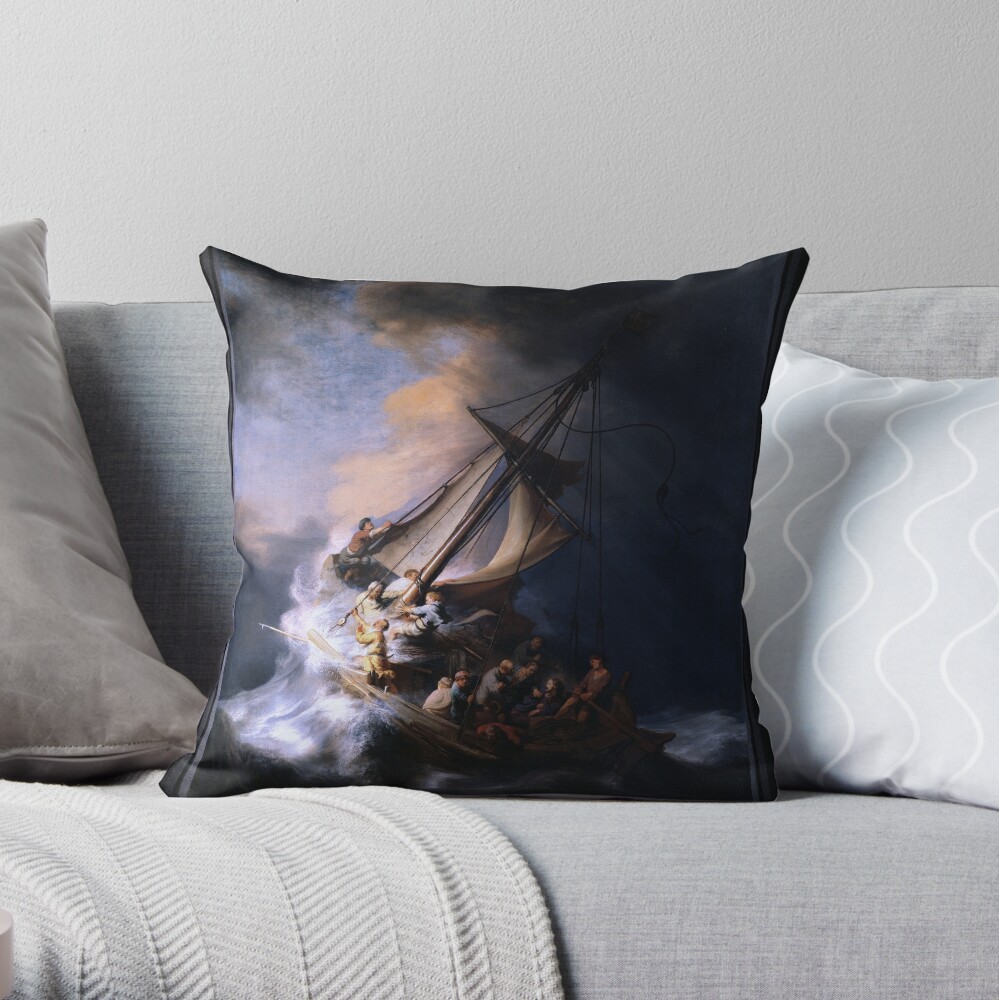
Le texture du tableau sert également à accroître l'impact émotionnel. Le rugueux, la mer tumultueuse contraste avec la douceur, rendu presque éthéré de la figure du Christ, dont le calme et la sérénité sont rendus encore plus prononcés par le chaos environnant. Les figures des disciples font l'objet d'une attention individuelle, avec leurs expressions et leurs mouvements capturés avec un sens de réalisme remarquable. Leurs expressions faciales, les plis de leurs vêtements, et leur langage corporel sont représentés avec le plus grand soin, permettre au spectateur de ressentir sa peur, lutte, et le désespoir.
Style, Thème, et humeur: Dramatic Realism
Le style caractéristique de Rembrandt réalisme dramatique est entièrement affiché dans ce tableau. L'accent mis sur la profondeur émotionnelle et la complexité psychologique est une caractéristique de son travail., et en La tempête sur la mer de Galilée, il utilise le moment de crise pour explorer des thèmes profonds de la foi, intervention divine, et la fragilité humaine. La tempête n'est pas seulement un événement physique mais une métaphore de la tourmente qui peut engloutir l'esprit humain., tandis que le Christ représente la présence inébranlable de la divinité qui offre confort et paix.
Le humeur de la peinture est une peinture de tension et de contraste. La peur et le désespoir des disciples sont palpables, tandis que le calme du Christ offre un sentiment d’espoir et d’assurance divine. Le spectateur est entraîné dans la tempête, tant en termes d'intensité physique de la scène que de lutte émotionnelle des personnages. Les éléments contrastés de la lumière et de l'obscurité, calme et chaos, inviter à réfléchir sur la nature de la foi et la manière dont la croyance peut offrir du réconfort dans les moments de plus grande détresse.
Conclusion
Dans La tempête sur la mer de Galilée, Rembrandt van Rijn capture un moment biblique d'une profonde signification avec à la fois une maîtrise artistique et une profondeur émotionnelle. Grâce à son utilisation dramatique de la lumière et de l'ombre, souci du détail, et une représentation soignée de l'émotion humaine, la peinture devient plus qu'un simple récit visuel, c'est une méditation sur la nature de l'intervention divine et le pouvoir de la foi face à la peur. L’intensité émotionnelle de la tempête et la présence tranquille du Christ invitent les spectateurs à contempler leurs propres réponses aux tempêtes de la vie., qu'il soit interne ou externe.
La tempête sur la mer de Galilée est une reproduction de maîtres anciens d'art numérique retouchée d'une image du domaine public disponible sous forme de impression roulée.
Cette création d'art numérique, comme toutes les œuvres d'art disponibles sur le site Web Xzendor7, elles sont disponibles à l'achat en ligne dans une variété de formats de matériaux, y compris des impressions sur toile., impressions acryliques, impressions métalliques, gravures sur bois, impressions encadrées, affiches, et sous forme d'impressions sur toile roulées dans une variété de tailles de 12 pouces à 72 pouces en fonction de la taille de l'œuvre d'art réelle et de la boutique d'impression à la demande auprès de laquelle vous choisissez d'acheter l'art.
L’œuvre d’art est également disponible sur une large gamme de vêtements pour hommes et femmes., tasses, fourre-tout, écharpes, cahiers et journaux et de nombreux produits de décoration intérieure.
Biographie de l'artiste
Info ci-dessous de Wikipedia.org
La nouvelle République néerlandaise était la nation la plus prospère d'Europe et menait le commerce européen, science, et l'art. Les provinces du nord des Pays-Bas qui composaient le nouvel État étaient traditionnellement des centres artistiques moins importants que les villes de la Flandre au sud.. Les bouleversements et transferts massifs de population de la guerre, et la rupture brutale avec les anciennes traditions culturelles monarchistes et catholiques, signifiait que l'art néerlandais devait se réinventer. La peinture de sujets religieux a fortement diminué, mais un nouveau marché important pour de nombreux sujets profanes s'est développé.
Bien que la peinture hollandaise de l'âge d'or soit incluse dans la période européenne générale de la peinture baroque, et montre souvent plusieurs de ses caractéristiques, la plupart manquent de l'idéalisation et de l'amour de la splendeur typiques de la plupart des œuvres baroques, dont celui de la Flandre voisine. La plupart des travaux, y compris celle dont la période est la plus connue, reflète les traditions de réalisme détaillé héritées de la peinture des premiers Pays-Bas.
Un trait distinctif de la période est la prolifération de genres distincts de peintures, la majorité des artistes produisant l'essentiel de leur travail dans l'un de ces. Le plein développement de cette spécialisation se voit à partir de la fin des années 1620, et la période à partir de là jusqu'à l'invasion française de 1672 est au cœur de la peinture de l'âge d'or. Les artistes passeraient la majeure partie de leur carrière à ne peindre que des portraits, scènes de genre, paysages, marines et navires, ou nature morte, et souvent un sous-type particulier au sein de ces catégories. Beaucoup de ces types de sujets étaient nouveaux dans la peinture occidentale, et la façon dont les Hollandais les ont peints à cette époque a été déterminante pour leur développement futur.