

Les trois as
“Les trois As” est un magnifique tableau créé par l'artiste italien Vittorio Matteo Corcos (1859 – 1933) à la fin du 19e et au début du 20e siècle, spécifiquement autour 1900. Né dans 1859, Corcos est devenu célèbre pour ses représentations vivantes de femmes élégantes, leurs expressions, et des contextes sociaux qui reflètent à la fois l'aristocratie et les cercles sociétaux raffinés de l'époque. Cette peinture, marqué par son souci du détail impeccable, invite le spectateur dans un monde de loisirs sophistiqués et d'intrigues subtiles. Il présente une scène de la haute société, offrant non seulement un aperçu de la vie de la classe supérieure, mais également un aperçu de la technique remarquable de l'artiste.
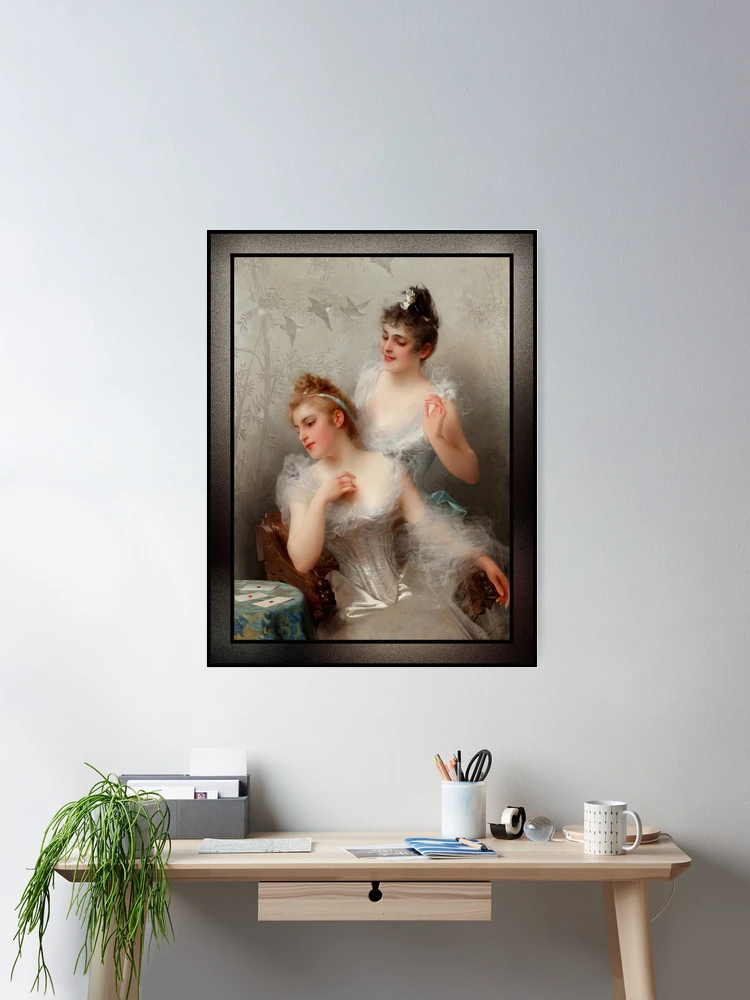
Table des matières
Le sujet principal et la composition
Dans “Les trois as,” l'accent est mis sur deux femmes assises ensemble à une table, engagé dans un moment ludique. La scène est riche d'émotions subtiles, représentant deux femmes dans un ensemble complexe, pour attirer les riches, suggérant le soin et l’attention accordés à leur rôle en tant que membre de l’élite de la société.
Une des femmes est assise au premier plan, sa délicatesse, aspect presque éthéré marqué par de douces teintes pastel. Elle est vêtue d'un corset qui épouse sa silhouette et est ornée de dentelle et de tissus fins, créer un sentiment de formalité, tandis que son expression douce porte une pointe d'amusement. Son compagnon, debout derrière elle, semble plus détendu, offrant un léger, sourire ludique qui ajoute un air d'intimité et de légèreté à la composition.
La table entre eux ajoute une couche d'interaction dans la pièce, sa surface ornée de cartes à jouer éparses. La présence des cartes intrigue, car il symbolise à la fois un jeu de hasard et une réflexion métaphorique sur la vie et la fortune. Le jeu fait apparemment partie de leurs loisirs occasionnels, mais cela fait aussi allusion aux incertitudes et aux risques ludiques inhérents à la haute société., où apparence et réalité se confondent souvent.
Les coiffures des deux femmes sont un autre élément clé de la composition.. Leurs cheveux luxueux sont méticuleusement coiffés, avec la première femme portant un bandeau bleu qui contraste doucement avec les tons clairs de ses cheveux. Les cheveux de l'autre femme sont légèrement plus foncés, orné de fleurs dans le goût de l'époque, symbolisant à la fois la jeunesse et la fertilité. Leurs coiffures ne sont pas seulement des déclarations de mode mais aussi des marqueurs de leur statut social et de leur raffinement..
Le réglage et les matériaux
L'arrière-plan du tableau est tout aussi significatif que les personnages au premier plan. Le doux, les tons sourds de la pièce complètent les couleurs vibrantes mais raffinées de la tenue vestimentaire des femmes. Le fond neutre est rempli de délicates, des oiseaux presque oniriques qui volent, ajouter une touche de mouvement à la scène autrement immobile.
Ces créatures éthérées, dessiné avec une grande attention aux détails, sont presque comme une bouffée d'air contre la douceur, atmosphère lourde du cadre somptueux des femmes. La pièce, légèrement texturé avec du papier peint à fleurs, est meublé avec des meubles anciens, renforçant subtilement le sentiment de richesse et de confort.
La lumière qui tombe sur les femmes et sur l'environnement met en valeur la technique magistrale employée par Corcos.. L'utilisation d'un éclairage doux et d'ombres crée un mélange harmonieux de réalisme et d'idéalisation.. Le pâle, les tissus translucides des robes pour femmes brillent à la lumière, et la texture de la dentelle et des voiles délicats qu'ils portent suggèrent une réalité presque tactile qui entraîne le spectateur dans leur monde.. La maîtrise de la lumière et de la texture de Corcos capture le scintillement subtil de la soie et de la dentelle., élevant la scène à un niveau de beauté presque romantique.
Style, Thème, et humeur
Le style de Corcos dans cette pièce est un mélange harmonieux de réalisme avec une touche d'idéalisation caractéristique de l'art de la fin du 19e siècle et du début du 20e siècle.. Son utilisation de pastels doux et de pinceaux délicats s'aligne sur l'esthétique de la période Belle Époque., Où la beauté, loisirs, et le luxe étaient célébrés à travers les arts visuels. Les femmes dans “Les trois as” sont peints avec une élégance raffinée qui témoigne de leur statut social élevé et d'un sens inhérent de la grâce.
Le thème du tableau est celui des loisirs, beauté, et une interaction subtile. Il existe une tension palpable entre le caractère ludique du jeu de cartes et l'élégance des femmes impliquées.. C’est comme si les cartes représentaient un moment de répit dans la vie des femmes qui, malgré leur opulence, sont engagés dans les joies simples de la compagnie et dans un jeu de hasard éphémère. Leurs expressions posées mais sereines suggèrent que, même dans les moments de frivolité, ils font partie d'une danse sociale plus vaste où les apparences sont soigneusement gérées.
L'ambiance du tableau est celle d'une contemplation tranquille, avec une nuance d'intrigue. Le caractère ludique du jeu contraste avec les expressions réservées des femmes, faisant allusion à un monde intérieur qui n'est pas immédiatement apparent. La douceur des couleurs et des textures renforce l'atmosphère tranquille, ce qui rend cette œuvre à la fois visuellement frappante et émotionnellement résonnante. Il y a un élément d'intemporalité dans la peinture, où la nature éphémère du jeu est capturée aux côtés des qualités éternelles de beauté et d'équilibre.
Conclusion
Dans “Les trois as,” Vittorio Matteo Corcos a une fois de plus démontré sa maîtrise dans la capture des nuances de la vie mondaine.. Par son rendu minutieux de ses sujets et de leur environnement, il nous invite à apprécier à la fois l'élégance et la fugacité du moment qu'il met en scène. Le tableau n'est pas seulement une représentation de deux femmes dans un décor luxueux, mais une fenêtre sur un monde où la richesse de la vie et l'attrait des jeux sociaux cohabitent avec la beauté, grâce, et la tension tranquille des interactions quotidiennes.
The Three Aces est une reproduction de maîtres anciens d'art numérique retouchée d'une image du domaine public.
Biographie de l'artiste dérivée de Wikipedia.org
Vittorio est né de parents juifs, Isaac et Giuditta Baquis, à Livourne, et à l'âge de 16, il a obtenu sa formation artistique à l'Académie des Beaux-Arts de Florence sous la tutelle du Peintre Italien Enrico Pollastrini (1817 – 1876).
Puis entre 1878 et 1879 il a travaillé sous le peintre italien Domenico Morelli (1826 – 1901) à Naples; connu pour produire des peintures historiques et religieuses; et qui était considéré comme une grande influence dans les arts de la seconde moitié du 19ème siècle.
Vittorio se rend ensuite à Paris où il rencontre le peintre français Léon Bonnat (1833 – 1922), et signé un contrat avec le Goupil & Cie une concession leader dans la France du 19ème siècle, à partir de laquelle il a pu compléter ses revenus de portraitiste avec des illustrations pour des magazines.
Il fréquente les cercles du Peintre italien Giuseppe De Nittis (considéré comme l'un des peintres italiens les plus importants du 19ème siècle); et de 1881 jusqu'à ce que 1886, il expose fréquemment au Salon.
Dans 1886 Vittorio est retourné en Italie, putativement rejoindre l'armée, puis s'installe à Florence. À ce moment-là, il se convertit au catholicisme et épousa une veuve nommée Emma Ciabatti.
À Florence, il s'est fait des amis dans les cercles intellectuels de l'époque, et fait des portraits du peintre réaliste italien Silvestro Lega (1826 – 1895), Poète italien Giosue Carducci (1835 – 1907), et le compositeur italien Pietro Mascagni (1863 – 1945).
Après 1900, il a écrit pour le Journal florentin Il Marzocco.; ainsi que publié une nouvelle dans le magazine Fanfulla della Domenica intitulée Mademoiselle Leprince.
Dans 1904, il s'est rendu à Potsdam pour peindre l'empereur Guillaume II (1859 – 1941) et d'autres membres de la monarchie allemande.
Pendant la Première Guerre mondiale en 1916, Le fils de Vittorio est mort au combat. Plus tard dans les années 1920, il rejoint le Gruppo Labronico avec les peintres italiens Plinio Nomellini (1866 – 1943) et Ulvi Liegi (1858 – 1939).
Il a également peint des portraits de Mussolini (Benito Amilcare Andrea Mussolini 1883 – 1945) dans 1928; Comtesse Annina Morosini (1924 – 1965); Comtesse Nerina Volpi de Misurata; Carducci, Puccini et Mascagni; La reine Amélie de Portugal et la princesse d'Orléans.