

The Three Aces
“The Three Aces” is a magnificent painting created by Italian artist Vittorio Matteo Corcos (1859 – 1933) in the late 19th to early 20th century, specifically around 1900. Urodzony w 1859, Corcos became renowned for his vivid depictions of elegant women, their expressions, and social settings that reflect both the aristocracy and the refined societal circles of the time. Ten obraz, marked by his impeccable attention to detail, invites the viewer into a world of sophisticated leisure and subtle intrigue. It presents a scene of high society, offering not only a glimpse into the lives of the upper class but also insight into the artist’s remarkable technique.
Spis treści
Główny temat i kompozycja
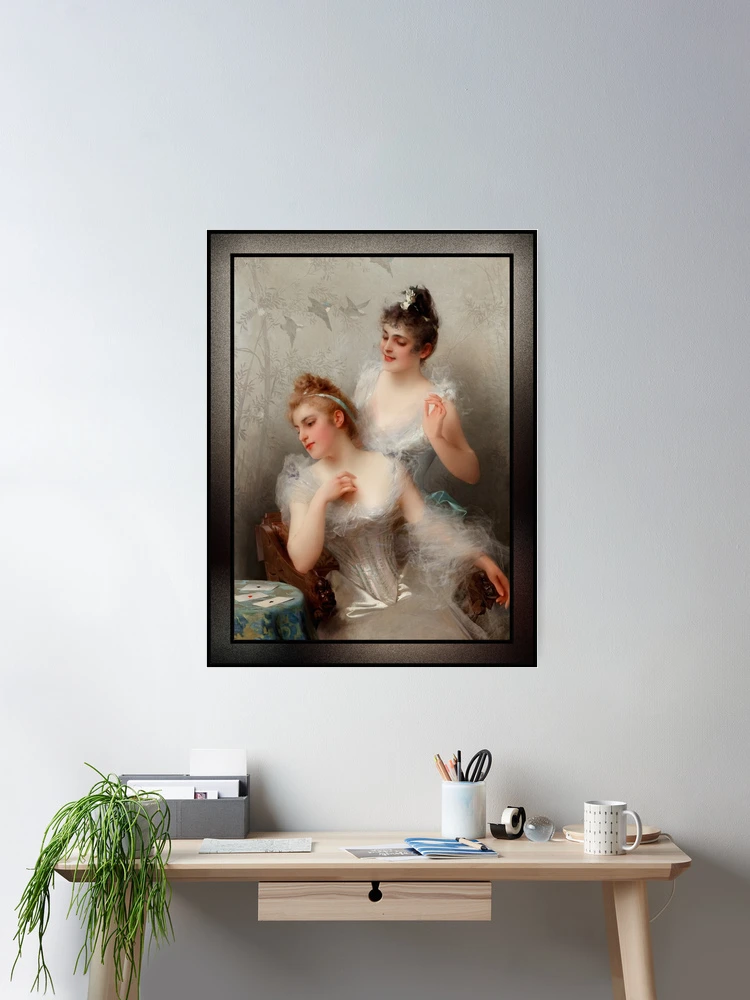
W “The Three Aces,” the focus is on two women sitting together at a table, engaged in a playful moment. The scene is rich with subtle emotion, portraying two women in intricate, opulent attire, suggesting the care and attention given to their roles as part of society’s elite.
One of the women is seated in the foreground, her delicate, almost ethereal appearance marked by soft pastel hues. She is dressed in a corset that hugs her figure and is adorned with lace and fine fabric, creating a sense of formality, while her soft expression carries a hint of amusement. Her companion, standing behind her, seems more relaxed, offering a slight, playful smile that adds an air of intimacy and lightness to the composition.
The table between them adds a layer of interaction in the piece, its surface adorned with scattered playing cards. The presence of the cards is intriguing, as it symbolizes both a game of chance and a metaphorical reflection on life and fortune. The game is seemingly a part of their casual leisure, but it also hints at the uncertainties and playful risks inherent in high society, where appearance and reality often blur.
The two women’s hairstyles are another key element of the composition. Their luxurious hair is meticulously styled, with the first woman wearing a headband of blue that contrasts softly against the light tones of her hair. The other woman’s hair is slightly darker, adorned with flowers in the style of the period, symbolizing both youth and fertility. Their coiffures are not just fashion statements but also markers of their social status and refinement.
The Setting and Materials
The background of the painting is just as significant as the figures in the foreground. Miękkie, muted tones of the room complement the vibrant yet refined colors of the women’s attire. The neutral background is filled with delicate, almost dreamlike birds flying, adding a touch of motion to the otherwise still scene.
These ethereal creatures, drawn with great attention to detail, are almost like a breath of air against the otherwise soft, heavy atmosphere of the women’s lavish surroundings. Pokój, faintly textured with floral wallpaper, is furnished with antique furniture, subtly reinforcing the sense of wealth and comfort.
The light that falls on the women and the surrounding environment highlights the masterful technique Corcos employed. The use of soft lighting and shadows creates a harmonious blend of realism and idealization. The pale, translucent fabrics of the women’s dresses glow in the light, and the texture of the lace and delicate veils they wear suggests an almost tactile reality that pulls the viewer into their world. Corcos’ command of light and texture captures the subtle shimmer of silk and lace, elevating the scene to an almost romantic level of beauty.
Styl, Temat, i Nastrój
Corcos’ style in this piece is a harmonious blend of realism with a touch of idealization that was characteristic of the late 19th century and early 20th century art. His use of soft pastels and delicate brushwork aligns with the aesthetic of the Belle Époque period, gdzie piękno, leisure, and luxury were celebrated through visual art. The women in “The Three Aces” are painted with a refined elegance that speaks to their high social status and an inherent sense of grace.
The theme of the painting is one of leisure, piękno, and subtle interaction. There is a palpable tension between the playful nature of the card game and the elegance of the women involved. It’s as if the cards represent a moment of respite in the lives of women who, despite their opulence, are engaged in the simple joys of companionship and a fleeting game of chance. Their poised yet serene expressions suggest that, even in moments of frivolity, they are part of a larger social dance where appearances are carefully managed.
The mood of the painting is one of quiet contemplation, with an undertone of intrigue. The playfulness of the game contrasts with the reserved expressions of the women, hinting at an inner world that is not immediately apparent. The softness of the colors and textures reinforces the tranquil atmosphere, making this work both visually striking and emotionally resonant. There is an element of timelessness in the painting, where the transient nature of the game is captured alongside the eternal qualities of beauty and poise.
Wniosek
W “The Three Aces,” Vittorio Matteo Corcos has once again demonstrated his mastery in capturing the nuances of high society life. Through his meticulous rendering of his subjects and their environment, he invites us to appreciate both the elegance and the fleeting nature of the moment he portrays. The painting is not just a representation of two women in a luxurious setting, but a window into a world where the richness of life and the allure of social games coexist with beauty, łaska, and the quiet tension of everyday interactions.
The Three Aces is a retouched digital art old masters reproduction of a public domain image.
Bio artysty pochodzące z Wikipedia.org
Vittorio urodził się w żydowskiej rodzinie, Izaaka i Judith Baquis, w Livorno, i w wieku 16, uzyskał wykształcenie artystyczne w Akademii Sztuk Pięknych we Florencji pod kierunkiem włoskiego malarza Enrico Pollastriniego (1817 – 1876).
Potem pomiędzy 1878 i 1879 pracował pod kierunkiem włoskiego malarza Domenico Morelli (1826 – 1901) w Neapolu; znany z tworzenia obrazów historycznych i religijnych; i uważany za osobę wywarjącą ogromny wpływ na sztukę drugiej połowy XIX wieku.
Następnie Vittorio udał się do Paryża, gdzie poznał francuskiego malarza Léona Bonnata (1833 – 1922), i podpisał kontrakt z Goupilem & Cie wiodący dealer w XIX-wiecznej Francji, z którego jako portrecista mógł uzupełniać swoje dochody ilustracjami do czasopism.
Bywał w kręgu włoskiego malarza Giuseppe De Nittisa (uważany za jednego z najważniejszych malarzy włoskich XIX wieku); i od 1881 dopóki 1886, często wystawiał na Salonie.
W 1886 Vittorio wrócił do Włoch, przypuszczalnie wstąpić do wojska, a następnie osiadł we Florencji. W tym czasie przeszedł na katolicyzm i poślubił wdowę o imieniu Emma Ciabatti.
We Florencji, zaprzyjaźnił się w ówczesnych kręgach intelektualnych, i wykonał portrety włoskiego malarza realisty Silvestro Legi (1826 – 1895), Włoski poeta Giosue Carducci (1835 – 1907), i włoski kompozytor Pietro Mascagni (1863 – 1945).
Po 1900, pisał dla florenckiego czasopisma Il Marzocco.; a także opublikował opowiadanie w czasopiśmie Fanfulla della Domenica pt. Mademoiselle Leprince.
W 1904, udał się do Poczdamu, aby namalować cesarza Wilhelma II (1859 – 1941) i inni członkowie monarchii niemieckiej.
W czasie I wojny światowej w 1916, Syn Vittorio zginął w bitwie. Później w latach dwudziestych dołączył do Gruppo Labronico wraz z włoskimi malarzami Plinio Nomellinim (1866 – 1943) i Ulviego Liegi (1858 – 1939).
Malował także portrety Mussoliniego (Benito Amilcare Andrei Mussoliniego 1883 – 1945) w 1928; Hrabina Annina Morosini (1924 – 1965); Hrabina Nerina Volpi z Misuraty; Carducci, Pucciniego i Mascagniego; Królowa Portugalii Amelia i księżna Orleanu.