

The Toilet of Venus: The Allure of Leisure
The Toilet of Venus, this version was painted by François Boucher (1703 – 1770) around 1751; and stands as a quintessential example of Rococo art, embodying its characteristic sensuality, eleganza, and playful depiction of mythological themes. This large-scale canvas, currently residing in the Louvre Museum, transports viewers to a realm of idyllic beauty and leisurely indulgence, showcasing Boucher’s mastery of color, luce, è cumpusizioni. The painting is not merely a representation of the goddess Venus; it’s an exploration of feminine grace within a carefully constructed fantasy landscape.
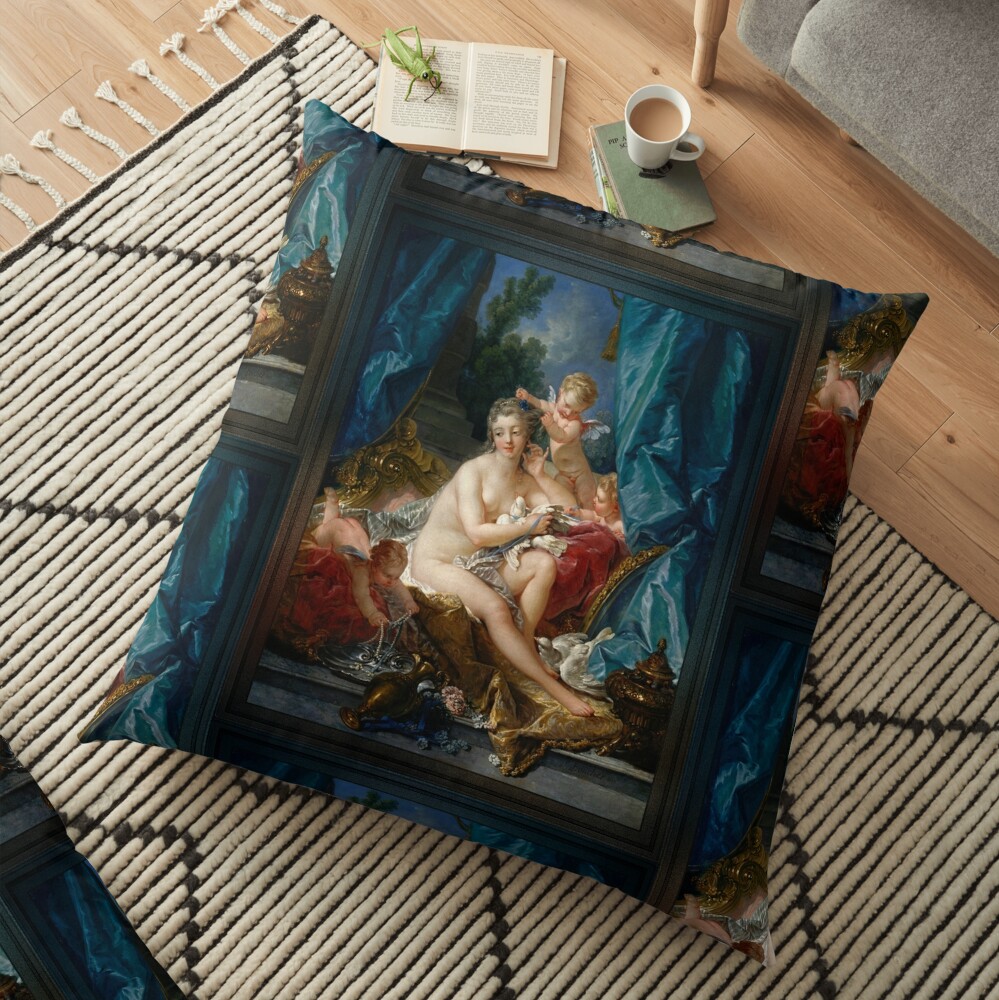
Table of Contents
A Scene of Delicate Rituals
A figura centrale, undeniably Venus (Aphrodite in Greek mythology), reclines upon a lavishly adorned chaise lounge. She is depicted mid-action, engaged in the intimate act of dressing her hair. Her posture is relaxed and graceful, conveying an air of serene contentment rather than any sense of formality or grandeur. The artist’s focus isn’t on portraying Venus as a powerful deity but rather as a beautiful woman enjoying a moment of personal care.
She holds a small mirror to one side, seemingly admiring her reflection while a handmaid gently arranges ribbons in her hair. This intimate scene is far removed from the heroic narratives often associated with classical mythology; invece, it emphasizes domesticity and private pleasure.
Cherubic Companions & Decorative Details
Surrounding Venus are several cherubs, characteristic figures within Rococo art. These playful spirits flit about, attending to the goddess’s needs. One cherub playfully blows bubbles, while another offers a bouquet of flowers. Their presence adds an element of lightness and whimsy to the scene, reinforcing the overall atmosphere of carefree enjoyment.
The chaise lounge itself is a masterpiece of decorative detail, featuring intricate carvings and luxurious fabrics in rich reds and golds. Scattered around Venus are various objects associated with beauty and adornment: perfume bottles, scattered roses, gioielli, and a small white rabbit – all contributing to the painting’s opulent aesthetic.
A Stage Setting of Opulence & Natura
The setting for this idyllic scene is equally important. Heavy blue draperies frame the composition on either side, creating a sense of theatricality and enclosure. Beyond these curtains lies a glimpse of a lush garden with verdant trees and classical architecture in the distance. This carefully constructed backdrop suggests a secluded paradise, further enhancing the feeling of privacy and indulgence. L'usu di a luce hè particularmente degne di nota; Boucher masterfully employs soft, diffused lighting to illuminate Venus’s figure, highlighting her skin’s luminosity and creating a sense of warmth and intimacy.
Paleta di culori & Tecnica Artistica
Boucher’s color palette in “The Toilet of Venus” is dominated by pastel hues – pinks, blues, verdi, and golds – which are hallmarks of the Rococo style. These soft colors contribute to the painting’s overall feeling of lightness and delicacy. His brushwork is loose and fluid, creating a sense of movement and spontaneity. The artist’s technique prioritizes capturing the essence of beauty and pleasure over strict realism. He uses subtle gradations of color to model Venus’s form, emphasizing her curves and contours while maintaining an ethereal quality.

Cuntestu & Eredità
“The Toilet of Venus” was created during a period when Rococo art flourished in France, particularly under the patronage of Madame de Pompadour, Louis XV’s influential mistress. Boucher became the leading artist of this style, known for his decorative paintings that catered to the tastes of the aristocracy. The painting reflects the prevailing cultural values of the time – an emphasis on pleasure, bellezza, and refined leisure.
It’s a testament to Boucher’s ability to create visually stunning works that captured the spirit of the Rococo era and continues to captivate audiences with its charm and elegance. The work’s influence can be seen in subsequent artistic trends, particularly in depictions of idealized feminine figures and the use of decorative elements to enhance visual appeal.
Biografia di l'artista Da Wikipedia.org
Nativu di Parigi, Boucher era u figliolu di un pittore pocu cunnisciutu Nicolas Boucher, chì li dete a so prima furmazione artistica. À l'età di diciassette anni, un dipintu di Boucher era ammiratu da u pittore François Lemoyne. Lemoyne dopu hà numinatu Boucher cum'è u so apprendista, ma dopu solu trè mesi, andò à travaglià pè l'incisore Jean-François Cars.
In 1720, vincìu l'élite Grand Prix de Rome per a pittura, ma ùn hà pigliatu l'oppurtunità di studià in Italia finu à cinque anni dopu, per via di prublemi finanziarii à l'Accademia Reale di Pittura è Scultura.[1] Al suo ritorno dai suoi studi in Italia fu ammesso alla rifondata Académie de peinture et de sculpture on 24 Nuvembre 1731. U so pezzu di ricezione (pezza di ricezione) era u so Rinaldu è Armida di 1734.
Boucher sposò Marie-Jeanne Buzeau in 1733. A coppia avia trè figlioli inseme. Boucher hè diventatu un membru di a facultà in 1734 è a so carriera s'accelerà da questu puntu chì hè statu prumuvutu Prufessore dopu Rettore di l'Accademia, diventendu ispettore à a Royal Gobelins Manufactory è infine Premier Peintre du Roi (Primu Pittore di u Re) in 1765. Ritrattu di Marie-Louise O'Murphy c. 1752
Boucher hè mortu 30 Maghju 1770 in a so Parigi natale. U so nome, cù quellu di a so patrona Madame de Pompadour, era diventatu sinonimu di u stilu rococò francese, guidà i fratelli Goncourt à scrive: “Boucher hè unu di quelli omi chì rapprisentanu u gustu di un seculu, qui s'expriment, personificà è incarna.”
Boucher hè famosu per dì chì a natura hè “troppu verde è pocu illuminatu” (troppu verde è mal illuminatu).
Boucher era assuciatu cù l'incisore di pietre preziose Jacques Guay, à qui il a enseigné à dessiner. Il a également encadré le peintre moravo-austriaque Martin Ferdinand Quadal ainsi que le peintre néoclassique Jacques-Louis David en 1767.[4] Più tardi, Boucher hà fattu una serie di disegni di l'opere di Guay chì Madame de Pompadour hà poi incisu è distribuitu cum'è un voluminu bellu rilegatu à i cortigiani favuriti.
The Toilet of Venus is a retouched digital art reproduction of a public domain image, which can be purchased as a stampa su tela in linea.