

Toiled Venus: The Allure of Leisure
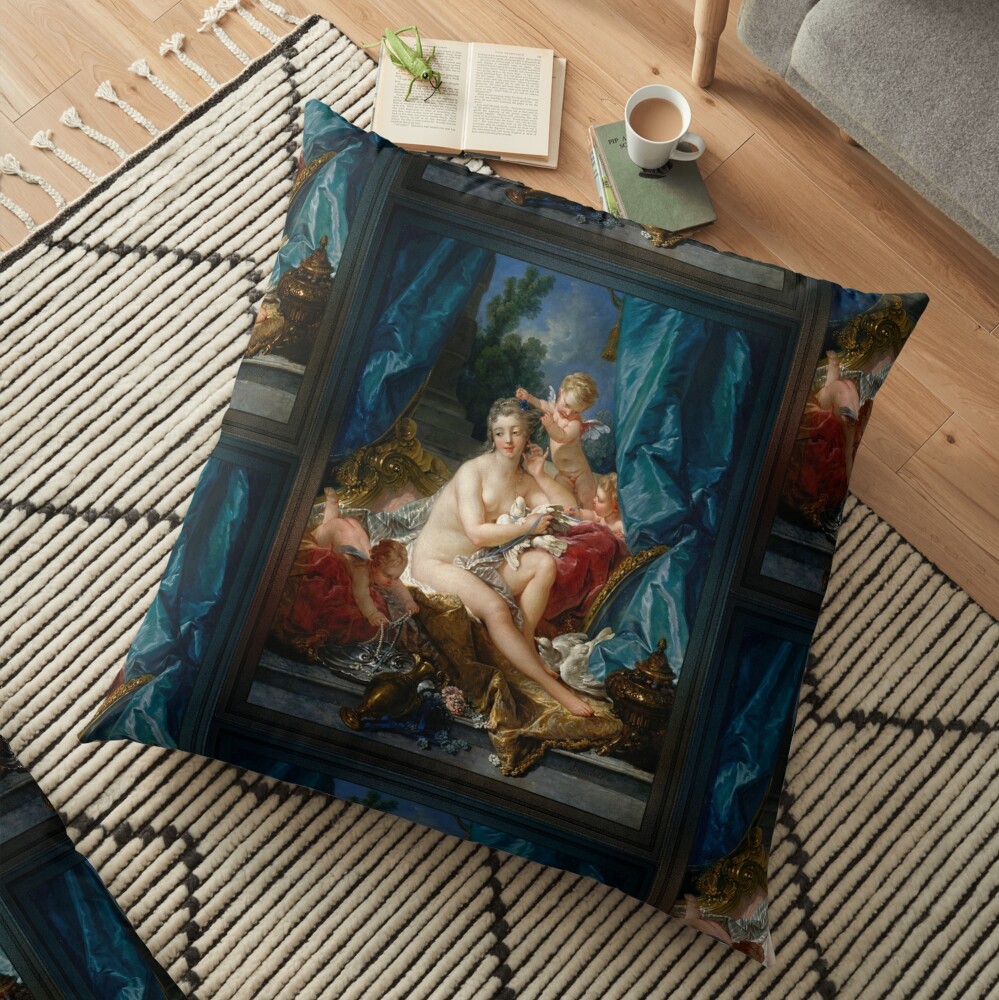
Toiled Venus, this version was painted by François Boucher (1703 – 1770) around 1751; and stands as a quintessential example of Rococo art, embodying its characteristic sensuality, geinder, and playful depiction of mythological themes. This large-scale canvas, currently residing in the Louvre Museum, transports viewers to a realm of idyllic beauty and leisurely indulgence, showcasing Boucher’s mastery of color, golau, a chyfansoddiad. The painting is not merely a representation of the goddess Venus; it’s an exploration of feminine grace within a carefully constructed fantasy landscape.
Tabl Cynnwys
A Scene of Delicate Rituals
Y ffigur canolog, undeniably Venus (Aphrodite in Greek mythology), reclines upon a lavishly adorned chaise lounge. She is depicted mid-action, engaged in the intimate act of dressing her hair. Her posture is relaxed and graceful, conveying an air of serene contentment rather than any sense of formality or grandeur. The artist’s focus isn’t on portraying Venus as a powerful deity but rather as a beautiful woman enjoying a moment of personal care.
She holds a small mirror to one side, seemingly admiring her reflection while a handmaid gently arranges ribbons in her hair. This intimate scene is far removed from the heroic narratives often associated with classical mythology; yn lle, it emphasizes domesticity and private pleasure.
Cherubic Companions & Decorative Details
Surrounding Venus are several cherubs, characteristic figures within Rococo art. These playful spirits flit about, attending to the goddess’s needs. One cherub playfully blows bubbles, while another offers a bouquet of flowers. Their presence adds an element of lightness and whimsy to the scene, reinforcing the overall atmosphere of carefree enjoyment.
The chaise lounge itself is a masterpiece of decorative detail, featuring intricate carvings and luxurious fabrics in rich reds and golds. Scattered around Venus are various objects associated with beauty and adornment: perfume bottles, scattered roses, gemwaith, and a small white rabbit – all contributing to the painting’s opulent aesthetic.
A Stage Setting of Opulence & Natur
The setting for this idyllic scene is equally important. Heavy blue draperies frame the composition on either side, creating a sense of theatricality and enclosure. Beyond these curtains lies a glimpse of a lush garden with verdant trees and classical architecture in the distance. This carefully constructed backdrop suggests a secluded paradise, further enhancing the feeling of privacy and indulgence. The use of light is particularly noteworthy; Boucher masterfully employs soft, diffused lighting to illuminate Venus’s figure, highlighting her skin’s luminosity and creating a sense of warmth and intimacy.
Palet Lliw & Techneg Artistig
Boucher’s color palette in “The Toilet of Venus” is dominated by pastel hues – pinks, felan, gwyrddion, and golds – which are hallmarks of the Rococo style. These soft colors contribute to the painting’s overall feeling of lightness and delicacy. His brushwork is loose and fluid, creating a sense of movement and spontaneity. The artist’s technique prioritizes capturing the essence of beauty and pleasure over strict realism. He uses subtle gradations of color to model Venus’s form, emphasizing her curves and contours while maintaining an ethereal quality.

Cyd-destun & Etifeddiaeth
“The Toilet of Venus” was created during a period when Rococo art flourished in France, particularly under the patronage of Madame de Pompadour, Louis XV’s influential mistress. Boucher became the leading artist of this style, known for his decorative paintings that catered to the tastes of the aristocracy. The painting reflects the prevailing cultural values of the time – an emphasis on pleasure, harddwch, and refined leisure.
It’s a testament to Boucher’s ability to create visually stunning works that captured the spirit of the Rococo era and continues to captivate audiences with its charm and elegance. The work’s influence can be seen in subsequent artistic trends, particularly in depictions of idealized feminine figures and the use of decorative elements to enhance visual appeal.
Artist Bio From Wikipedia.org
Brodor o Baris, Roedd Boucher yn fab i arlunydd llai adnabyddus Nicolas Boucher, a roddodd ei hyfforddiant artistig cyntaf iddo. Yn ddwy ar bymtheg oed, edmygwyd paentiad gan Boucher gan yr arlunydd François Lemoyne. Yn ddiweddarach, penododd Lemoyne Boucher yn brentis iddo, ond ar ôl dim ond tri mis, aeth i weithio i'r engrafwr Jean-François Cars.
Yn 1720, enillodd y Grand Prix de Rome elitaidd am baentio, ond ni fanteisiodd ar y cyfle canlyniadol i astudio yn yr Eidal tan bum mlynedd yn ddiweddarach, oherwydd problemau ariannol yn yr Academi Frenhinol Peintio a Cherflunio.[1] Ar ôl dychwelyd o astudio yn yr Eidal derbyniwyd ef i'r cerflun Académie de peinture et de newydd ei addurno 24 Tachwedd 1731. Ei ddarn derbyn (darn derbynfa) oedd ei Rinaldo ac Armida o 1734.
Priododd Boucher â Marie-Jeanne Buzeau yn 1733. Roedd gan y cwpl dri o blant gyda'i gilydd. Daeth Boucher yn aelod cyfadran yn 1734 a chyflymodd ei yrfa o'r pwynt hwn wrth iddo gael ei ddyrchafu'n Athro ar y pryd yn Rheithor yr Academi, dod yn arolygydd yn y Royal Gobelins Manufactory ac yn olaf Premier Peintre du Roi (Peintiwr Cyntaf y Brenin) yn 1765. Portread o Marie-Louise O’Murphy c. 1752
Bu farw Boucher ymlaen 30 Mai 1770 yn ei wlad enedigol Paris. Ei enw, ynghyd â rhywun ei noddwr Madame de Pompadour, wedi dod yn gyfystyr ag arddull Rococo Ffrainc, arwain y brodyr Goncourt i ysgrifennu: “Mae Boucher yn un o'r dynion hynny sy'n cynrychioli blas canrif, sy'n mynegi, personoli a'i ymgorffori.”
Mae Boucher yn enwog am ddweud bod natur yn “rhy wyrdd a goleuo'n wael” (rhy wyrdd a goleuo'n wael).
Roedd Boucher yn gysylltiedig â'r engrafwr gemstone Jacques Guay, y dysgodd ei dynnu. Bu hefyd yn mentora'r arlunydd Morafaidd-Awstria Martin Ferdinand Quadal yn ogystal â'r arlunydd neoglasurol Jacques-Louis David yn 1767.[4] Yn ddiweddarach, Gwnaeth Boucher gyfres o luniau o weithiau gan Guay y gwnaeth Madame de Pompadour eu hysgythru a'u dosbarthu fel cyfrol wedi'i rhwymo'n golygus i lyswyr a ffefrir
Atgynhyrchiad celf ddigidol wedi'i ail-gyffwrdd o ddelwedd parth cyhoeddus yw Toiled Venus, which can be purchased as a argraffu cynfas ar-lein.