

Čarodějnický sabat
The Witch’s Sabbath: Exploring The Allure of Night
The Witches Sabbath by Luis Ricardo Falero (1851-1896) was a Spanish painter known for his evocative depictions of mythological and fantastical subjects, often imbued with a romantic sensibility. His work frequently explored themes of the supernatural and the allure of the night, drawing inspiration from folklore and literary sources. “The Witch’s Sabbath,“ maloval kolem 1880, stands as one of Falero’s most celebrated pieces, capturing a moment of ethereal flight and nocturnal mystery. The painting is an example of academic art with elements of symbolism and romanticism that were popular during the late nineteenth century.
Obsah
Compositional Elements & Narativní návrh
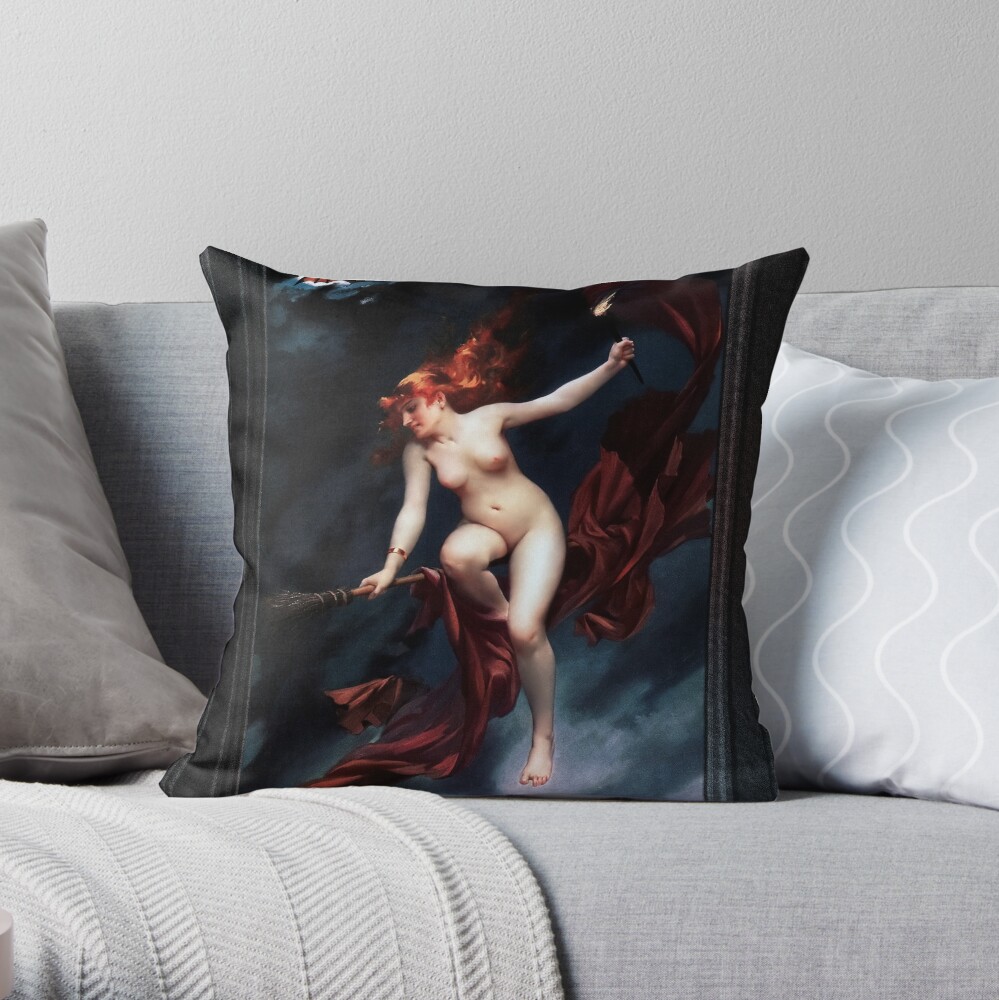
The composition immediately draws the viewer’s eye upward towards a central figure suspended in mid-air amidst a swirling, tempestuous sky. Toto číslo, a nude woman with fiery red hair, is the focal point of the artwork. She appears to be engaged in an act of flight, propelled by a broomstick held firmly beneath her. The dramatic diagonal line created by the broom and her outstretched arm contributes significantly to the dynamism of the scene, suggesting movement and upward momentum.
The background is dominated by a dark, brooding sky filled with swirling clouds illuminated by a crescent moon. This celestial backdrop reinforces the nocturnal setting and lends an air of mystery and foreboding to the overall atmosphere. A single bat flies across the moon, adding another layer of symbolism associated with the supernatural. The artist’s skillful use of chiaroscuro – the contrast between light and dark – further enhances the drama and emphasizes the figure’s form against the shadowy background.
Figure & Umělecká technika
Falero’s rendering of the female figure is notable for its anatomical accuracy, a hallmark of academic training. Her pose is graceful yet powerful, conveying a sense of both vulnerability and control. The artist meticulously details her skin tone, highlighting the subtle curves and contours of her body. The flowing red fabric that drapes around her adds to the visual interest, creating a dynamic interplay of light and shadow as it billows in the wind.
Falero’s brushwork is evident throughout the painting, particularly in the rendering of the clouds and the woman’s hair. The artist employs loose, expressive strokes to capture the movement and texture of these elements, while maintaining a level of detail in the figure itself. The color palette is dominated by cool tones – blues, šedé, and blacks – which contribute to the overall sense of mystery and melancholy. nicméně, the warm hues of the woman’s hair and the red fabric provide a striking contrast, drawing the viewer’s attention to these key elements.
Symbolismus & Výklad
“The Witch’s Sabbath” draws heavily on European folklore and traditions surrounding witchcraft. The image of a witch flying through the night sky on a broomstick is a recurring motif in such narratives, often associated with gatherings of witches performing rituals under the light of the full moon. Falero’s painting taps into this rich cultural heritage, evoking a sense of both fascination and apprehension.
The crescent moon itself carries symbolic weight, representing cycles, přeměna, and the feminine principle. The bat, traditionally linked to darkness and the supernatural, further reinforces the painting’s association with the occult. While the artwork doesn’t explicitly depict any ritualistic actions, it suggests a moment of transformation or transcendence – a departure from the mundane world into a realm of magic and mystery.
Umělecké vlivy & Dědictví
Falero’s work reflects the influence of several artistic movements prevalent during his time. The academic training evident in his meticulous rendering of the human form aligns with the traditions of classical art. nicméně, the painting’s emphasis on emotion, atmosphere, and the supernatural also reveals a connection to Romanticism, which celebrated imagination, individualismus, and the power of nature.
“The Witch’s Sabbath” remains a compelling example of Falero’s artistic skill and his ability to capture the allure of the fantastical. The painting has been widely reproduced and admired for its dramatic composition, evokativní atmosféra, and enduring appeal. It stands as a testament to the artist’s talent and his contribution to the rich tapestry of nineteenth-century Spanish art.
Technical Details & Provenance
The artwork is executed in oil on canvas. It measures approximately 105 X 74 cm (41.3 X 29.1 palce). The painting’s provenance, or history of ownership, has been documented through various collections and exhibitions over the years. It currently resides within a private collection. The signature “Falero – 1880” is visible in the lower right corner of the canvas.
Artist Bio Derived Wikipedia.org
Falero se narodil v Granadě a původně se věnoval kariéře ve španělském námořnictvu, ale vzdal to rodičům zklamání; když se rozhodl odcestovat do Paříže, kde studoval umění, chemie a strojírenství.
Během studia chemie a strojírenství; experimenty, které musel provádět, považoval za příliš nebezpečné, což ho přivedlo k tomu, aby zaměřil svou pozornost pouze na malbu.
V důsledku toho se stal studentem francouzského portrétisty a orientalisty Gabriel-Joseph-Marie-Augustin Ferrier (1847 – 1914). Po Paříži, přestěhoval do Londýna, kde pokračoval ve studiu, a nakonec se vyrovnal.
Falero měl zvláštní zájem o astronomii a do mnoha svých děl začlenil nebeská souhvězdí, jako “Manželství komety” a “Twin Stars”. Jeho zájem a znalosti astronomie ho také vedly k ilustraci děl Camille Flammarionové.
v 1896, rok jeho smrti, Maud Harvey žalovala Falera o otcovství. Oblek tvrdil, že Falero svedla Harveyho, když byla 17, nejprve sloužil jako jeho služebná, a pak jeho model. Když zjistil, že je těhotná, propustil ji.
Vyhrála případ a získala pět šilinků týdně na podporu jejich dítěte. Falero zemřel v univerzitní fakultní nemocnici, Londýn, ve věku 45
The Witches Sabbath je retušovaná digitální umělecká reprodukce obrazu ve veřejném vlastnictví starých mistrů; a stejně jako všechna umělecká díla, která lze nalézt na webu Xzendor7, je k dispozici ke koupi online v různých materiálových formátech včetně tisků na plátno, akrylové tisky, kovové potisky, otisky dřeva, zarámované tisky, plakáty, a jako rolované obrazy na plátně v různých velikostech od 12 palce až 72 palce v závislosti na velikosti skutečného uměleckého díla a obchodu s tiskem na vyžádání, ve kterém se rozhodnete umění koupit..