

De heksensabbat
The Witch’s Sabbath: Exploring The Allure of Night
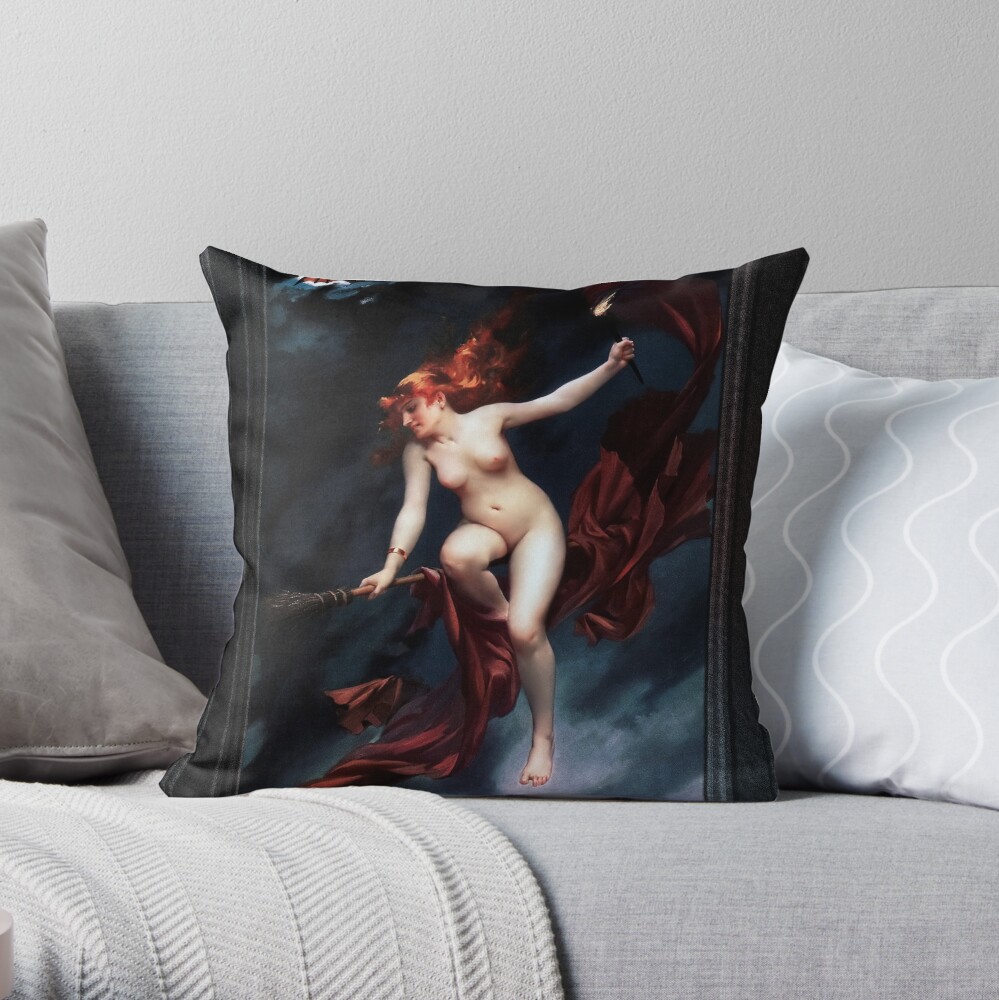
The Witches Sabbath by Luis Ricardo Falero (1851-1896) was a Spanish painter known for his evocative depictions of mythological and fantastical subjects, often imbued with a romantic sensibility. His work frequently explored themes of the supernatural and the allure of the night, drawing inspiration from folklore and literary sources. “The Witch’s Sabbath,'omheen geschilderd 1880, stands as one of Falero’s most celebrated pieces, capturing a moment of ethereal flight and nocturnal mystery. The painting is an example of academic art with elements of symbolism and romanticism that were popular during the late nineteenth century.
Inhoudsopgave
Compositorische elementen & Verhalende suggestie
The composition immediately draws the viewer’s eye upward towards a central figure suspended in mid-air amidst a swirling, tempestuous sky. Dit cijfer, a nude woman with fiery red hair, is the focal point of the artwork. She appears to be engaged in an act of flight, propelled by a broomstick held firmly beneath her. The dramatic diagonal line created by the broom and her outstretched arm contributes significantly to the dynamism of the scene, suggesting movement and upward momentum.
The background is dominated by a dark, brooding sky filled with swirling clouds illuminated by a crescent moon. This celestial backdrop reinforces the nocturnal setting and lends an air of mystery and foreboding to the overall atmosphere. A single bat flies across the moon, adding another layer of symbolism associated with the supernatural. The artist’s skillful use of chiaroscuro – the contrast between light and dark – further enhances the drama and emphasizes the figure’s form against the shadowy background.
Figure & Artistieke techniek
Falero’s rendering of the female figure is notable for its anatomical accuracy, a hallmark of academic training. Her pose is graceful yet powerful, conveying a sense of both vulnerability and control. The artist meticulously details her skin tone, highlighting the subtle curves and contours of her body. The flowing red fabric that drapes around her adds to the visual interest, creating a dynamic interplay of light and shadow as it billows in the wind.
Falero’s brushwork is evident throughout the painting, particularly in the rendering of the clouds and the woman’s hair. The artist employs loose, expressive strokes to capture the movement and texture of these elements, while maintaining a level of detail in the figure itself. The color palette is dominated by cool tones – blues, grijzen, and blacks – which contribute to the overall sense of mystery and melancholy. Echter, the warm hues of the woman’s hair and the red fabric provide a striking contrast, drawing the viewer’s attention to these key elements.
Symboliek & Interpretatie
“The Witch’s Sabbath” draws heavily on European folklore and traditions surrounding witchcraft. The image of a witch flying through the night sky on a broomstick is a recurring motif in such narratives, often associated with gatherings of witches performing rituals under the light of the full moon. Falero’s painting taps into this rich cultural heritage, evoking a sense of both fascination and apprehension.
The crescent moon itself carries symbolic weight, representing cycles, change, and the feminine principle. The bat, traditionally linked to darkness and the supernatural, further reinforces the painting’s association with the occult. While the artwork doesn’t explicitly depict any ritualistic actions, it suggests a moment of transformation or transcendence – a departure from the mundane world into a realm of magic and mystery.
Artistieke invloeden & Nalatenschap
Falero’s work reflects the influence of several artistic movements prevalent during his time. The academic training evident in his meticulous rendering of the human form aligns with the traditions of classical art. Echter, the painting’s emphasis on emotion, atmosphere, and the supernatural also reveals a connection to Romanticism, which celebrated imagination, individualism, and the power of nature.
“The Witch’s Sabbath” remains a compelling example of Falero’s artistic skill and his ability to capture the allure of the fantastical. The painting has been widely reproduced and admired for its dramatic composition, evocative atmosphere, and enduring appeal. It stands as a testament to the artist’s talent and his contribution to the rich tapestry of nineteenth-century Spanish art.
Technical Details & Provenance
The artwork is executed in oil on canvas. It measures approximately 105 x 74 cm (41.3 x 29.1 inches). The painting’s provenance, or history of ownership, has been documented through various collections and exhibitions over the years. It currently resides within a private collection. The signature “Falero – 1880” is visible in the lower right corner of the canvas.
Bio van kunstenaar afgeleid Wikipedia.org
Falero werd geboren in Granada en had oorspronkelijk een carrière bij de Spaanse marine, maar gaf het op aan de teleurstelling van zijn ouders; toen hij besloot naar Parijs te reizen, waar hij kunst studeerde, scheikunde en werktuigbouwkunde.
Tijdens is studies in scheikunde en werktuigbouwkunde; hij vond de experimenten die hij moest uitvoeren te gevaarlijk, waardoor hij zijn aandacht alleen op het schilderen richtte.
Als gevolg hiervan werd hij een leerling van de Franse portretschilder en oriëntalist Gabriel-Joseph-Marie-Augustin Ferrier (1847 – 1914). Na Parijs, hij verhuisde naar Londen, waar hij zijn studie voortzette, en uiteindelijk geregeld.
Falero had een bijzondere interesse in astronomie en verwerkte hemelse sterrenbeelden in veel van zijn werken, zoals “Het huwelijk van een komeet” en “Tweelingsterren”. Zijn interesse en kennis van astronomie brachten hem er ook toe om de werken van Camille Flammarion te illustreren.
In 1896, het jaar van zijn dood, Maud Harvey klaagde Falero aan wegens vaderschap. Het pak beweerde dat Falero Harvey had verleid toen ze dat was 17, eerst als zijn dienstmeisje, en dan zijn model. Toen hij ontdekte dat ze zwanger was, hij stuurde haar weg.
Ze won de zaak en kreeg vijf shilling per week ter ondersteuning van hun kind. Falero stierf in het University College Hospital, Londen, op de leeftijd van 45
The Witches Sabbath is een geretoucheerde digitale kunst oude meesters reproductie van een afbeelding uit het publieke domein; en zoals bij alle kunstwerken die op de Xzendor7-website te vinden zijn, is deze online te koop in verschillende materiaalformaten, waaronder canvasafdrukken, acryl afdrukken, metalen prints, hout prints, ingelijste afdrukken, affiches, en als opgerolde canvasafdrukken in diverse maten vanaf 12 inch tot 72 inch, afhankelijk van de grootte van het daadwerkelijke kunstwerk en de print on demand-winkel waar je de kunst wilt kopen..