

Kirjoitusmestari c1882
Kirjoittamisen mestari, c1882, amerikkalainen taidemaalari Thomas Eakins (1844 – 1916)
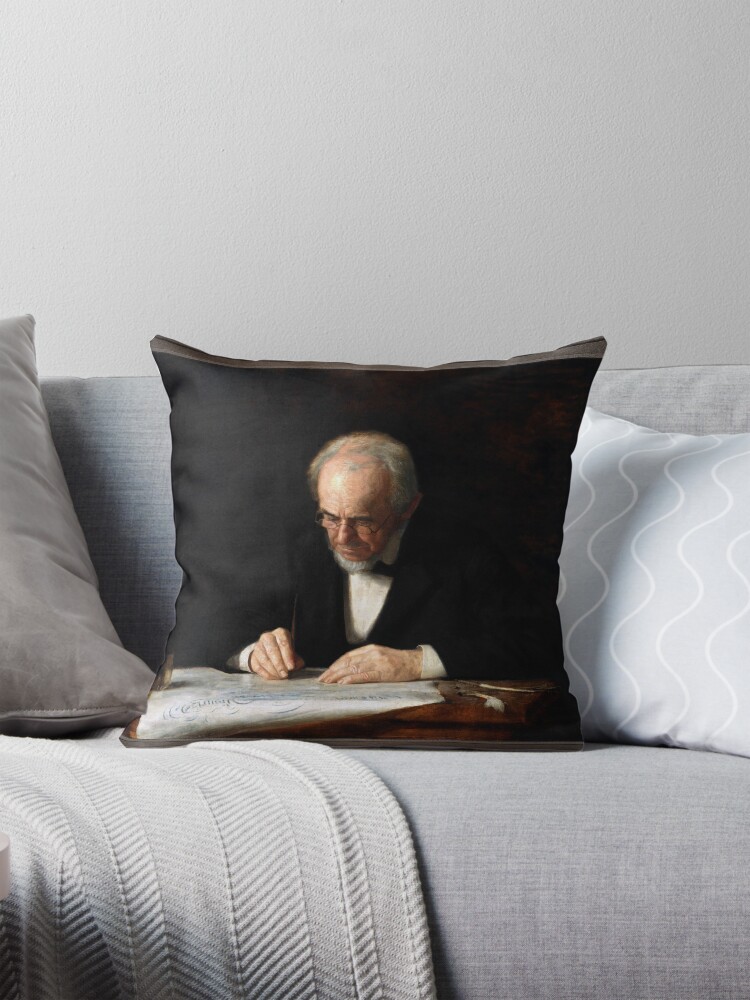
Teoksessa nimeltä Kirjoittamisen mestari, luotu vuonna 1882, Amerikkalainen taiteilija Thomas Eakins (1844 – 1916) esittää vaikuttavan kohtauksen, joka vangitsee hetken intensiivisestä keskittymisestä ja kurinalaisuudesta. Maalauksen kohteena on vanhempi mies, oletettavasti kirjoittamisen opettaja, joka nähdään ahkerasti työssä, syventynyt tehtäväänsä. Eakins’ hahmon kuvaus korostaa hänen tunnusomaista taitoa ihmisen anatomian ja psykologisen syvyyden esittämisessä, korostaen paitsi miehen asentoa myös hänen keskittymiskykynsä hiljaista voimakkuutta. Taiteilija vangitsee miehen vuorovaikutuksen ympärillään olevien esineiden kanssa, nimittäin, paperi ja hänen ammattinsa välineet, heijastaa kurinalaista, ammattimainen ilmapiiri.
Sisällysluettelo
Kohde ja koostumus
Keskeinen hahmo Kirjoittamisen mestari is a man of advanced age, dressed in formal attire, with a neatly tied white cravat, dark vest, and a black coat. His bald head and the wisps of white hair at the temples suggest the passage of years. His posture is composed but slightly hunched as he bends over the desk, focused intently on his work.
Mies, who appears to be an educator or a skilled craftsman, holds a quill in his right hand, poised above a sheet of parchment. The quill, likely an extension of the man’s work, reflects his mastery over his craft, while the careful lines of writing on the paper demonstrate his expertise. The stark contrast between the man’s age and the delicacy with which he handles the quill underscores a lifetime of experience.
Figuurin takana, the composition is dark and simple, with no overt distractions from the subject matter. The background serves as a silent, unobtrusive setting for the man’s intellectual endeavor, evoking a timeless atmosphere of quiet focus.
Eakins uses shadow and light effectively to direct the viewer’s attention, accentuating the subject’s face and hands while leaving the surroundings in shadow. This technique emphasizes the man’s isolation in this moment of concentration, allowing the viewer to reflect on his role and the significance of his task.
Esineet ja materiaalit
On the table in front of the man, several key objects help to establish the setting and reinforce the theme of intellectual labor. A piece of parchment lies open, with carefully drawn lines that reflect the traditional art of writing that the man is practicing. The paper is of high quality, and the neatness of the lines shows a dedication to precision and craftsmanship.
The quill in the man’s hand is a classic tool of writing, its elegant, curved shape suggesting it is a cherished implement for the writer, and perhaps a symbol of his expertise. Next to the parchment is an ink bottle, carefully placed to the side. The dark glass of the ink bottle is illuminated in such a way that it reflects light softly, drawing attention to the writing process that the man is immersed in.
Materiaalien yleinen yksinkertaisuus vahvistaa keskeistä teemaa: taidemuodon hallinta jatkuvan työn ja kurinalaisuuden kautta. Koristeet tai häiriötekijät puuttuvat, katsoja voi keskittyä vain kirjoittamiseen ja miehen sitoutumiseen siihen. Eakinsin huomio näiden esineiden tekstuureihin lisää niiden merkitystä entisestään, korostaa käsityöläisen ja hänen työkalujensa välistä yhteyttä.
Teema ja mieliala
Kirjoittamisen mestari vangitsee teeman, joka resonoi syvästi taiteen mestaruuden ja kurinalaisuuden käsitteen kanssa. Maalauksen aihe, keskittyi herkkää kirjoittamisen taiteeseen, herättää älyllisen ankaruuden ja omistautumisen tunteen. Tätä teemaa korostavat miehen asento ja seesteisyys, kohtauksen mietiskelevä tunnelma.
Maalauksen hiljainen ympäristö, with its dark background and the dim lighting, creates a sense of solitude and introspection. The viewer is invited to reflect on the precision and patience required to master such an intricate skill.
The mood of the painting, although quiet and restrained, is not one of melancholy or isolation. Sen sijaan, it conveys a sense of respect for the practice of writing as a discipline. The subdued light that falls on the figure’s hands and face is almost reverential, highlighting the significance of the task at hand.
There is a quiet dignity in the man’s concentrated effort, and the viewer is left with a sense of admiration for his devotion to his craft. Through this, Eakins suggests the fulfillment that comes from the pursuit of mastery and the satisfaction of engaging in meaningful, thoughtful work.
Taiteellinen tyyli
Thomas Eakins was known for his dedication to realism, ja Kirjoittamisen mestari ei ole poikkeus. His attention to detail is evident in the naturalistic rendering of the figure, the textures of the objects on the desk, and the play of light and shadow throughout the scene.
The artist’s skill in depicting the human form is apparent in the way the subject’s age and character are portrayed through the fine lines of his face and the carefully observed details of his hands. The figure is depicted with anatomical precision, reflecting Eakins’ background in studying human anatomy, a focus that is evident in his portrayal of the writing master’s hands, which are gracefully but confidently handling the quill.
Chiaroscuron käyttö, or the contrast between light and dark, is also a defining feature of the work. Eakins employs this technique to emphasize the subject’s face and hands, directing the viewer’s attention to the most important elements of the composition. Syvä, dark tones of the background contrast with the lighter areas of the figure and the desk, creating a sense of depth and focus that draws the viewer into the scene.
The overall composition is restrained, with the simplicity of the setting and the subtle use of light creating a powerful sense of intimacy and focus. The figure’s detailed rendering and the attention to texture make this work a striking example of Eakins’ commitment to capturing the human experience with honesty and skill.
Johtopäätös
Sisään Kirjoittamisen mestari, Thomas Eakins creates a vivid and intimate portrayal of a man devoted to his craft. Through his careful rendering of the figure and his meticulous attention to detail, Eakins invites the viewer to contemplate the nature of mastery and the discipline required to achieve it. The painting’s subdued mood, combined with its naturalistic style and the quiet dignity of the subject, leaves a lasting impression on the viewer. It is a testament to the artistry of Eakins, who was able to capture both the physical and emotional essence of his subject with remarkable precision and grace.
Taideteos
Tämä on muotokuva jonka Thomas Cowperthwait Eakins teki isästään, a master writer and calligrapher showing him as an aging craftsman sitting at his work table wearing a pair of glasses, engaged in the copying of a document in an old-fashioned Copperplate Script.
Tämä on retusoitu digitaalisen taiteen vanhojen mestareiden kopio julkisesta kuvasta.
Artist Bio Is Derived From Wikipedia.org
Thomas was born to Benjamin Eakins (1818 – 1899) a writing master and calligraphy teacher and Caroline Cowperthwait Eakins, in the American state of Philadelphia on July 25, 1844.
He was the eldest child of the couple and his full name was Thomas Cowperthwait Eakins, and by the age of 12 demonstrated skills in prices line drawing, perspective and the use of grid layout; most like from observing his father at work.
Sisään 1861 Thomas attended the Pennsylvania Academy of the Fine Arts and later attended the Jefferson Medical College for two years, where he took classes on anatomy and dissection.
Later he would follow in his fathers footsteps as a writing teacher; but his scientific interest in the human body would lead him into becoming a surgeon.
Then from 1866 että 1870 Thomas would move to France, where he studied with French Realist Painter Jean-Léon Gérôme (1824 – 1904) a master of Orientalism, French Realist Painter Léon Bonnat (1833 -1922), who emphasized anatomical preciseness; who’s methods he would adopt in his own paintings.
From this point on, and for the next 40 years Thomas would dedicate his career in creating exacting works of art from life; painting several hundred portraits of friends, family, and people of prominence in the arts, sciences, medicine and the clergy.