

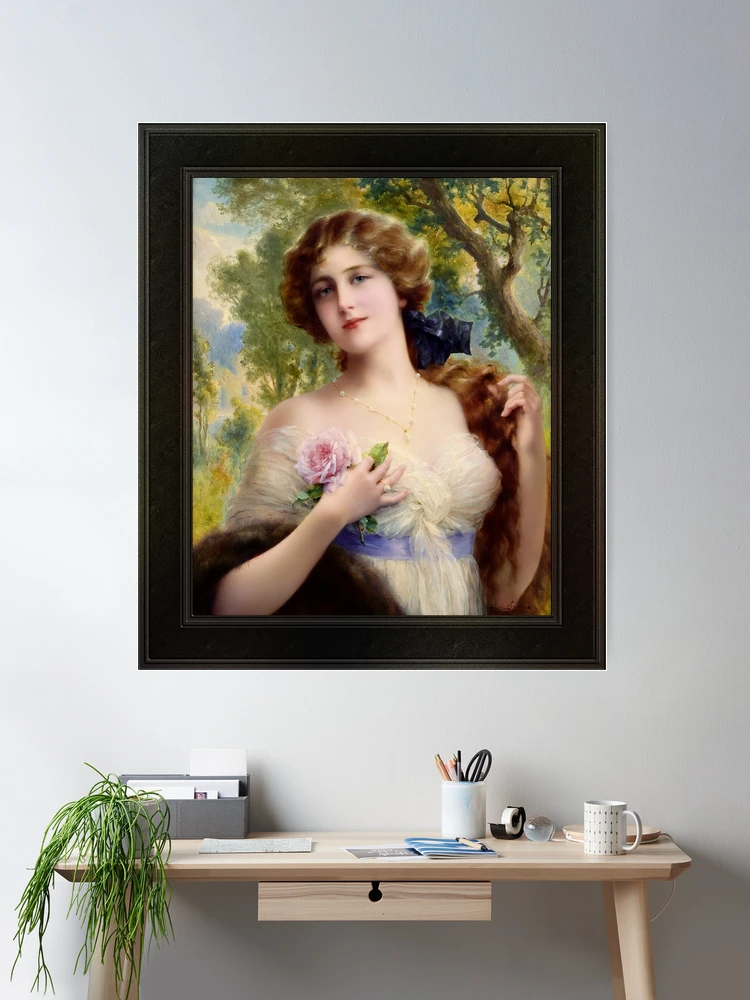
Den unge dame med en rose c1916
“Den unge dame med en rose,” opprettet i 1916 av den franske maleren Emile vernon (1872 – 1919), er en fengslende skildring av feminin skjønnhet satt i sammenheng med fransk kunst fra tidlig på 1900-tallet. Vernon, kjent for sine romantiske og idealiserte kvinneskildringer, bringer frem en visjon om nåde og delikatesse som står som et godt eksempel på hans arbeid. Maleriet utstråler en følelse av fredelig ro, fange motivet med en forsiktig, nesten eterisk tilstedeværelse. Dette stykket er et bevis på Vernons mestring av lys, tekstur, og de subtile nyansene i følelsesmessig uttrykk, trekker seerne inn i et intimt øyeblikk av tidløs eleganse.
Innholdsfortegnelse
Hovedfag og komposisjon
Den sentrale figuren i maleriet er en ung kvinne, elegant stilt, holder en stor, myk rosa rose i venstre hånd. Hun stirrer lett på betrakteren, innbydende smil. Øynene hennes, øm og myk, formidle en luft av varme og mildhet, og de myke foldene i hennes gyllenbrune hår, tilfeldig arrangert, utfyller hennes rolige uttrykk. Kvinnens antrekk består av en delikat off-white kjole, delvis drapert over skuldrene hennes, med en lys lavendelblå ramme som tilfører et element av fargekontrast og sofistikert.
Rosen hun holder er et symbol på skjønnhet, femininitet, og raffinement. Den er stor, myke kronblader ser nesten ut til å vibrere av liv, fanget med en nesten taktil presisjon. Vernons dyktige gjengivelse av rosen og dens tilhørende grønt gir en vakker kontrast til kvinnens bleke hudfarge og lyse kjole. Blomsten er naturlig, myk rosa farge står som en stille erklæring om ungdommelig skjønnhet, ytterligere understreker emnets renhet og ynde.
Innstillingen og bakgrunnen
Bak den unge kvinnen, bakgrunnen avslører et rolig og frodig landskap. En mild skogsscene med sprakket sollys som filtrerer gjennom trærne skaper en myk, nesten drømmeaktig atmosfære. Bladverket er malt i rike nyanser av grønt, foreslår fredelige landlige omgivelser eller hager, antyder muligens et idyllisk tilfluktssted på landet. De varme tonene av sollys kontrasterer subtilt med de kjølige skyggene, forbedre tredimensjonaliteten til motivet og gi scenen en atmosfære av ro.
Vernons valg av en slik naturlig, fredelig miljø utfyller den ungdommelige uskylden til faget. Innstillingen dominerer ikke komposisjonen, men støtter i stedet den generelle stemningen av ro og kontemplasjon. Det myke penselverket som brukes til å avbilde trærne og det fjerne landskapet utdyper følelsen av dybde og rom i verket ytterligere.
Stil og teknikk
Émile Vernon ble påvirket av symbolistbevegelsen, og verkene hans bar ofte elementer av romantikk og realisme. “Den unge dame med en rose” eksemplifiserer hans evne til å blande disse påvirkningene til en harmonisk og elegant stil. Hans maleteknikk er preget av en delikat håndtering av lys og farge, hvilken, i dette tilfellet, skaper en atmosfære av mykhet og subtil eleganse. Vernons ekspertbruk av lys, spesielt den milde belysningen av den unge kvinnens ansikt og figur, creates a glowing effect, drawing the viewer’s eye to the subject and enhancing the overall ethereal mood of the piece.
The brushwork in the painting is both smooth and detailed, with an emphasis on the textures of the skin, stoff, and flowers. Each fold in the woman’s gown is carefully modeled to suggest softness and movement, while her delicate features—especially her eyes and lips—are rendered with precise attention to form, yet with a subtlety that avoids overemphasis. The handling of the rose and its petals is particularly skillful, as Vernon has captured the flower’s delicate structure with a near-photographic quality, lending it an almost tangible presence in the scene.
Tema og stemning
The theme of the painting is centered on youthful beauty and femininity, conveyed through the depiction of the young woman as both a subject of admiration and a symbol of grace. The flower she holds in her hand, with its soft colors, is often associated with themes of love, skjønnhet, og renhet, aligning with the serene and delicate expression she carries.
The mood of the artwork is one of quiet contemplation and serenity. The young woman is not portrayed as an object of desire, but as a figure that embodies gentleness and a sense of inner peace. Her expression and posture suggest an intimate moment of grace, evoking a sense of tranquility and timelessness. Den varme, gyllent lys, paired with the natural beauty of the surroundings, contributes to an atmosphere that feels both nostalgic and enduring. The gentle, harmonious palette further enhances the overall calm and peaceful tone of the piece.
Materialer og overflate
“Den unge dame med en rose” er malt med tradisjonell olje på lerret. Overflaten er jevn, men strukturert på steder, som i stoffet til kvinnens kjole og den detaljerte gjengivelsen av rosen. Vernons presise bruk av oljer gjør det mulig å lage myke fargegradienter som er integrert i stemningen i maleriet. Maleriet er rikt på detaljer, beholder likevel en flyt som gjør at arbeidet føles uanstrengt, fremhever den naturlige skjønnheten til motivet og hennes miljø.
Den overordnede presentasjonen av maleriet, fra motivets myke hud til detaljene i bladverket, gjenspeiler det høye nivået av ferdigheter og oppmerksomhet på detaljer som Vernon brukte gjennom hele karrieren. Materialene, teknikk, og fargevalg jobber sammen for å skape et kunstverk som forblir tidløst og stemningsfullt.
Konklusjon
I “Den unge dame med en rose,” Émile Vernon has created an artwork that combines romance, eleganse, and serenity in a single frame. The soft palette, the graceful depiction of the young woman, and the serene landscape combine to create a work that speaks of beauty and calm, making it a quintessential example of Vernon’s style. The rose, a central motif, serves as both a literal and symbolic reminder of the delicate nature of femininity, while the painting as a whole speaks to the enduring power of beauty, captured in a moment of peace.
Dette er en retusjert digital kunst som gamle mestere gjengir av et offentlig domenebilde.
Kunstnerbiografi
Info nedenfor fra Galleri Og Jan
Émile Vernon var elev ved kunstskolen i Tours hvor han vant førstepremien for å tegne inn 1888; etterpå ble han veiledet av William Bouguereau og Auguste Truphème.
Deretter inn 1898 han deltok i Tours-utstillingen for Fine Arts and Decorative Arts og senere samme år, i den franske kunstnerutstillingen og stilte jevnlig ut arbeidet der fra 1898 til 1913; presentere portretter, landskap, scener fra Bretagne, stillebenbuketter som han malte i akvarell, samt feminine figurer, som senere ble er spesialitet.
Émile utmerket seg i maleriene av mykt opplyste, yndige barnefigurer og elegante unge kvinner, som han ofte assosierte et kjæledyr som en katt, hund eller fugl, og prydet bildene hans med kranser eller blomsterbuketter, gjennom hele karrieren; men han var også en veldig allsidig kunstner som kunne male med strenghet og kraft som i hans verk portrettet av Madame Vernon og Sous la Lampe (Under lampen).