

Twin Stars: A Celestial Dance in Falero’s Vision
Twin Stars Kirjailija: Luis Ricardo Falero (1851-1896) was a Spanish painter known for his allegorical and mythological scenes rendered with meticulous detail and a distinct Romantic sensibility. “Twin Stars,” luotu ympäri 1881, exemplifies these qualities, presenting a captivating vision of ethereal beauty and otherworldly grace. The painting is characterized by its dramatic composition, rikas väripaletti, and the artist’s skillful rendering of light and shadow, all contributing to an atmosphere of dreamlike wonder.
Sisällysluettelo
Koostumuselementit & Kertomusehdotus
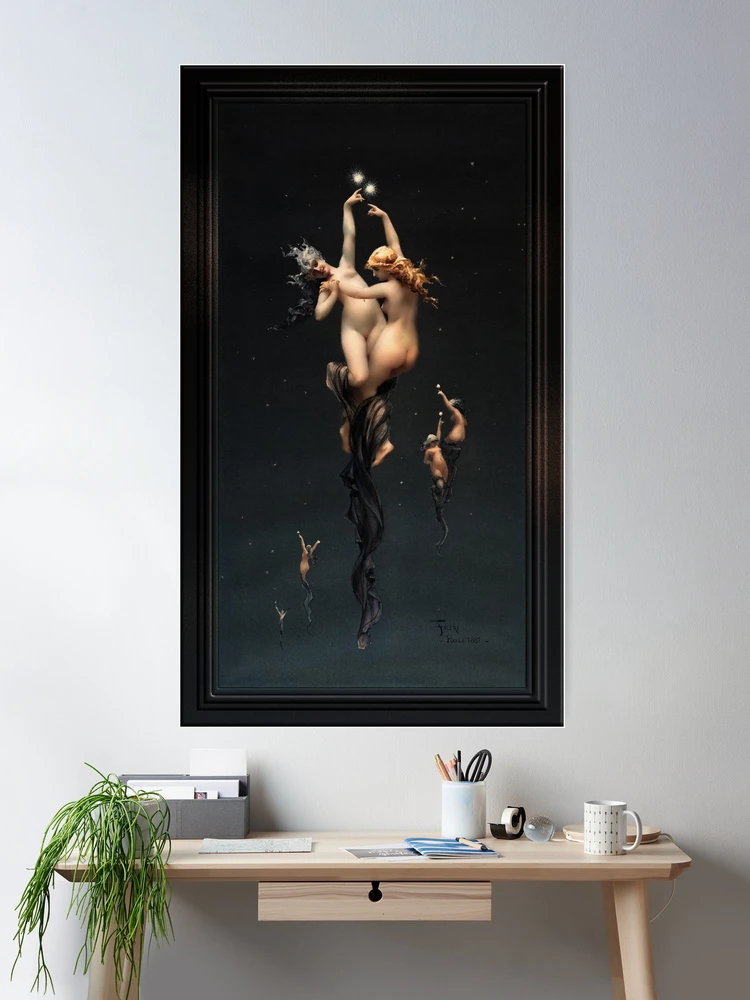
The artwork’s central focus rests upon a female figure suspended in mid-air against a deep, almost impenetrable black background. This stark contrast immediately draws the viewer’s attention to the illuminated subject. The composition is vertically oriented, emphasizing the upward movement and ascension of the figure. Below her, several smaller figures appear to float or drift upwards, seemingly drawn towards the celestial light above. Their forms are less defined than the central figure, contributing to a sense of mystery and suggesting a narrative of transformation or spiritual elevation.
Järjestely ei ole jäykästi symmetrinen; pikemminkin, it possesses a dynamic asymmetry that enhances the feeling of movement and fluidity. The swirling drapery around the main figure contributes significantly to this effect, creating visual pathways for the eye to follow as it explores the scene. Falero’s use of negative space – the vast expanse of black surrounding the figures – amplifies their luminosity and isolates them within a realm that feels both distant and intimate.
Keskushahmo: Tutkimus valossa & Lomake
The female figure is depicted nude, but her nudity isn’t presented with any overt sensuality. Sen sijaan, it serves to highlight the purity and vulnerability of her form as she interacts with the celestial elements. Her skin glows with an inner light, contrasting sharply with the darkness that surrounds her. Falero’s mastery of chiaroscuro – the dramatic interplay of light and shadow – is evident in the way he sculpts her body, emphasizing its curves and contours while simultaneously obscuring portions within deep shadows.
Hänen hiuksensa, a vibrant shade of auburn, cascades around her shoulders and blends with the swirling fabric that envelops her lower half. This fabric isn’t merely clothing; it appears to be an extension of the surrounding atmosphere, blurring the boundaries between the figure and the environment. Her gaze is directed upwards towards two bright stars, which are the focal point of the entire composition. Her arms are extended, reaching as if to grasp or embrace these celestial bodies.
The Significance of the Stars & Supporting Figures
The twin stars themselves hold symbolic weight within the painting’s narrative. They could represent ideals, aspirations, or perhaps a connection to a higher power. Their brightness contrasts with the surrounding darkness, symbolizing hope and guidance in an otherwise uncertain world. Falero’s choice to depict them as twins suggests duality – balance, harmonia, or opposing forces that ultimately converge.
The smaller figures floating below contribute to the painting’s overall sense of mystery. They appear to be undergoing a similar transformation as the central figure, ascending towards the light and stars. Their indistinct forms suggest they are not fully realized individuals but rather representations of souls or spirits in transit. Their varied poses – some reaching upwards, others seemingly drifting passively – add depth and complexity to the narrative.
Taiteellinen tekniikka & Vaikutteet
Falero’s technique demonstrates a clear influence from the academic tradition of his time, particularly the emphasis on anatomical accuracy and meticulous detail. kuitenkin, he also incorporates elements of Romanticism, evident in the painting’s dramatic lighting, emotionaalinen intensiteetti, and focus on otherworldly themes. The smooth blending of colors and subtle gradations of tone create a sense of realism while simultaneously imbuing the scene with an ethereal quality.
The use of impasto – applying paint thickly to the canvas – is minimal but strategically employed to highlight certain areas, such as the stars and portions of the central figure’s body. This technique adds texture and visual interest, further enhancing the painting’s overall impact. The dark background, achieved through layers of carefully applied black pigment, creates a sense of depth and envelopment, Vietäjän piirtäminen kohtaukseen.
Yleinen vaikutelma & Perintö
“Twin Stars” is a captivating work that invites contemplation on themes of aspiration, muunnos, and the human connection to the cosmos. Falero’s skillful technique and evocative imagery create an atmosphere of dreamlike wonder, jättää katsojaan pysyvän vaikutuksen. The painting stands as a testament to his artistic talent and his ability to blend classical techniques with Romantic sensibilities to produce works of enduring beauty and significance. It remains a compelling example of 19th-century Spanish art and continues to resonate with audiences today.
Artist Bio Derived Wikipedia.org
Falero syntyi Granadassa ja aloitti uransa Espanjan laivastossa, mutta luopui vanhempiensa pettymyksestä; kun hän päätti matkustaa Pariisiin, jossa hän opiskeli taidetta, kemia ja konetekniikka.
Aikana on kemian ja konetekniikan opintoja; hän piti suoritettavia kokeita liian vaarallisina, näin hän saa keskittymään huomionsa yksinomaan maalaamiseen.
Tämän seurauksena hänestä tuli ranskalaisen muotokuvamaalarin ja orientalistin Gabriel-Joseph-Marie-Augustin Ferrierin opiskelija (1847 – 1914). Pariisin jälkeen, hän muutti Lontooseen, missä hän jatkoi opintojaan, ja lopulta asettui.
Falero oli erityisen kiinnostunut tähtitieteestä ja sisällytti taivaalliset tähtikuviot moniin teoksiinsa, kuten “Komeetin avioliitto” ja “Twin Stars”. Hänen kiinnostuksensa ja tietämyksensä tähtitieteestä sai hänet myös kuvaamaan Camille Flammarionin teoksia.
Sisään 1896, hänen kuolemansa vuosi, Maud Harvey haastoi Faleron isyyden vuoksi. Puvussa väitettiin, että Falero vietti Harveyn hänen ollessaan 17, ensin palveli hänen sisäkkäinsä, ja sitten hänen mallinsa. Kun hän huomasi, että hän oli raskaana, hän erotti hänet.
Hän voitti tapauksen ja sai viisi shillinkiä viikossa heidän lapsensa tueksi. Falero kuoli University College -sairaalassa, Lontoo, iässä 45
Twin Stars on retusoitu digitaalisen taiteen vanhojen mestarien kopio julkisesta kuvasta.