

Twin Stars: A Celestial Dance in Falero’s Vision
Twin Stars by Luis Ricardo Falero (1851-1896) was a Spanish painter known for his allegorical and mythological scenes rendered with meticulous detail and a distinct Romantic sensibility. “Twin Stars,” cruthaithe timpeall 1881, mar eiseamláir de na cáilíochtaí seo, presenting a captivating vision of ethereal beauty and otherworldly grace. The painting is characterized by its dramatic composition, rich color palette, and the artist’s skillful rendering of light and shadow, all contributing to an atmosphere of dreamlike wonder.
Clár na nÁbhar
Eilimintí Comhdhéanta & Narrative Suggestion
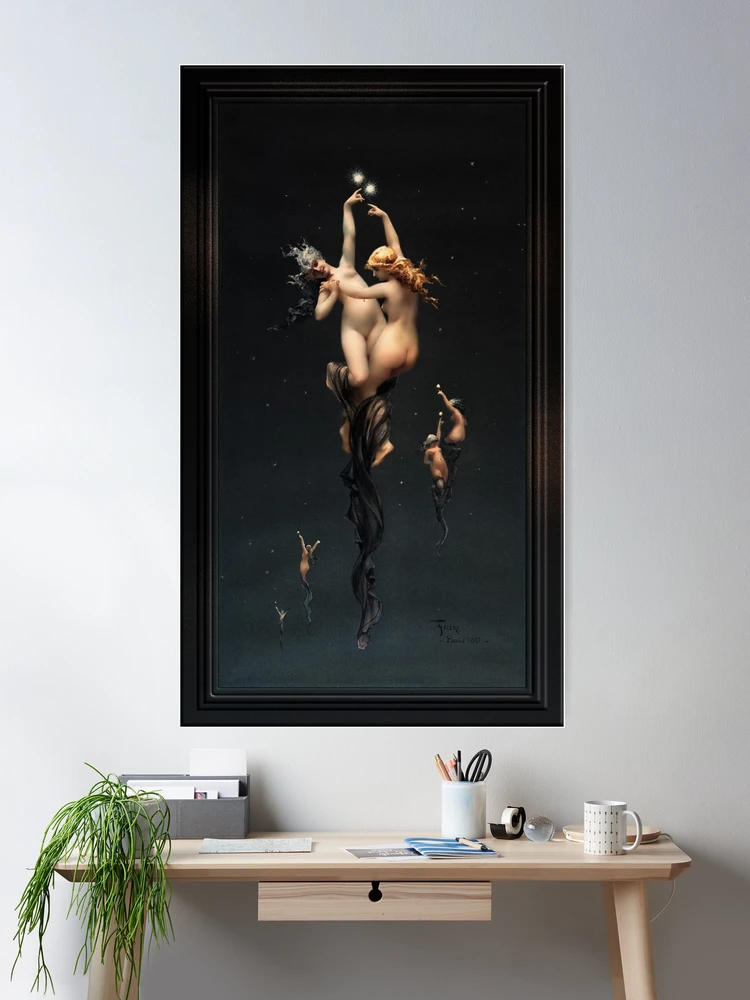
The artwork’s central focus rests upon a female figure suspended in mid-air against a deep, almost impenetrable black background. This stark contrast immediately draws the viewer’s attention to the illuminated subject. Tá an comhdhéanamh dírithe go hingearach, emphasizing the upward movement and ascension of the figure. Below her, several smaller figures appear to float or drift upwards, seemingly drawn towards the celestial light above. Their forms are less defined than the central figure, contributing to a sense of mystery and suggesting a narrative of transformation or spiritual elevation.
The arrangement isn’t rigidly symmetrical; in áit, it possesses a dynamic asymmetry that enhances the feeling of movement and fluidity. The swirling drapery around the main figure contributes significantly to this effect, creating visual pathways for the eye to follow as it explores the scene. Falero’s use of negative space – the vast expanse of black surrounding the figures – amplifies their luminosity and isolates them within a realm that feels both distant and intimate.
An Fíor Lárnach: Staidéar i Solas & Foirm
The female figure is depicted nude, but her nudity isn’t presented with any overt sensuality. Ina áit sin, it serves to highlight the purity and vulnerability of her form as she interacts with the celestial elements. Her skin glows with an inner light, contrasting sharply with the darkness that surrounds her. Falero’s mastery of chiaroscuro – the dramatic interplay of light and shadow – is evident in the way he sculpts her body, emphasizing its curves and contours while simultaneously obscuring portions within deep shadows.
A cuid gruaige, a vibrant shade of auburn, cascades around her shoulders and blends with the swirling fabric that envelops her lower half. This fabric isn’t merely clothing; it appears to be an extension of the surrounding atmosphere, blurring the boundaries between the figure and the environment. Her gaze is directed upwards towards two bright stars, which are the focal point of the entire composition. Her arms are extended, reaching as if to grasp or embrace these celestial bodies.
The Significance of the Stars & Supporting Figures
The twin stars themselves hold symbolic weight within the painting’s narrative. They could represent ideals, aspirations, or perhaps a connection to a higher power. Their brightness contrasts with the surrounding darkness, symbolizing hope and guidance in an otherwise uncertain world. Falero’s choice to depict them as twins suggests duality – balance, chéile, or opposing forces that ultimately converge.
The smaller figures floating below contribute to the painting’s overall sense of mystery. They appear to be undergoing a similar transformation as the central figure, ascending towards the light and stars. Their indistinct forms suggest they are not fully realized individuals but rather representations of souls or spirits in transit. Their varied poses – some reaching upwards, others seemingly drifting passively – add depth and complexity to the narrative.
Teicníc Ealaíne & Influences
Falero’s technique demonstrates a clear influence from the academic tradition of his time, particularly the emphasis on anatomical accuracy and meticulous detail. ach, he also incorporates elements of Romanticism, evident in the painting’s dramatic lighting, déine mhothúchánach, and focus on otherworldly themes. The smooth blending of colors and subtle gradations of tone create a sense of realism while simultaneously imbuing the scene with an ethereal quality.
The use of impasto – applying paint thickly to the canvas – is minimal but strategically employed to highlight certain areas, such as the stars and portions of the central figure’s body. This technique adds texture and visual interest, further enhancing the painting’s overall impact. The dark background, achieved through layers of carefully applied black pigment, creates a sense of depth and envelopment, an breathnóir a tharraingt isteach sa radharc.
Léiriú Foriomlán & Oidhreacht
“Twin Stars” is a captivating work that invites contemplation on themes of aspiration, transformation, and the human connection to the cosmos. Falero’s skillful technique and evocative imagery create an atmosphere of dreamlike wonder, leaving a lasting impression on the viewer. The painting stands as a testament to his artistic talent and his ability to blend classical techniques with Romantic sensibilities to produce works of enduring beauty and significance. It remains a compelling example of 19th-century Spanish art and continues to resonate with audiences today.
Beathaisnéis Ealaíontóra Wikipedia.org
Rugadh Falero i Granada agus chuaigh sé i mbun gairme i gCabhlach na Spáinne ar dtús, ach thug sé díomá ar a thuismitheoirí é; mar shocraigh sé taisteal go Páras, áit a ndearna sé staidéar ar ealaín, ceimic agus innealtóireacht mheicniúil.
Le linn staidéir ar cheimic agus innealtóireacht mheicniúil; mheas sé go raibh na turgnaimh a bhí le déanamh aige ró-chontúirteach, rud a thug air a aird a dhíriú ar phéintéireacht amháin.
Mar thoradh air sin tháinig sé chun bheith ina mhac léinn le Péintéir Portráid na Fraince agus Oirthearach Gabriel-Joseph-Marie-Augustin Ferrier (1847 – 1914). Tar éis Pháras, bhog sé go Londain, áit ar lean sé lena chuid staidéir, agus shocraigh sé sa deireadh.
Bhí spéis faoi leith ag Falero sa réalteolaíocht agus ionchorpraíodh réaltbhuíonta neamhaí i go leor dá shaothair, mar “Pósadh Cóiméad” agus “Twin Stars”. Mar gheall ar a spéis agus a eolas ar an réalteolaíocht, léirigh sé saothair Camille Flammarion.
I 1896, bliain a bháis, D'áitigh Maud Harvey Falero as atharthacht. Líomhnaigh an chulaith gur mheall Falero Harvey nuair a bhí sí 17, ag fónamh mar a bhean tí ar dtús, agus ansin a mhúnla. Nuair a fuair sé amach go raibh sí ag iompar clainne, chuir sé as a phost í.
Bhuaigh sí an cás agus bronnadh cúig scilling sa tseachtain uirthi mar thacaíocht dá leanbh. Fuair Falero bás in Ospidéal Choláiste na hOllscoile, Londain, ag aois 45
Is é atá i Twin Stars ná seanmháistrí ealaíne digití atá á mhacasamhlú ar íomhá fearainn phoiblí.