

Estrelas gêmeas: A Celestial Dance in Falero’s Vision
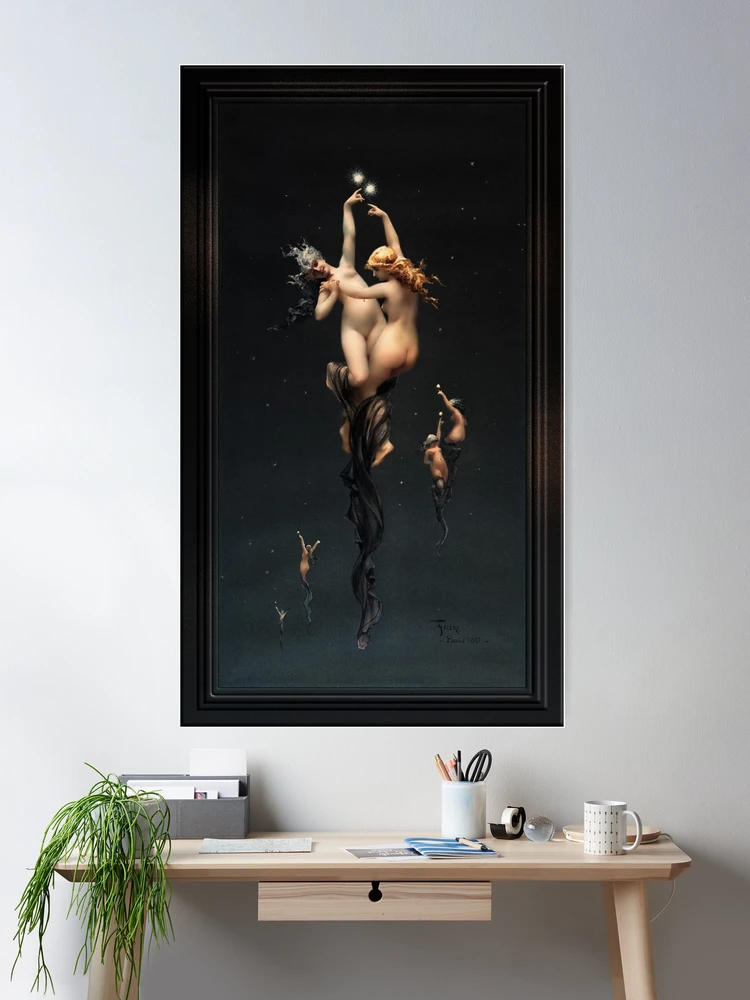
Estrelas gêmeas por Luis Ricardo Falero (1851-1896) was a Spanish painter known for his allegorical and mythological scenes rendered with meticulous detail and a distinct Romantic sensibility. “Estrelas gêmeas,” criado ao redor 1881, exemplifies these qualities, presenting a captivating vision of ethereal beauty and otherworldly grace. The painting is characterized by its dramatic composition, rich color palette, and the artist’s skillful rendering of light and shadow, all contributing to an atmosphere of dreamlike wonder.
Índice
Elementos Composicionais & Narrative Suggestion
The artwork’s central focus rests upon a female figure suspended in mid-air against a deep, almost impenetrable black background. Este forte contraste chama imediatamente a atenção do observador para o assunto iluminado. A composição é orientada verticalmente, enfatizando o movimento ascendente e ascensão da figura. Abaixo dela, várias figuras menores parecem flutuar ou flutuar para cima, aparentemente atraído pela luz celestial acima. Suas formas são menos definidas que a figura central, contribuindo para uma sensação de mistério e sugerindo uma narrativa de transformação ou elevação espiritual.
O arranjo não é rigidamente simétrico; em vez de, possui uma assimetria dinâmica que aumenta a sensação de movimento e fluidez. A cortina ondulante em torno da figura principal contribui significativamente para este efeito., criando caminhos visuais para o olho seguir enquanto explora a cena. Falero’s use of negative space – the vast expanse of black surrounding the figures – amplifies their luminosity and isolates them within a realm that feels both distant and intimate.
A figura central: Um estudo à luz & Forma
The female figure is depicted nude, but her nudity isn’t presented with any overt sensuality. Em vez de, it serves to highlight the purity and vulnerability of her form as she interacts with the celestial elements. Her skin glows with an inner light, contrasting sharply with the darkness that surrounds her. Falero’s mastery of chiaroscuro – the dramatic interplay of light and shadow – is evident in the way he sculpts her body, emphasizing its curves and contours while simultaneously obscuring portions within deep shadows.
O cabelo dela, a vibrant shade of auburn, cascades around her shoulders and blends with the swirling fabric that envelops her lower half. This fabric isn’t merely clothing; it appears to be an extension of the surrounding atmosphere, blurring the boundaries between the figure and the environment. Her gaze is directed upwards towards two bright stars, which are the focal point of the entire composition. Her arms are extended, reaching as if to grasp or embrace these celestial bodies.
The Significance of the Stars & Figuras de apoio
The twin stars themselves hold symbolic weight within the painting’s narrative. They could represent ideals, aspirations, or perhaps a connection to a higher power. Their brightness contrasts with the surrounding darkness, symbolizing hope and guidance in an otherwise uncertain world. Falero’s choice to depict them as twins suggests duality – balance, harmonia, or opposing forces that ultimately converge.
The smaller figures floating below contribute to the painting’s overall sense of mystery. They appear to be undergoing a similar transformation as the central figure, ascending towards the light and stars. Their indistinct forms suggest they are not fully realized individuals but rather representations of souls or spirits in transit. Their varied poses – some reaching upwards, others seemingly drifting passively – add depth and complexity to the narrative.
Técnica artística & Influências
Falero’s technique demonstrates a clear influence from the academic tradition of his time, particularly the emphasis on anatomical accuracy and meticulous detail. Contudo, he also incorporates elements of Romanticism, evident in the painting’s dramatic lighting, intensidade emocional, and focus on otherworldly themes. The smooth blending of colors and subtle gradations of tone create a sense of realism while simultaneously imbuing the scene with an ethereal quality.
The use of impasto – applying paint thickly to the canvas – is minimal but strategically employed to highlight certain areas, such as the stars and portions of the central figure’s body. This technique adds texture and visual interest, further enhancing the painting’s overall impact. The dark background, achieved through layers of carefully applied black pigment, creates a sense of depth and envelopment, drawing the viewer into the scene.
Impressão geral & Legado
“Estrelas gêmeas” is a captivating work that invites contemplation on themes of aspiration, transformation, and the human connection to the cosmos. Falero’s skillful technique and evocative imagery create an atmosphere of dreamlike wonder, deixando uma impressão duradoura no espectador. The painting stands as a testament to his artistic talent and his ability to blend classical techniques with Romantic sensibilities to produce works of enduring beauty and significance. It remains a compelling example of 19th-century Spanish art and continues to resonate with audiences today.
Artist Bio Derived Wikipedia.org
Falero nasceu em Granada e originalmente seguiu carreira na Marinha Espanhola, mas desistiu para a decepção de seus pais; como ele decidiu viajar para Paris, onde ele estudou arte, química e engenharia mecânica.
Durante seus estudos em química e engenharia mecânica; ele considerou os experimentos que ele teve que conduzir muito perigosos, levando-o a concentrar sua atenção apenas na pintura.
Como resultado, ele se tornou um aluno do pintor de retratos e orientalista francês Gabriel-Joseph-Marie-Augustin Ferrier (1847 – 1914). Depois de paris, ele se mudou para Londres, onde ele continuou seus estudos, e eventualmente resolvido.
Falero tinha um interesse particular em astronomia e incorporou constelações celestes em muitas de suas obras, tal como “O casamento de um cometa” e “Estrelas gêmeas”. Seu interesse e conhecimento de astronomia também o levaram a ilustrar as obras de Camille Flammarion.
Dentro 1896, o ano de sua morte, Maud Harvey processou Falero por paternidade. O processo alegou que Falero seduziu Harvey quando ela era 17, primeiro servindo como sua empregada, e então seu modelo. Quando ele descobriu que ela estava grávida, ele a dispensou.
Ela ganhou o caso e recebeu cinco xelins por semana em apoio ao filho. Falero morreu no University College Hospital, Londres, na idade de 45
Twin Stars is a retouched digital art old masters reproduction of a public domain image.