

“Een voorheen toegewijde ronde tempel” (Een ooit toegewijde ronde tempel)
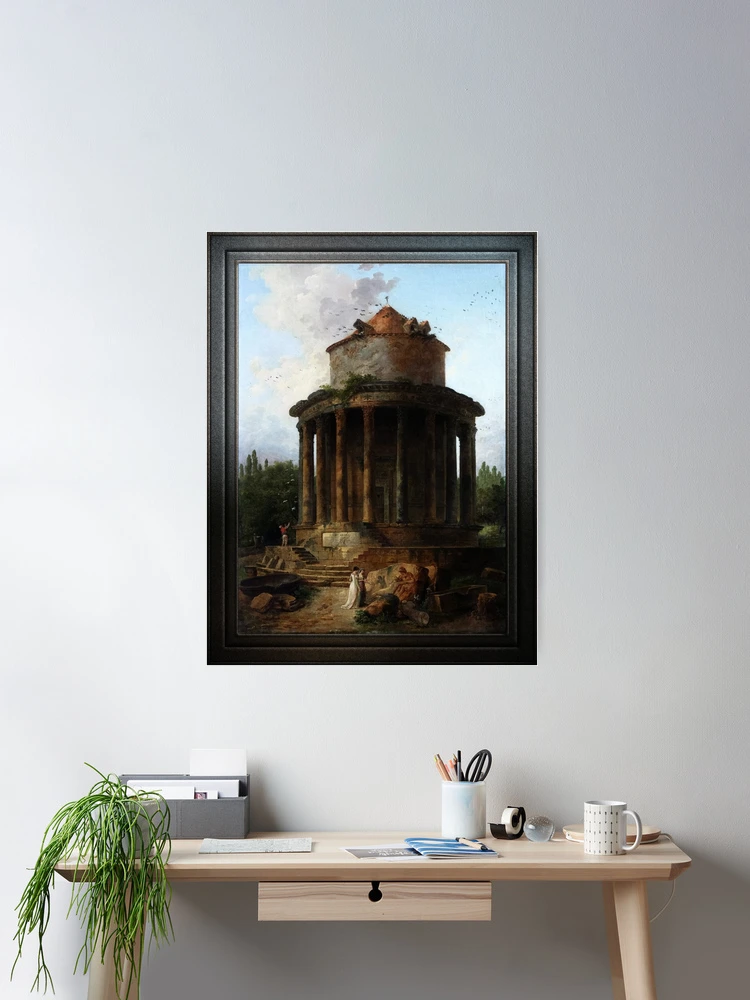
“Een voorheen toegewijde ronde tempel” (Een ooit toegewijde ronde tempel) is a remarkable work created by Hubert Robert, a French painter born in 1733 and passed away in 1808. Known for his exceptional ability to convey the magnificence of ancient architecture in a romanticized yet realistic manner, Robert presents a scene of ruin, evoking a deep sense of nostalgia and melancholy for the forgotten splendor of ancient structures. Painted during the 18th century, this work reflects Robert’s fascination with classical ruins and his ability to merge art and history in ways that celebrate both the grandeur of the past and the inexorable passage of time.
Inhoudsopgave
The Composition and Architecture
The artwork presents a dilapidated, yet awe-inspiring circular temple set amidst a landscape that has been overtaken by nature. The temple is the central focus, its grand columns rising against a backdrop of cloud-filled skies. The circular nature of the structure and its symmetrical form are distinct elements, emphasizing the classical architectural style that was revered in the 18th century. The temple’s structure appears to have once been magnificent, but now it is crumbling, with parts of the walls showing clear signs of age, wear, and neglect. The roof, once ornate, is now partially missing, and the remaining columns, some of which are damaged, stand as silent witnesses to time’s relentless passage.
The temple’s ruins, while deteriorated, still retain their grandeur. The artist captures the texture of the weathered stone, with moss creeping up the sides of the columns and cracks visible in the structure. This juxtaposition of ancient beauty and decay evokes a timeless theme, celebrating both the achievements of the past and the inevitable return to nature. De kolommen, arranged in a circular pattern, give the composition a rhythmic harmony, each pillar a symbol of the history that the structure once embodied.
Figures and Human Interaction
Op de voorgrond, human figures are depicted in varying degrees of engagement with the ruin. A group of three figures, two women and a man, stand by the broken remnants of the temple. The women, dressed in flowing, classical attire, sit gracefully on the stone blocks scattered around the temple. Their garments are painted with great attention to detail, showing the textures and folds of the fabric as they interact with the surrounding environment. One of the women is looking towards the man, who is standing a little farther away and appears to be in a more active stance, perhaps contemplating the temple or its past.
The women’s serene presence contrasts with the looming ruin behind them, and their posture suggests a reverence for the place they inhabit, as if they are visitors to a sacred site now lost to time. This sense of respectful admiration for the ancient structure mirrors the broader theme of the painting: the passage of time, the fading of civilizations, and the respect we continue to give to the remnants of our history.
Above them, a man stands slightly elevated on the steps of the temple. He is engaged in an action—he is perhaps releasing birds into the air, symbolizing freedom, or possibly suggesting a ceremonial offering to the once-sacred space. His gesture adds an element of life to the otherwise still scene. The birds, caught in mid-flight, bring a sense of movement and vitality to the composition, which might otherwise feel static due to the heavy presence of ruins and quiet figures.
Natural Landscape and Mood
The surrounding landscape is lush, with greenery overtaking the ruins. Vines snake their way up the columns, and the ground is littered with broken stones and fragments, creating a feeling of nature reclaiming the space. A tree with a twisted trunk grows near the base of the temple, its limbs extending over the stonework. This symbiotic relationship between nature and the built environment is a key theme in Hubert Robert’s work, symbolizing the natural cycle of creation, verwoesting, and renewal.
The sky above is vast and dramatic, with soft clouds casting shadows across the scene. The birds soaring across the sky add a sense of freedom, lichtheid, and eternity, contrasting with the heaviness of the ruined temple below. The overall mood is one of melancholy mixed with admiration—a recognition of the beauty that once was, but is now lost. The interplay of light and shadow on the weathered stones further enhances this somber reflection on the passage of time.
The Style and Symbolism
The painting is done in a classical style, characteristic of Hubert Robert’s work, with a focus on realism and attention to architectural detail. His masterful handling of light and texture brings the scene to life, creating an immersive experience for the viewer. The ruinous state of the temple is painted with a great degree of realism, showing the wear and tear of centuries. Echter, Robert also imbues the scene with an idealized quality, heightening the emotional impact of the ruins by setting them within a picturesque, almost idyllic landscape.
The symbolic elements in the painting are also deeply important. De tempel, once a place of worship and dedication, now lies abandoned, suggesting the transience of human achievements. The figures interacting with the ruins reflect the passage of time, with humanity standing as both a witness to and a participant in the cyclical nature of existence. The temple itself symbolizes both the impermanence of civilization and the enduring beauty that can be found in decay. The birds in flight may represent freedom or the eternal nature of the human spirit, a motif common in romanticized ruins paintings.
Conclusie
“Een voorheen toegewijde ronde tempel” is a beautiful, melancholic reflection on the themes of ruin, tijd, and nature’s power to reclaim what human hands have built. Hubert Robert captures the quiet grandeur of a lost world, creating a visual narrative that invites the viewer to contemplate the inevitable erosion of even the most glorious human accomplishments. Through his skillful rendering of both architecture and nature, Robert encourages a deep reflection on the passage of time and the enduring beauty that can be found in the ruins of the past.
Un Temple Circulaire Jadis Dédié is a retouched digital art old masters reproduction of a public domain image that is available for purchase online as a opgerold canvas afdrukken.
Info hieronder van Wikipedia.org
Hubert Robert werd geboren in Parijs in 1733. Zijn vader, Nicolas Robert, was in dienst van François-Joseph de Choiseul, markies de Stainville een vooraanstaande diplomaat uit Lotharingen. De jonge Robert voltooide zijn studie bij de jezuïeten aan het Collège de Navarre in 1751 en ging het atelier van de beeldhouwer Michel-Ange Slodtz binnen, die hem ontwerp en perspectief leerde, maar hem aanmoedigde om te schilderen. In 1754 hij vertrok naar Rome in de trein van Étienne-François de Choiseul, zoon van de werkgever van zijn vader, die tot Franse ambassadeur was benoemd en staatssecretaris van Buitenlandse Zaken van Lodewijk XV zou worden in 1758.
Hij bracht de volledige elf jaar door in Rome, een opmerkelijke tijdsduur; nadat de officiële residentie van de jonge kunstenaar aan de Franse Academie in Rome opraakte, hij steunde zichzelf met werken die hij maakte voor bezoekende kenners zoals de abbé de Saint-Non, die Robert in april naar Napels bracht 1760 om de ruïnes van Pompeii te bezoeken. De markies de Marigny, directeur van de Bâtiments du Roi werd op de hoogte gehouden van zijn ontwikkeling in correspondentie met Natoire, directeur van de Franse Academie, die de pensionaires aanspoorde om buitenshuis te schetsen, uit de natuur: Robert had geen aansporing nodig; tekeningen uit zijn schetsboeken documenteren zijn reizen: Villa d'Este, Caprarola.
Uitzicht op de haven van Rippeta in Rome, C. 1766, met het oude Romeinse Pantheon naast een denkbeeldige poort
Het contrast tussen de ruïnes van het oude Rome en het leven van zijn tijd wekte zijn grootste belangstelling op. Hij werkte een tijd in de studio van Pannini, wiens invloed te zien is in de denkbeeldige weergave van de verwoeste Louvre-galerij (illustratie). Robert bracht zijn tijd door in het gezelschap van jonge kunstenaars in de kring van Piranesi, wiens grillen van romantisch overwoekerde ruïnes hem zo sterk beïnvloedden dat hij de bijnaam Robert des ruines kreeg.[2] De albums met schetsen en tekeningen die hij in Rome verzamelde, leverden hem motieven op die hij zijn hele carrière in schilderijen heeft verwerkt.