

Vase de fleurs c1722
“Vase de fleurs” est un chef-d'œuvre de la nature morte hollandaise créé en 1722 par Jan van Huysum (1682 – 1749). Connu pour son extraordinaire talent à capturer la beauté complexe des fleurs, Le travail de van Huysum transporte le spectateur dans un monde de naturalisme somptueux. Cette peinture est un exemple typique de l’âge d’or florissant de l’art de la nature morte aux Pays-Bas., célébré pour son attention méticuleuse aux détails, riche palette de couleurs, et la célébration de la beauté éphémère de la nature. La représentation des fleurs, avec leurs textures délicates, teintes variées, et un arrangement somptueux, révèle la profonde expertise de van Huysum dans la restitution du monde naturel avec une précision et un dynamisme saisissants.
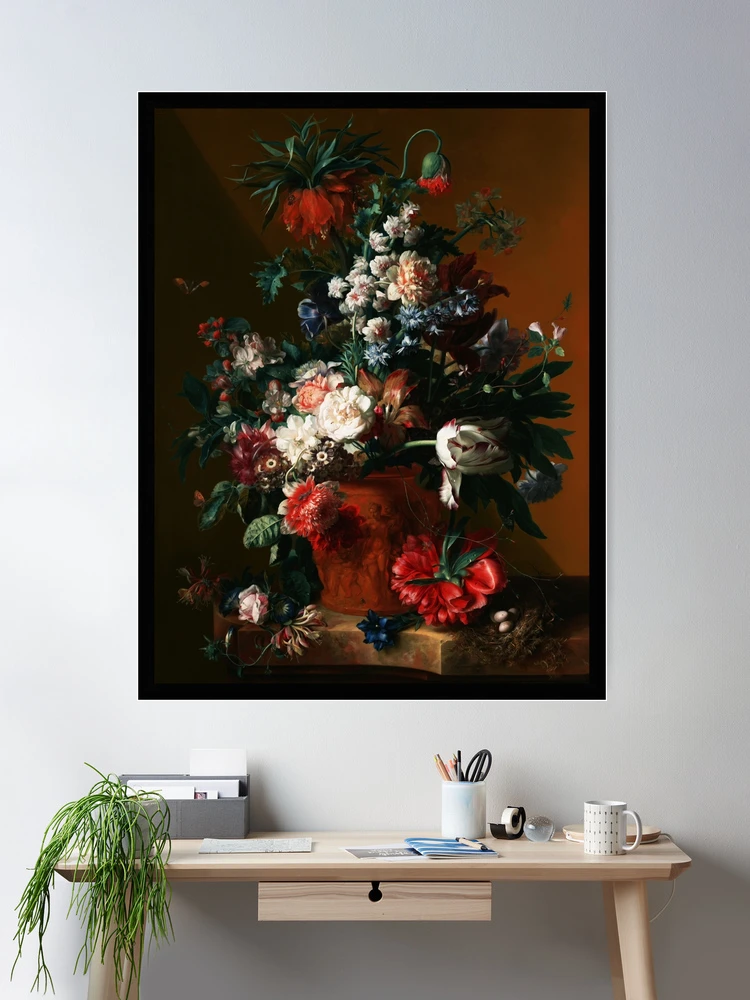
Table des matières
Le sujet principal: Un arrangement floral généreux
Au cœur de ce tableau se trouve un abondant arrangement de fleurs, chacun soigneusement sélectionné pour sa signification visuelle et symbolique. Le point central de la composition est un grand, vase richement décoré, débordant d'une myriade de fleurs. Le vase, orné de motifs classiques, devient un récipient élégant pour l’exposition exubérante des plus belles fleurs de la nature.
Les fleurs sont disposées dans une composition magistrale qui capture leur présence à la fois vivante et délicate.. Le talent exceptionnel du peintre est évident dans les couleurs vibrantes et le rendu précis de chaque pétale., feuilles, et les tiges. Chaque fleur est présentée comme si elle venait d'être cueillie dans un jardin en pleine floraison., dégageant une sensation de fraîcheur et de vitalité.
Les fleurs présentées comprennent une variété de tulipes, œillets, lys, et des roses, chacun représentant des significations différentes dans le langage des fleurs, qui était une tradition populaire dans l'art néerlandais aux XVIIe et XVIIIe siècles. Les tulipes rouges au premier plan attirent immédiatement l'attention, leur couleur vive contrastant avec les tons plus doux des autres fleurs.
Les délicates roses blanches, qui semblent se replier doucement sur eux-mêmes, transmettre un sentiment de pureté et de fragilité. les lys, souvent symbolique de grâce et de beauté, ajouter une élégance raffinée à la composition, tandis que les riches nuances d'œillets violets et jaunes suggèrent une appréciation à la fois de la beauté et de l'affection..
The inclusion of smaller details, such as butterflies fluttering through the composition and a small snail positioned near the bottom of the vase, highlights van Huysum’s keen observational skills and his deep interest in the natural world. These elements serve to enrich the work, creating a sense of movement and life that brings the still life to life.
Le vase: Une touche classique
The vase in “Vase de fleurs” is not merely a functional object but rather an integral part of the composition. It is intricately designed, showcasing the classical motifs popular during the Baroque period. The vessel itself is decorated with a rich, earthy terracotta color, which contrasts beautifully with the lush tones of the flowers. The craftsmanship of the vase suggests a high level of attention to detail and speaks to the luxurious nature of the painting. Its classical shape and design elevate the entire piece, emphasizing the importance of the vase as both a container and a symbol of human achievement in the arts.
The vase’s ornate decoration, featuring sculpted figures and bas-reliefs, invokes a sense of grandeur and sophistication. It is evident that the artist was deeply influenced by classical antiquity, a theme that was frequently revisited by Dutch still life painters in the 17th and 18th centuries. The vase’s presence anchors the floral arrangement, lending the painting a sense of balance and symmetry.
Le fond et la lumière: Créer de la profondeur et de la concentration
The background of the painting is a warm, soft gradient of ochre and amber tones, which serves as the perfect backdrop to highlight the vivid colors of the flowers. The light in this composition plays a crucial role in guiding the viewer’s eye towards the vase and its flourishing contents.
Le doux, diffused light that illuminates the flowers creates subtle shadows, enhancing their texture and giving the piece a sense of depth. The way the light interacts with the surfaces of the petals and leaves suggests the fleeting nature of the flowers’ beauty, a theme often explored in still life paintings of this period.
Van Huysum’s ability to capture the play of light and shadow, particularly how it emphasizes the three-dimensionality of the flowers and vase, adds an almost lifelike quality to the painting. This technique is characteristic of van Huysum’s style, demonstrating his mastery of the light-dark contrast that brings a sense of realism and richness to the composition.
L'humeur: Une célébration de la beauté de la nature
L'ambiance de “Vase de fleurs” is one of both serenity and exuberance. The arrangement of flowers suggests a harmonious balance between nature’s beauty and human artistry. Les fleurs, while delicate, are rendered with such attention to detail that they appear almost tangible, allowing the viewer to feel as though they could reach out and touch their soft petals. The mood is peaceful, with a sense of quiet contemplation evoked by the flowers’ tranquil beauty.
En même temps, there is an exuberance in the arrangement’s vibrancy, a sense of celebration that speaks to the wealth and prosperity of the Dutch Golden Age. The lavishness of the flowers, combined with the opulent vessel, conveys a sense of abundance and luxury. Il y a un respect évident pour la nature dans cette œuvre, alors que l'artiste invite le spectateur à faire une pause et à apprécier la beauté qui nous entoure, peu importe qu'il soit éphémère ou éphémère.
L'héritage de Jan van Huysum
Jan van Huysum “Vase de fleurs” témoigne du talent inégalé de l’artiste et de sa capacité à insuffler la vie dans des objets inanimés. En tant que l'un des principaux peintres de fleurs du XVIIIe siècle, le travail de van Huysum est célébré pour son génie technique et la joie qu'il apporte à ceux qui le regardent. Sa sélection rigoureuse de fleurs, son souci du détail, et sa capacité à créer un riche, la composition texturée contribue à l'impact durable de cette peinture.
L’œuvre reflète l’obsession baroque pour l’opulence et l’appréciation de la beauté éphémère de la nature.. Van Huysum’s ability to freeze a moment in time through his art gives the viewer a chance to appreciate the ephemeral nature of life, a theme that resonates deeply in the context of the 18th century Dutch society, où la richesse, pouvoir, and the natural world were constantly admired and celebrated.
Il s'agit d'une reproduction d'art numérique retouchée d'une image du domaine public.
Biographie de l'artiste dérivée de Wikipedia.org et Britannica.com
Jan van Huysum était le fils aîné du peintre de fleurs néerlandais de l'âge d'or Justus van Huysum (1659 – 1716), et venait d'une famille d'artiste.
Son petit frère décédé à l'âge de 22 était aussi un peintre accompli tout comme sa sœur Maria; et sa fille Francina Margaretha van Huysum (1707 – 1789) était aussi un peintre de fleurs.
Jan a étudié sous le mentorat de son père et a développé des compétences qui surpasseront plus tard les compétences de son père..
Sa spécialité était la peinture de somptueux arrangements floraux, qu'il a créé avec une extrême précision et délicatesse.
Il était aussi un peintre paysagiste, mais son talent inégalé dans la peinture de somptueux arrangements floraux est ce pour quoi il est connu et ce qui l'a séparé des autres est ce genre.