

-ren ikuspegia’ arco di Benevento nel regno di Napoli
-ren ikuspegia’ arco di Benevento nel regno di Napoli c1748-74 by Italian Painter Giovanni Battista Piranesi (1720 – 1778); margolaria, classical archaeologist and architect know for his etchings of Rome and fictitious atmospheric prisions.
-ren ikuspegia’ arco di Benevento is a capriccio of the ancient Roman triumphal Arch of Trajan in Benevento, of Southern Italy; which was erected in honor of the Emperor Trajan (53 AD – 117 AD) across the Via Appia (which was one of the earliest strategic and important roads of the ancient republic), at the point where it enters the city.
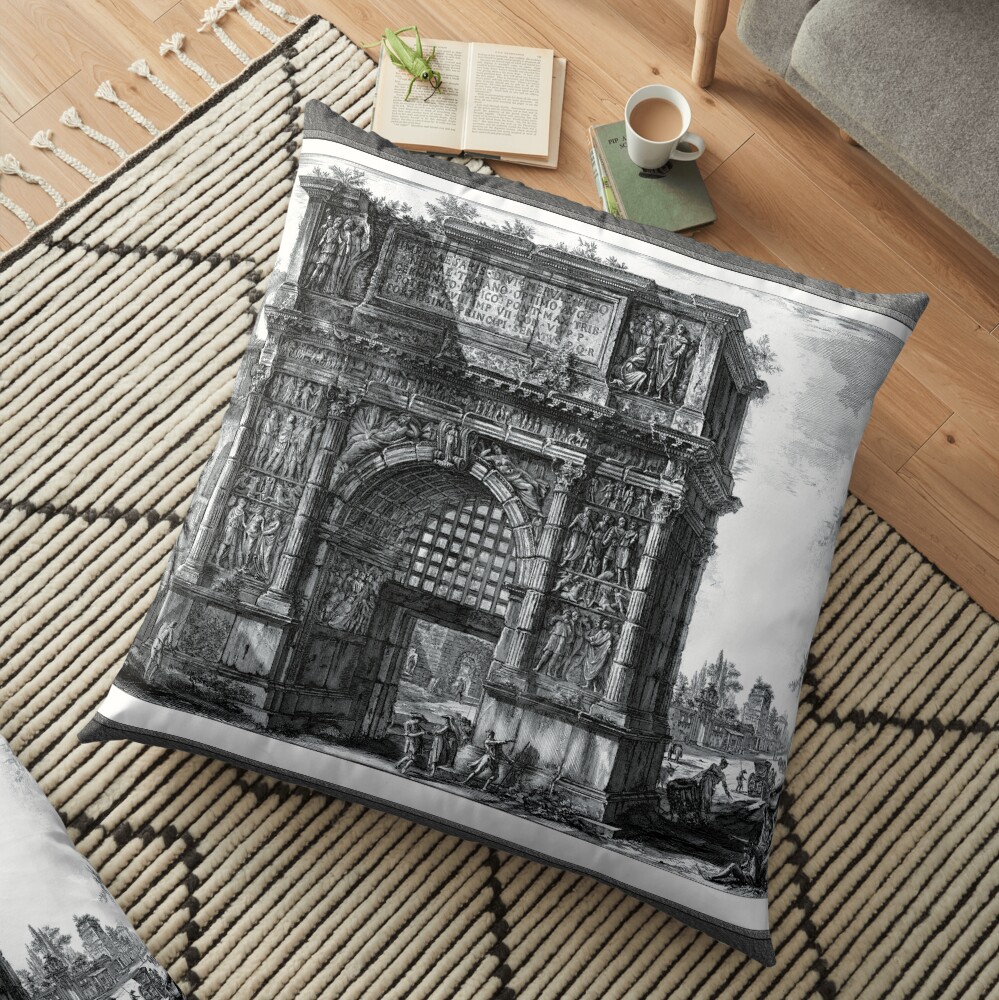
There are people gathered by the Arch and we can see people in the distance in horse and buggy, with backpack horses, and a town.
-ren ikuspegia’ arco di Benevento nel regno di Napoli is a remastered digital art old masters reproduction of a public domain image that is available online as a canvas rolled print.
Informazioa Behean Deribatua Wikipedia.org
Piranesi hargin baten semea zen eta Venezian jaio zen, S parrokian. Moisè non bataiatu zuten. His brother Andrea introduced him to Latin literature and ancient Greco-Roman civilization.
Later he was apprenticed under his uncle, Matteo Lucchesi, who was a leading architect in Magistrato delle Acque, the state organization responsible for engineering and restoring historical buildings.
Bertatik 1740, Giovanni had an opportunity to work in Rome as a draughtsman for Marco Foscarini, the Venetian ambassador of the new Pope Benedict XIV.
He resided in the Palazzo Venezia and studied under Giuseppe Vasi, who introduced him to the art of etching and engraving of the city and its monuments.
Giuseppe Vasi found that Giovanni’s talent was much greater than that of a mere engraver; according to Legrand, Vasi told Piranesi that “you are too much of a painter, my friend, to be an engraver.”
After his studies with Vasi concluded, he collaborated with pupils of the French Academy in Rome to produce a series of vedute (views) of the city.
In 1743 Giovanni created his first work the Prima parte di Architettura e Prospettive, and followed that up in 1745 with Varie Vedute di Roma Antica e Moderna.
Bertatik 1743 to 1747 Giovanni was mainly in Venice where, according to some sources, he often visited Giovanni Battista Tiepolo, a leading artist in Venice.
It was Tiepolo who expanded the restrictive conventions of reproductive, topographical and antiquarian engravings.
Giovanni then returned to Rome, where he opened a workshop in Via del Corso; eta barruan 1748 – 1774 he created an important series of vedute of the city which established his fame.
In the meantime Piranesi devoted himself to the measurement of many of the ancient buildings, horrek Le Antichità Romane de argitaratzea ekarri zuen’ lehen Errepublikaren eta lehen enperadoreen garaia (“Lehen Errepublikaren eta Lehen Enperadoreen garaiko antzinate erromatarrak”).
In 1761 Accademia di San Lucako kide egin zen eta bere inprimategia ireki zuen. In 1762 Campo Marzio dell’antica Roma grabatu bilduma inprimatu zen.
Hurrengo urtean Klemente XIII.a Aita Santuak Lateranoko San Giovanni abesbatza zaharberritzeko enkargua jaso zuen, baina lana ez zen gauzatu.
In 1764, Aita Santuaren ilobetako bat, Rezzonico kardinala, bere arkitektura lan bakarra hasteko izendatu zuen, Maltako Zaldunen Villako Santa Maria del Priorato eliza zaharberritzea, Erromako Aventino muinoan.
Elementu arkitektoniko klasikoak uztartu zituen, trophies and escutcheons with his own particular imaginative genius for the design of the facade of the church and the walls of the adjacent Piazza dei Cavalieri di Malta.
In 1767 he was made a knight of the Golden Spur, which enabled him to sign himself “Cav[aliere] Piranesi”. In 1769 his publication of a series of ingenious and sometimes bizarre designs for chimneypieces, as well as an original range of furniture pieces, established his place as a versatile and resourceful designer.
In 1776 he created his best known work as a ‘restorer’ of ancient sculpture, the Piranesi Vase, eta barruan 1777 – 78 he published Avanzi degli Edifici di Pesto (Remains of the Edifices of Paestum).